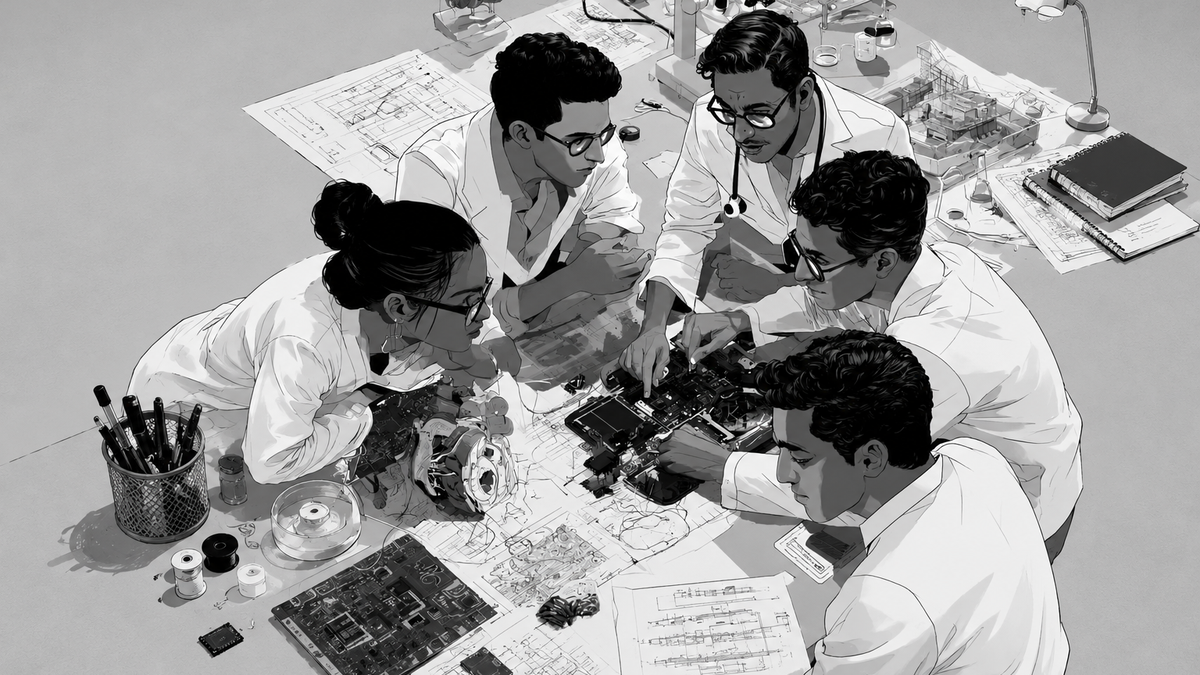
India’s engineering education ecosystem is undergoing one of its biggest transformations in decades. For years, a B. Tech degree was largely defined by theoretical coursework, semester examinations, and classroom-based learning. While this model helped build academic foundations, it often struggled to keep pace with the rapidly evolving demands of industry. Today, employers are no longer looking for graduates who only understand concepts on paper, they want professionals who can solve real-world problems from day one.(Sign up for THEdge, The Hindu’s weekly education newsletter.)This shift is fundamentally redefining what engineering education should look like in India. Coding, Artificial Intelligence (AI), and project-based experiential learning are no longer optional add-ons to a B. Tech curriculum; they are becoming the core pillars that determine a student’s industry readiness and employability.The rise of AI-led technologies, automation, data science, cloud computing, cybersecurity, robotics, and digital product ecosystems has transformed almost every sector from healthcare and finance to manufacturing and retail. As businesses rapidly digitise operations, the demand for engineers who can think computationally, work with intelligent systems, and build practical solutions has surged significantly.In this new environment, coding has evolved into a foundational skill, much like mathematics or communication. It is no longer restricted to computer science students alone. Mechanical engineers are working with automation systems, civil engineers are using predictive analytics and simulation tools, and electronics students are building AI-enabled devices. The future engineer is expected to be interdisciplinary, adaptable, and digitally fluent.Artificial Intelligence, in particular, is becoming a defining force in the future of work. Companies across industries are integrating AI into decision-making, customer engagement, logistics, product development, and operations. This means engineering graduates must not only understand AI theoretically but also know how to apply it practically through machine learning models, automation frameworks, and data-driven problem-solving.However, technical knowledge alone is insufficient in today’s industry landscape. Employers increasingly value candidates who have hands-on exposure to real business challenges. This is where project-based learning is changing the dynamics of engineering education.Real-world projects expose students to practical problem-solving, teamwork, deadlines, innovation, and industry expectations. When students work on live projects, hackathons, product simulations, capstone assignments, or startup-driven challenges, they develop the confidence and adaptability that traditional classroom learning often cannot provide. Such experiences bridge the long-standing gap between academic learning and workplace execution.The importance of experiential learning becomes even more critical in the context of India’s evolving startup ecosystem. India is now home to one of the world’s largest startup ecosystems, creating new-age opportunities in fintech, healthtech, edtech, mobility, SaaS, and deep-tech sectors. Startups seek agile professionals who can build, test, iterate, and innovate quickly. Graduates with project exposure and practical coding expertise naturally have a stronger edge in this environment.Another significant shift is the growing democratisation of high-quality tech education across Tier-2 and Tier-3 cities. Earlier, access to industry-oriented learning opportunities was concentrated in a handful of metropolitan institutions. Today, technology-enabled learning platforms, AI-powered tools, virtual labs, and industry partnerships are enabling students from emerging cities to access career-focused engineering education at scale. This is creating a more inclusive and future-ready talent pipeline for India.Importantly, the role of educational institutions is also evolving from being degree providers to becoming career accelerators. The focus is steadily moving toward outcome-driven education where placements, skill readiness, industry certifications, internships, and employability outcomes are becoming equally important as academic scores.The engineering graduate of the future will not be evaluated solely by marksheets but by portfolios, problem-solving ability, practical exposure, innovation mindset, and technological adaptability. Recruiters today are increasingly interested in what students have built, automated, coded, designed, or solved during their academic journey.As India positions itself as a global technology and innovation hub, the need for industry-aligned engineering talent will continue to rise. Educational institutions that integrate coding, AI, and experiential learning deeply into their B. Tech ecosystem will play a crucial role in shaping this next generation of engineers.The future of engineering education is no longer confined to textbooks and classrooms. It lies in intelligent learning ecosystems that combine technology, innovation, and real-world application. In many ways, coding, AI, and practical projects are becoming the new language of engineering success and students who embrace this shift early will be best positioned to lead the industries of tomorrow.(By Ashish Munjal, Co-Founder & CEO - Sunstone | Founder - Alta School of Technology)
Why coding, AI, and real-world projects are the new foundation of B. Tech education
Explore how coding, AI, and real-world projects are transforming B. Tech education and shaping industry-ready engineers in India.
714 words~3 min read