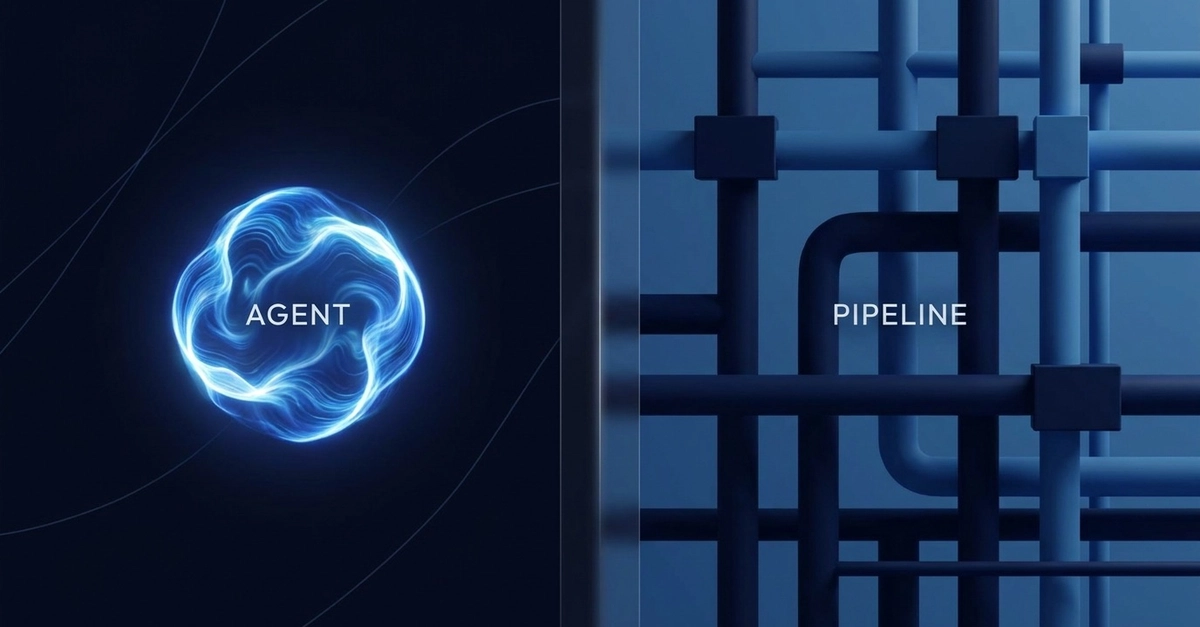
Everyone building with LLMs right now is bumping into the same question: should you wire up a predictable, step-by-step workflow, or let an AI agent figure things out on its own? The answer shapes your system's reliability, cost, latency, and how many 3 AM pages you'll field.The good news: you don't have to pick one forever. But it helps to understand what each approach is actually good at before you start combining them. This guide covers what AI workflows and agents are, when each one makes sense, why most production systems use both, and what infrastructure you need underneath to keep everything running.Build fast, accurate AI apps that scaleGet started with Redis for real-time AI context and retrievalWhat are AI workflows?An AI workflow is a system where LLMs and tools are orchestrated through predefined code paths. You, the developer, decide the execution order before the system runs. The LLM handles the reasoning within each step, but it doesn't get to choose what step comes next: your code does. You can add conditional logic, but every possible path is something you designed and can test ahead of time.A few workflow patterns show up across production LLM systems:Prompt chaining: Break a task into sequential steps where each LLM call processes the previous one's output. Write an outline, check it, then write the full document.Routing: Classify an input and send it to a specialized handler. Easy questions go to a smaller, cheaper model; hard questions go to a more capable one.Parallelization: Run multiple LLM calls at the same time and combine the results. Useful for running several checks against the same input.Orchestrator-workers: A central LLM breaks down a task, delegates to workers, and synthesizes the results. Unlike parallelization, the subtasks are determined at runtime based on the input.Evaluator-optimizer: One LLM generates a response while a separate LLM evaluates it, looping until quality criteria are met.Those patterns differ in complexity, but they all keep the control flow largely in code. Taken together, they often resemble Directed Acyclic Graphs (DAGs), or graphs with explicitly controlled cycles. That structure is what gives workflows their biggest advantage: every path is testable. You can trace exactly what happened, reproduce bugs, and predict costs because you control how many LLM calls each run makes.What are AI agents?If workflows keep control in code, agents move that control into the model. The LLM directs its own execution, decides what to do next at runtime, recognizes when the task is done, and uses tools to interact with external systems.Agents run in a loop: reason about the current state, pick a tool, observe the result, and decide what to do next, repeating until an exit condition is met.A few things that matter in practice:Autonomy is a spectrum. An agent with minimal autonomy does exactly what you ask; a highly autonomous agent makes its own decisions about what to do and how. Autonomy isn't a fixed model property. It's shaped by your deployment design.Tool design is important. Tools form a contract between deterministic systems and non-deterministic agents. Too many tools, or overlapping tools, can distract agents from efficient strategies.Errors compound. In long-running agents, minor failures can snowball into catastrophic ones. You can't just restart from the beginning because restarts are expensive and frustrating for users.In other words, agents buy flexibility by moving more decisions into runtime behavior. Multi-agent patterns add another dimension, whether a manager coordinating specialists or peers handing off tasks, but the core principle stays the same: the LLM, not your code, determines the execution path.When workflows beat agents (& vice versa)Once that control difference is clear, the next question is when each pattern wins. A practical test helps: can you draw a flowchart of the task before the LLM runs? If yes, use a workflow. If the flowchart depends on what the LLM discovers at runtime, you likely need an agent.Workflows win when you need predictabilityWorkflows are the better fit when steps are known, repeatable, and low-ambiguity. You get a fixed token budget per run, so costs are predictable. Debugging is localized to explicit code paths. And for teams operating under SOC 2, GDPR, or internal model governance, repeatable execution is often a practical requirement.A few categories show up repeatedly:Order exception triage: Same classification and routing logic each time.Content generation pipelines: A fixed sequence: generate, review, translate, publish.Multi-step approval processes: Each step has a defined input, output, and handoff.The path is known before execution starts.AI is only as good as its memoryPower real-time context and retrieval with Redis for AI.
AI Agents vs Workflows: When to Use Each
Learn when to use AI agents vs workflows, why production systems combine both, and what memory infrastructure keeps everything running reliably.
1,786 words~8 min read