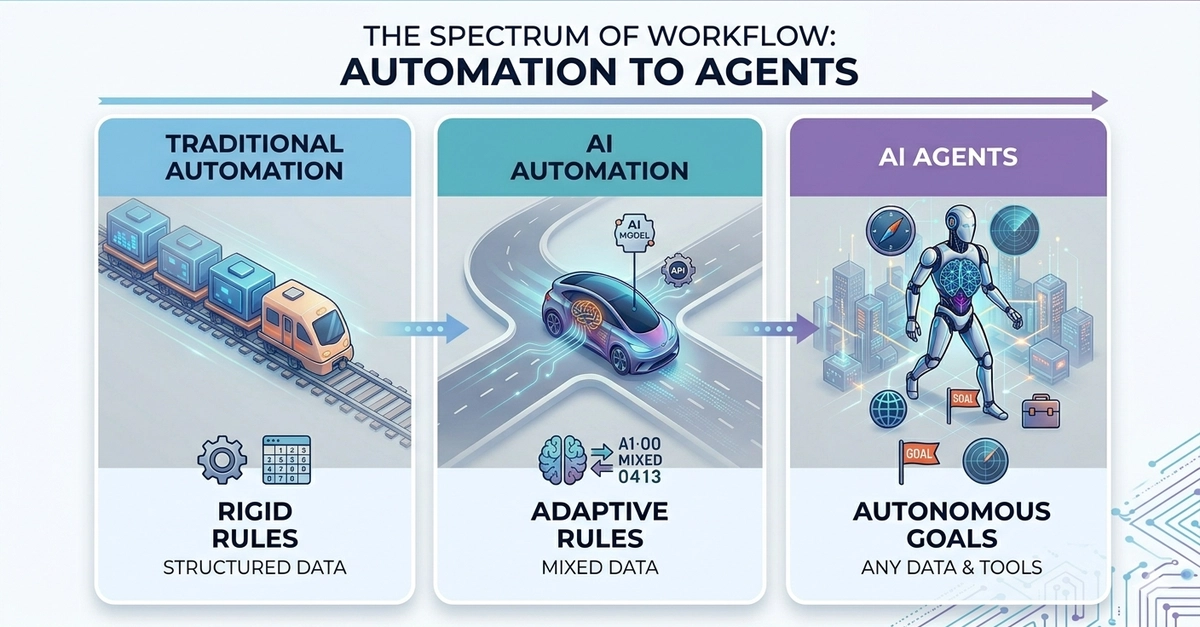
Agentic AI adoption trends are everywhere right now. Or at least, everyone says they are. But when you peel back the marketing, the line between a chatbot and an AI agent isn't always obvious. Picking the wrong one for your use case can mean burning money on infrastructure you don't need, or shipping something too simple for the problem you're solving.The difference is mostly about architecture, not branding. This guide covers what chatbots and AI agents are, how they evolved, when each one makes sense, and what real-world deployments can look like in production.What is a chatbot?Let's start with the simpler end of the spectrum: the chatbot. In this comparison, a chatbot is a system that takes user input and returns text without directly taking external actions. There are two flavors worth knowing about: rule-based chatbots and LLM-powered chatbots.Rule-based chatbots match input patterns against decision tree logic. You type "reset my password," the system matches that to a keyword, and it returns a pre-written response. No learning, no memory across sessions. Think of the frustrating support bots you've probably encountered, the ones that loop you back to the same three options.LLM-powered chatbots replace the rule engine with a language model. Instead of matching keywords, the model generates natural language responses that feel conversational and context-aware. Some chatbot stacks chain retrieval, function calls, or multiple internal LLM calls under the hood. But the boundary that matters here holds: the chatbot returns text. It can tell you how to get a refund, not process one.Chatbots are commonly deployed as session-scoped systems. Without an external memory layer, state lives in the active context window, and the chatbot doesn't carry continuity between sessions on its own.What is an AI agent?If a chatbot stops at text generation, the next step is a system that can act on a goal. In this comparison, an AI agent is a system that can pursue goals through external tools, autonomously or semi-autonomously. Where a chatbot generates text and stops, an agent enters a loop: it reasons about a goal, calls external tools, observes the results, re-plans based on what it learned, and keeps going until the task is done.A common pattern here is ReAct (Reasoning + Acting): LLMs reason and act in an interleaved manner. Each iteration follows three steps:The LLM analyzes the goal and its history, then forms a plan for the next step.It selects a tool and specifies what input to send.The framework executes the tool call and returns the result so the LLM can decide what to do next.Put together, those steps turn a single response into a feedback loop. This loop repeats until the agent has enough information to produce a final answer, or has completed the requested actions. The practical consequence is that agents can have side effects. They don't just talk about doing things; they read and write to external systems.Why memory matters moreThat action loop is also where memory starts to matter more. Short-term memory keeps track of state across the steps of a session, while long-term memory persists user profiles, rules, and knowledge across sessions.This is where infrastructure choices matter. Redis is a real-time data platform with sub-millisecond latency for in-memory operations, which fits the access patterns agents depend on: short-term working memory, long-term retrieval, and coordination across steps. Short-term working memory maps to in-memory data structures. Long-term memory uses vector search to retrieve relevant context across sessions. Using one platform for memory, caching, and vector retrieval can reduce the need to split these functions across multiple systems.Build fast, accurate AI apps that scaleGet started with Redis for real-time AI context and retrieval.The evolution path: from chatbot to agentic systemThat architectural difference didn't appear overnight. The path from chatbots to agents can be split into four broad generations, alongside a major shift in how LLM-based systems interact with tools.Generation 1: scripted rules (1966–2015)Early chat systems mimicked human conversation through typed input and natural-language responses. Later systems scaled that pattern with heuristic matching, but the core limitation didn't change: every response required a manually authored rule, and the system couldn't handle anything it wasn't explicitly programmed for.Generation 2: transformer-era LLMs (2017–2022)The transformer architecture changed the game. Its attention mechanism let models focus on different parts of an input sequence while processing elements in parallel, a shift from sequential processing. By late 2022, that capability was in everyone's hands. Suddenly, the responses weren't scripted anymore. But LLMs still only generated text; they couldn't take action against external systems or execute multi-step plans.Generation 3: tool-using LLMs & ReAct (2022–2023)The ReAct paper in October 2022 was an inflection point because it paired reasoning traces with task-specific actions, and it shaped a lot of later discussion around tool use and agent design. Frameworks matured through 2023, though agents at this stage were still maturing for consistent production tasks.Generation 4: agentic systems (2024–present)From there, the story shifts from model behavior to infrastructure. The last two years brought more of the agent infrastructure needed to make agents more practical, though production deployments remain early-stage.When to use a chatbot vs. an AI agentThe right call depends on the job. Match the architecture to the problem, and lean on infrastructure like fast memory, semantic caching, and vector retrieval to keep whichever path you choose performant in production.Here's how to think about it across the dimensions that matter in production.Task complexity & tool accessIf the task is information retrieval, deflecting routine questions, or guiding users through a defined decision tree, a chatbot is usually the right call. The output is read-only, the path is predictable, and a single inference call gets the job done.Agents earn their complexity when problems are open-ended and you can't hardcode a fixed path. Think multi-system operations that pull data from several sources, or workflows where the number of required steps isn't known upfront.Cost & latencyThis is where the difference gets concrete: in one throughput benchmark, a standard chatbot workload sustained up to 6.4 queries per second, while a ReAct agent sustained 1.2–2.6 queries per second. In that measured setup, the multi-step reasoning reduced throughput.Semantic caching helps offset these costs for predictable, repeatable query patterns by reusing LLM responses for similar questions. Redis LangCache, a semantic caching service, converts queries to vector embeddings and matches them against cached results based on similarity, returning stored responses without invoking the LLM. Redis reports up to 73% lower costs without code changes, though results depend on workload, query patterns, and cache hit rates.Make your AI apps faster and cheaperCut costs by up to 90% and lower latency with semantic caching powered by Redis.Reliability & governanceCost and latency are only part of the tradeoff. Chatbots can hallucinate in answers, but the blast radius is limited to incorrect text. Agents compound this risk by taking irreversible actions. This means governance requirements scale with autonomy. High-stakes actions like canceling orders, authorizing refunds, or making payments typically need human oversight until you've built confidence in agent reliability. For higher-autonomy or higher-risk production agents, teams generally add audit trails, validated inputs, and sanitized outputs.CriterionChatbotAgentTask typeSingle-turn questions, retrievalOpen-ended, variable stepsTool useNone or read-onlyDynamic tool selection in a loopLatencyLow, single inference callHigher, multi-step, multi-callInference costBaselineElevatedFailure modesHallucinated textCompounding errors, irreversible actionsGovernanceLowerHigher: audit trails, human-in-the-loopThat table is the practical tradeoff in one view, and the next question is what those choices look like once teams move from definitions to production systems.Real-world examplesThose tradeoffs get easier to picture once you look at production systems.Chatbots in productionProduction chatbot deployments usually stay close to the pattern described earlier: they answer questions, guide users through support flows, and surface information without autonomously acting on external systems. That makes them a good fit for high-volume support and self-service use cases where the path is narrow and the risk of side effects is low. Common examples:Airline support bots: Flight status, baggage policies, basic check-in workflows.Banking bots: Balance lookups, transaction history, common account questions.E-commerce bots: Order status, return policies, product details.Documentation chat: Search-and-answer over knowledge bases and product docs.What ties them together: text in, text out, with no autonomous action on external systems.AI assistants in productionProduction assistants often sit closer to the middle of the spectrum. They may operate beyond simple support flows, but the line between an assistant and a strict agent definition still depends on whether the system is actually selecting tools, tracking state across steps, and taking external actions in a loop. Common patterns include:IDE coding assistants: Suggest code, refactor blocks, and draft tests, with the developer accepting or rejecting each step.Email and document copilots: Draft replies, summarize threads, and generate first-pass content for review.Internal knowledge assistants: Pull from wikis, tickets, and chat history to surface context for support teams.Sales copilots: Research prospects, draft outreach, and summarize call notes, with the rep approving the next move.Hierarchical agentic systems show that orchestration, retrieval, and error recovery shape outcomes as much as model choice.Now see how this runs in RedisPower AI apps with real-time context, vector search, and caching.Power chatbots & agents with RedisThose production patterns point to the core takeaway: chatbots work well when the job is fast, read-only, and predictable. Agents make more sense when the task needs memory, tool use, and coordination across steps and sessions. Choosing between them is an infrastructure decision.Redis supports multiple AI data patterns in one real-time data platform: short-term working memory through native data structures, long-term memory through vector search, and semantic caching through Redis LangCache. Whether you're running a high-volume chatbot today or building your first production agent, using one platform for caching, vectors, session state, and pub/sub coordination can reduce the architectural complexity that kills projects before they ship.Try Redis free to build with vector search and semantic caching, or talk to our team about architecting your agent infrastructure.
AI Agent vs Chatbot: Key Differences Explained
Learn the real difference between AI agents and chatbots—architecture, memory, cost, and when to use each in production. Includes real-world examples.
1,614 words~7 min read