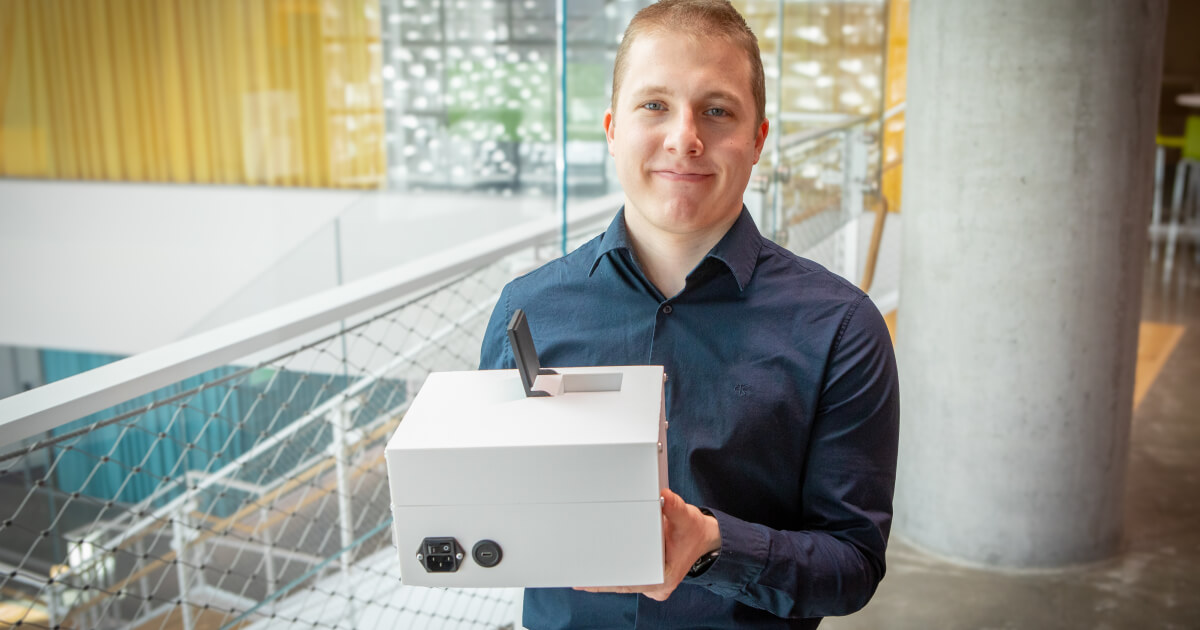
For their senior capstone project, Wafiqah Zubair and Madison Gates built a breathalyzer that detects bacterial sinus infection
Engineering Design Projects (ES 100), the capstone course at the Harvard John A. Paulson School of Engineering and Applied Sciences (SEAS), challenges seniors to engineer a creative solution to a real-world problem.Noninvasive Detection of Bacterial Sinusitis Leveraging Volatile Organic Compounds Wafiqah Zubair and Madison Gates, S.B. '26, Bioengineering and Electrical EngineeringAdvisor: Haritosh Patel• Please give a brief summary of your project.We built a breathalyzer to detect bacterial sinus infection. Our device samples exhaled breath, uses a multi-sensor array to convert chemical patterns into electrical signals, and uses a machine learning model to predict the presence of infection. Our final prototype demonstrates rapid, non-invasive point-of-care testing to clinical decision-making.• What real-world challenge does your project address?There is currently no rapid, accessible point-of-care test for bacterial sinus infections. Sinusitis diagnosis in primary care relies on clinical assessment, but because symptoms such as congestion, headache, and fatigue overlap with other acute infections, this can lead to misdiagnosis. As a result, patients are often prescribed antibiotics unnecessarily, contributing to antibiotic resistance. Bacteria culture tests can be used to provide confirmation, but they can take several days to produce results, delaying appropriate treatment.• How did you come up with this idea for your final project?We were inspired by previous ES100 projects in the Aizenberg Lab that used electronic-nose technology for applications like lung cancer and indoor toxins. Building on this concept, we evaluated potential target diseases based on prevalence, unmet diagnostic need, and the strength of existing research linking the disease to changes in breath volatile organic compounds (VOCs). This ultimately led us to sinusitis.• What was the timeline of your project?We began with background research and design considerations, identifying VOCs associated with infection and selecting corresponding gas sensors. Next, we designed and tested an initial printed circuit board (PCB) using a lab setup with bubbled VOCs to validate sensor performance. We then developed a second PCB that integrated environmental sensors and a fan-based exhaust system. Finally, we simulated healthy and unhealthy breath samples, trained our machine learning model, and automated the diagnostic process through a user-friendly graphical user interface.