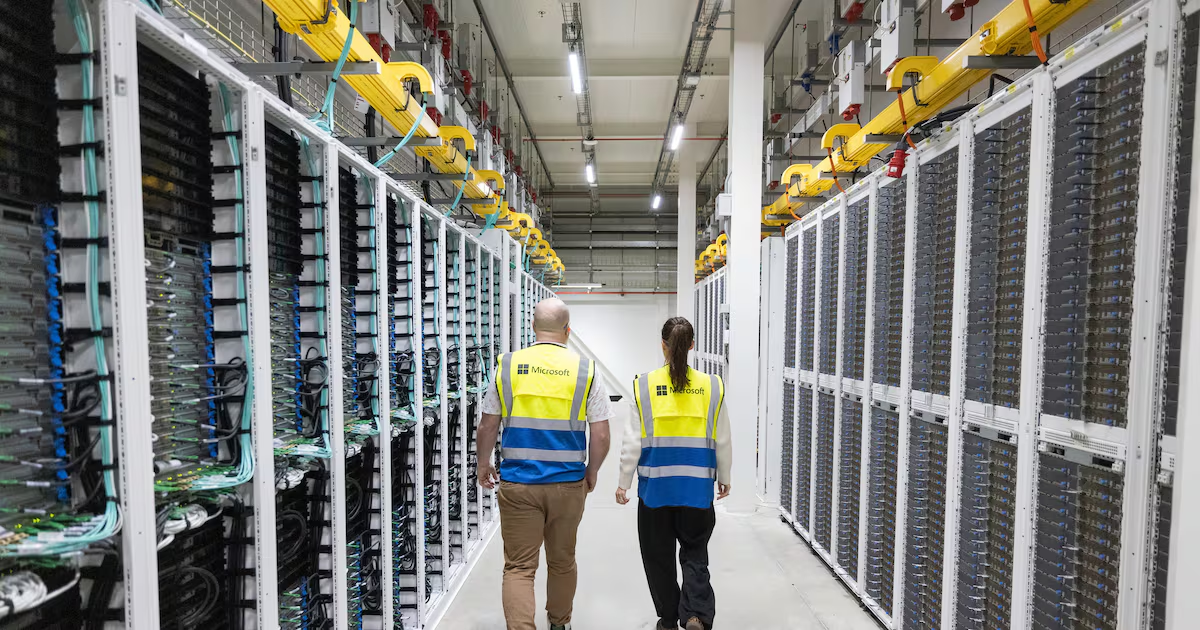
This week Meta announced that 350 jobs at its Irish subsidiary are under threat as part of a global restructuring that is expected to see the social media giant lay off approximately 10 per cent of its workforce.Chief executive Mark Zuckerberg says 2026 is the year that artificial intelligence (AI) changes the way the company works, while investing close to €100 billion in AI infrastructure. This news has led to renewed attention on Ireland’s exposure and reliance on US multinationals. It is more than ironic that data centres are contributing to the loss of jobs in Ireland’s tech sector, when Ireland has positioned itself as the data centre capital of the world. Data centres now account for 22 per cent of energy on the national grid; the closest country comparison is Singapore with 7 per cent.What is the social pay-off that comes from organising our economic and environmental futures around the needs of multinational tech companies? The response from the Government will be that we all benefit from foreign direct investment (FDI). But with jobs at risk, a significant drain on resources, and a growing gap between Ireland’s corporate tax bonanza and people’s daily lives, the story is ringing hollow. To consider how we move forward, it’s helpful to understand how we got here. TK Whitaker is often credited as the person who set Ireland on course towards an open economy and a receptive host to FDI. His 1958 white paper, Economic Development, outlined how Ireland should embrace economic planning and pivot from economic nationalism to a model of “industrialisation by invitation”. In truth, economic ideas emanating from the United States had percolated into Ireland’s policymaking circles since the end of the second World War – including the proposal that Ireland could become the “Puerto Rico of Europe”, attracting US exporting companies through low taxation. The Industrial Development Authority (IDA), established in 1948, became the primary vehicle for incentivising export-orientated, foreign-owned industrial investment. The IDA had success in attracting foreign investment to Ireland, but these companies did little to deliver on the promise of employment or increased indigenous economic activity. By the end of the 1970s, foreign investment had grown to 30 per cent of gross national product (vs 14 per cent in the US and 17 per cent in the UK), but employment had fallen to its lowest level ever. This meant higher taxation to pay for relief schemes, with the burden falling almost entirely on Pay As You Earn (PAYE) workers. In 1980, nearly 90 per cent of tax revenue was PAYE.[ What lies ahead for Meta in Ireland?Opens in new window ]On March 20th, 1979, 150,000 PAYE workers marched through Dublin calling on the government to reform the tax system in one of the largest worker demonstrations in the history of the State. The question that mobilised them: how can we be paying so much in tax and receiving so little in return? In 1982, the National Economic and Social Council published the Telesis report, concluding that Ireland’s FDI-led industrialisation strategy would not deliver the long-term development of the country. Yet, despite austerity and grim economic forecasts, the FDI-led development model survived. In 1991, the Guardian published an editorial lauding the “continuing Irish economic miracle”. The same year, unemployment remained high and 1 million people were living in poverty. Against this bleak economic backdrop, the IDA snared a big one in 1989 when Intel set up in Leixlip, Co Kildare. Reflecting in 2013, IDA chief executive Barry O’Leary explained that “Intel was a step change because of the scale. It would require massive buildings, and massive infrastructure.” Extensive land, energy and water infrastructure were provided by the State.It was estimated that the State paid £100,000 per job “created” by the Intel facility. In other words, State development strategy meant investment and infrastructure for multinationals, rather than the public per se. We can draw a direct line from the FDI-led infrastructural template of Intel to the growth in data centres, where enormous State effort has been expended to create the conditions for further data centre growth – from energy parks on Bord na Móna land, to legislative changes that will allow for large-scale, private grid energy infrastructure.[ People in Ireland want to know where our money goes. The answer is depressingOpens in new window ]Last month, The Irish Times columnist Sineád O’Sullivan produced a graph that captured the discrepancy between Ireland and other advanced economies when it came to the provision of public infrastructure and services versus gross domestic product. Her graph and subsequent commentary about how Ireland lacked strong institutions to deliver long-term planning and delivery went viral, prompting irked responses from politicians, as well as intense media interest. The history of FDI-led development and the IDA suggests the problem is not a lack of State planning, but a highly unbalanced form of planning that concentrates on making the country a low risk, very profitable environment for foreign investment. From tax and financial regimes, to energy resources and land, Ireland is capable of providing infrastructure – as long as it’s for strategic sectors of foreign capital. This helps explain why considerable State effort and resources are committed to data centre expansion, while 80 per cent of Ireland’s radiotherapy machines need immediate or imminent replacement. This uneven pattern of planning and development is not the result of weak institutions but a deeply ingrained ideology that conflates Ireland’s national interest with the interests of FDI, what Patrick Brodie and I call in our recent book FDI nationalism. Calls for better public infrastructure and democratic planning will continue to fall on deaf ears until we can address more fundamental questions about our economic model.Patrick Bresnihan is associate professor in the department of geography at Maynooth University and co-author of From the Bog to the Cloud: Dependency and Eco-Modernity in Ireland
Patrick Bresnihan: Ironic that data centres are contributing to job cuts in the world’s data centre capital
Ireland’s problem is not a lack of State planning, but rather planning that concentrates on making the country a profitable environment for foreign investment
970 words~4 min read