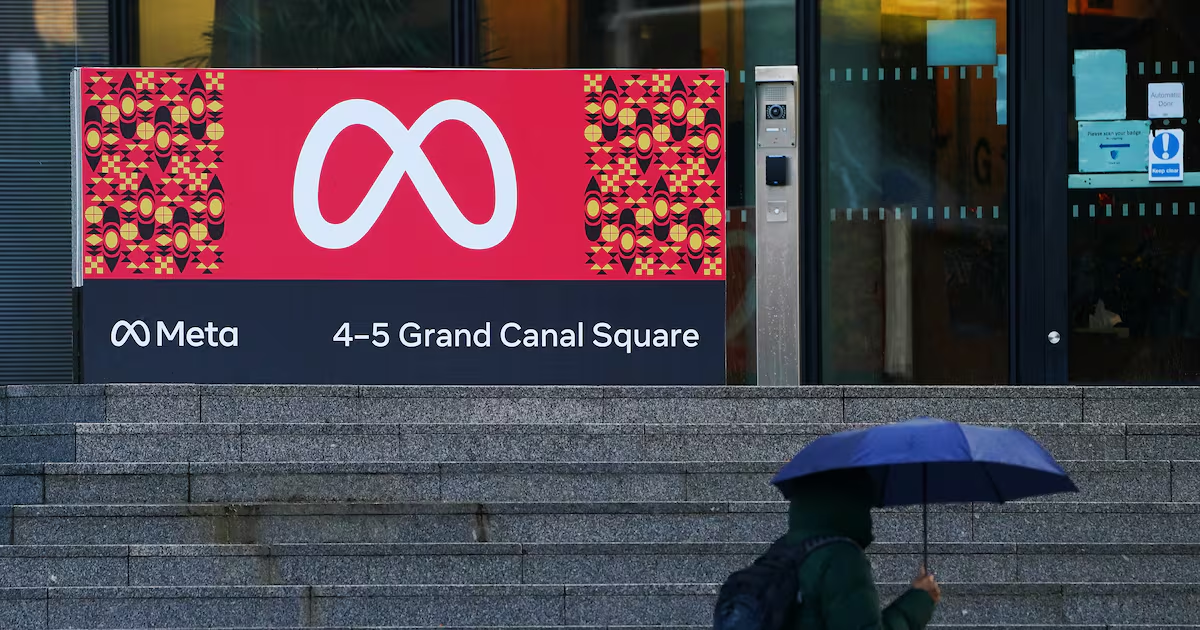
Ireland’s tech sector is shedding jobs and news from Meta, expected next week, is going to put this right back in focus. Over the years, Ireland has often escaped the worst of the job cuts in big digital tech firms – but with Meta this may not be the case“AI” replacing jobs will get the blame – and is part of the story. But there is a lot more going on, too, and one key question. Is this just a cyclical downturn in jobs in tech after a big post-Covid hiring surge, or is there something more serious going on under the bonnet: a structural threat to one of Ireland’s key sectors?Such is the upheaval and reshaping of the sector, largely due to AI, that this will all take time to play out. But we need to look at what we do know. Big tech went on an extraordinary hiring binge after Covid. In Ireland, employment in the sector rose from about 130,000 when the pandemic hit to a peak of close to 190,000 by late 2024 and by the end of last year it was back at 170,000. What is happening now is, at least in part, a pulling back from what was an over-expansion generally. There are also company-specific factors such as Meta’s failed Metaverse project, which had been launched in 2021.If that was all that was going on, it would be reassuring in a strategic sense, albeit not for those who are losing their jobs. Industries often have up and down cycles. And even in the midst of this one, hiring for many roles still continues, judging by more up-to-date indicators. One of the concerning issues in the months ahead will be that Meta and some others have also signalled a freeze or slowdown of hiring, which will make life harder for graduates and may also slow immigration.There is another key element to the wider backdrop. Large AI-driven investment by the big players in data centres and other AI infrastructure is central. It may seem crazy to say that such hugely profitably companies need “cash”. But they are laying large bets through huge investment – around $725 billion plus this year alone for the big four so-called hyperscalers – Amazon, Microsoft, Meta and Google. And this is eating up the cash generated from their sales. Cutting costs helps save cash to divert into this investment race and that is also driving what is going on.[ Most Irish companies say AI won’t hit their staff numbersOpens in new window ]The extent to which the technology is actually displacing jobs internationally is still disputed. It is definitely a factor. Talk to anyone working in techland and you will hear stories of international teams being trimmed, sometimes significantly. In particular, some of what might be termed support work – administration, finance, audit and so on – is now requiring fewer employees. Mark Zuckerberg and other tech bosses talk about how key tasks can be done more quickly and with fewer people. Meta announced last month that it would shed about 10 per cent of its staff worldwide, with news expected from next Wednesday on who will be affected. After recent rounds of reductions, it has about 1,800 employees here who will be nervously refreshing their emails. In previous multinational redundancy rounds, Irish operations have lost proportionately fewer jobs than the average; this time, the fear is that it will be different.In further evidence of cost-cutting, Irish company Covalen, which provides services to Meta including content moderation is to lay off more than half of its 720 workers. US multinationals hire slowly via multiple tests and interviews, pay well but lay people off quickly. The hope is that, in time, the big players will get more customers and business from their AI investments and hiring in the sector will turn upwards. The question, if and when this happens, will be how well Ireland is placed to take advantage.[ Deepfake Simon Harris is only the start of the Government’s AI problemOpens in new window ]Tech venture capitalist Stephen McIntyre has argued that Ireland needs to concentrate in terms of the longer-term impact on what jobs are being lost and what remains. His argument is that AI will allow big firms to strip back a lot of their support functions and focus on their “essence” – engineering, design and sales – areas where Ireland has made some progress but often remains behind other locations. Ireland needs to concentrate, according to McIntyre, on making the central skills available here.The AI advisory council set up by the Government has looked in detail at the issues, saying that it is very difficult to forecast the number of jobs to be hit, but that the nature of work is bound to be affected. This points to a new agenda for skills and training – including, crucially, within companies. The council argues that investment in measuring the impact of AI is vital and a real attempt to create an ecosystem in Ireland to seek to make the economy a leader in terms of applying the technology and regulating it. In the same way as Ireland attracted previous ways of AI, the council says that the State should aim to the preferred base in Europe for companies to launch of scale AI products and ventures. Ireland may not lead in developing AI, in other words, but it can be good at helping firms to apply it. The speed at which AI is advancing and the large investments being made by the big companies mean that upheaval is inevitable. The lay-offs will see Ireland take another lap around the track in the decades-long debate about promoting indigenous industry and not putting so much of its eggs in the multinational basket. This is fair – and important – but it is a policy direction that will take years and what is happening is going to hit in the months ahead.The immediate fallout will affect not only the sector itself but also professional services like accountancy and law who work for these companies and the exchequer – as well-rewarded tech employees pay a lot of income tax. The longer term strategic issues for Ireland are vital. Behind the PR spin of whatever is coming, the State and IDA Ireland need to look carefully at what is actually happening, what kind of jobs are under threat and what needs to be done to ensure Ireland is as well placed as possible to prosper as this disruptive technology wave hits. And to consider again our outsize economic exposure to a few big firms who may or may not be winners in the AI race – and how future policy can spend the State’s bets.
Cliff Taylor: Meta workers are bracing for another round of job cuts. We should all be nervous
The immediate fallout will hit a number of sectors, but the longer-term implications for Ireland are troubling
1,120 words~5 min read