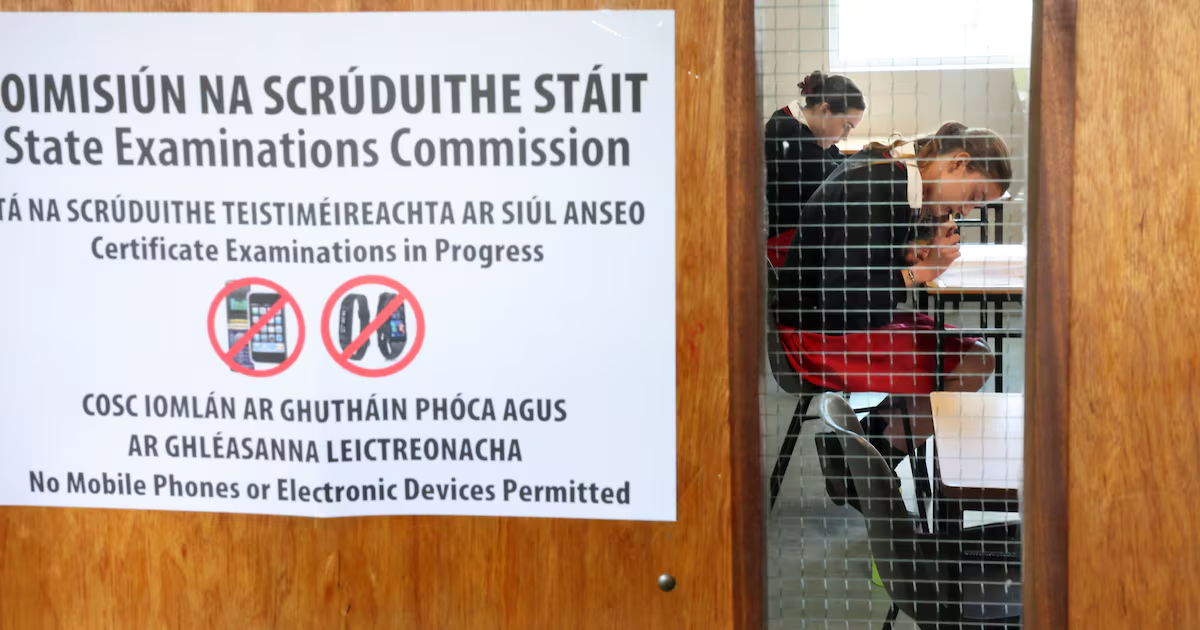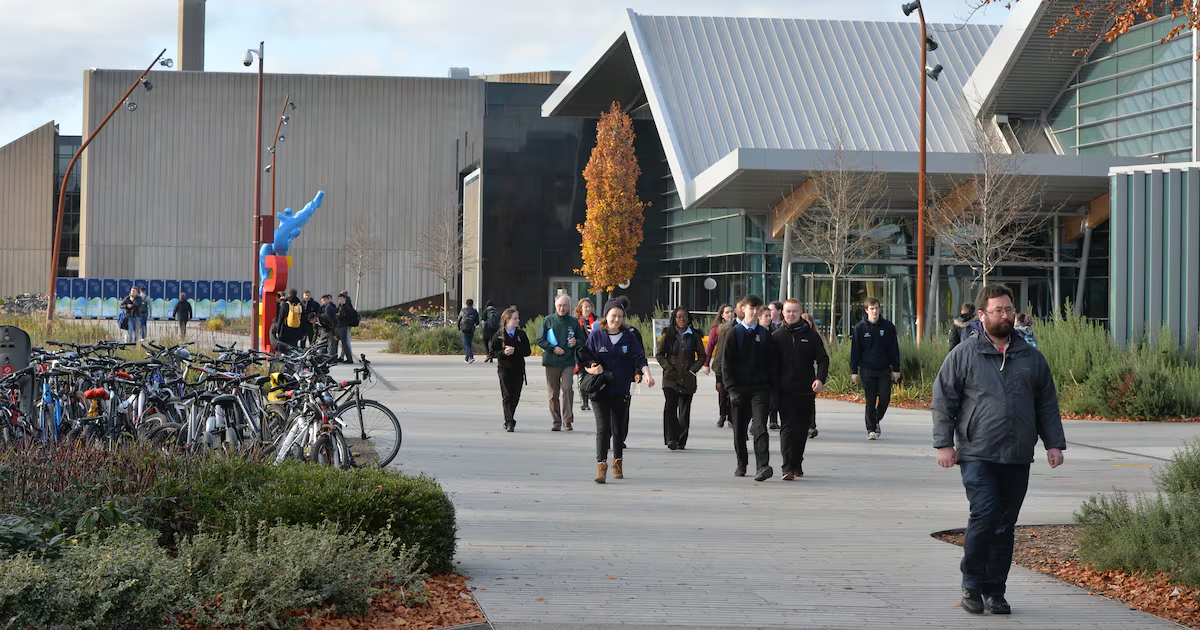
I felt nostalgic making my way to the UCD examination hall at the RDS in Ballsbridge this month. It brought back memories from more than 30 years ago of my annual trek there for various arts degrees exams. In an era before continuous assessment, there was lot riding on these three-hour exams, especially in the final year.But we were not overburdened compared to those who came before us. When reflecting on the lot of arts students in the 1960s and 1970s, UCD lecturer Michael Laffan, who taught many of them history, recalled: “Examinations took place in rapid succession and students had little time to regain their breath between papers. In 1966, for instance, history and politics students sat 11 three-hour examinations in just over a week, between 9.30am on one Tuesday and 12.30pm on the next.” Until the 1970s, only the end-of-year examinations in history counted for the final grade, meaning essays were excluded. The rival merits of examinations and continuous assessment were regularly debated; the minutes of a UCD committee meeting assessing the options suggested “the pressure or terror element was a major factor in the examination system – some saw it as a challenge and a stimulus”. In 1974, at another meeting between staff and students, it was asserted that if students fully appreciated what continuous assessment entailed most of them would react in favour of the existing exam system “which allows so much leeway for periods of self-discovery, disordered reading, friendship and general loafing”.Honours history students also sat a general essay paper; the mark awarded for this could only raise an overall grade; not lower it. In 1976, students petitioned that this challenge should not be abolished, as, according to the minutes of a history department meeting, “they feel it represents the ideal of a liberal education”. So liberal, that you would have no idea what question awaited you: imagine facing blank pages to be filled with an answer to a question such as “Love makes the world go round. Discuss.”I have no doubt a combination of “general loafing”, “disordered reading” and “self-discovery” is invaluable, but the trend towards continuous assessment prevailed. Yet the contemporary preponderance of generative artificial intelligence (AI) has prompted some re-evaluation. The reason I found myself back in the RDS is that some university teachers have opted for a return to sit-down exams due to generative AI. Its preponderance has made it problematic to establish the intellectual evolution of students.Developing those minds requires connections to be made between listening, reading, researching, writing, creating and challenging. One of the most impressive exam answers I read this year was an angry one; the student disputed the very basis of the question at length, and chided the work of historians who frame the type of question that was asked. It was provocative, informed and imaginative.But such an approach is too rare in this AI era, as the exercise of intellectual autonomy and questioning has become too sidelined with the reliance on digital tools that are about instantaneous shortcuts born of pattern recognition. An artificially generated answer might, at first glance, look plausible, but can also be inaccurate or even fictitious. Laffan recalls a case in UCD decades ago, when grades were awarded using the Greek alphabet. A student wrote a “meticulously constructed script, of heroic creativity and fantasy but with no connection to any known historical character or event. It was awarded the rare mark of delta minus with alpha in a cloud.” It was concluded by examiners that this student “deserved to flourish – if not in history”. Flair and flourish are the antitheses of generative AI. Last year, the American Historical Association noted that “the rapid adoption of AI tools suggests that it has never been more important to appreciate the complexity of our shared past and what it means to be human”.There are, of course, as underlined by the job losses announced in Meta this week, the wider questions of what AI will do to the workforce, the obscenity of Meta (originally Facebook) boss Mark Zuckerberg’s promised $145 billion spend on AI this year, the concentration of power and control over information, image abuse, and the corrosiveness of social media. Zuckerberg told a friend in 2004 “You can be unethical and still be legal ... that’s the way I live my life ha ha …” The same year, he described the way students were absorbed in Facebook as “the trance”. Preliminary findings from the Massachusetts Institute of Technology’s media lab last year comparing those who completed an essay using generative AI with those who did not suggested “brain connectivity systematically scaled down” the more reliance there was on generative AI, a reminder of the fatuousness of assuming that linking thinking and writing is some sort of inefficiency.
Diarmaid Ferriter: The best exam essay I read this year was an angry - and refreshingly human - one
There’s a fatuous assumption that linking thinking and writing is some sort of inefficiency
794 words~4 min read