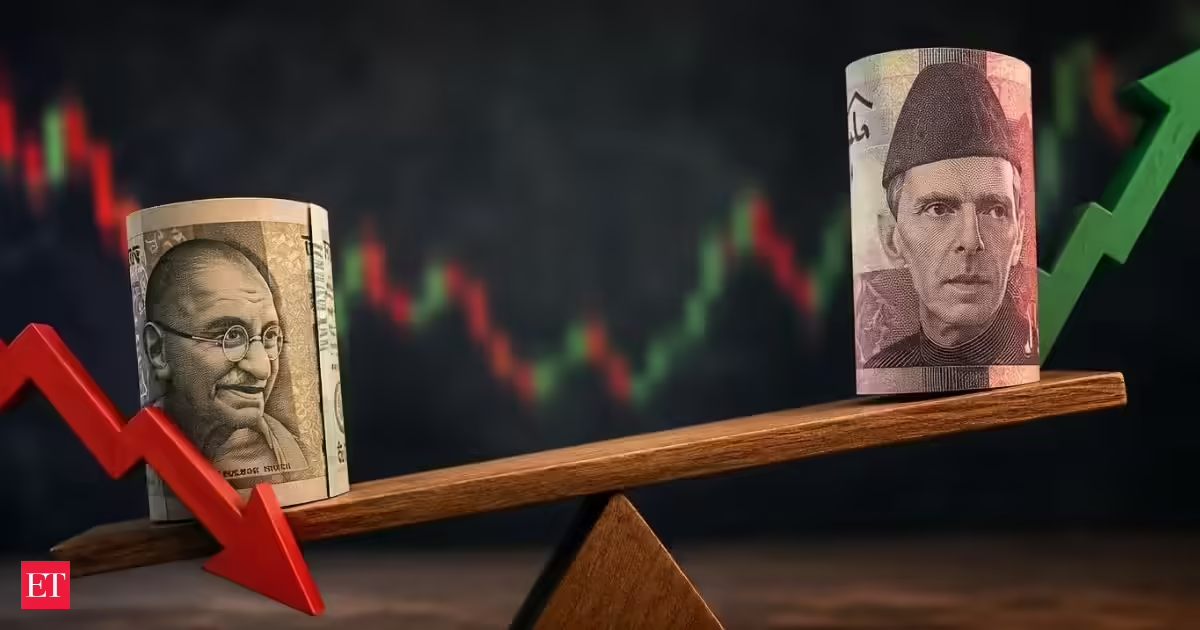
The Indian rupee continues to slide. Over the last 12 months, it has emerged as one of the weakest-performing currencies not only among Asian peers but also within the BRICS countries.This is not merely a strong-dollar story. The rupee has depreciated sharply against these currencies: by around 16-18 per cent against the yuan, ringgit, and rand, over 20 per cent against the real and rouble, and nearly 11-12 per cent even against the Pakistani rupee over the past year.But there is no reason for panic. A currency’s exchange rate reflects only its relative price in foreign exchange markets. It is not a direct measure of an economy’s intrinsic strength, nor does it capture its long-term productive potential. History offers many examples of fast-growing economies experiencing depreciating currencies during periods of adjustment, capital reallocation, or external shocks. Exchange rates ultimately reflect the balance between demand and supply for foreign currency, not a moral verdict on economic management.Three factorsThe persistent depreciation of the rupee can be attributed to three broad factors. The first is the oil shock stemming from geopolitical tensions in the Middle East, particularly concerns over the Strait of Hormuz. Given India’s huge oil imports, when oil prices rise sharply, the demand for dollars automatically increases because the oil trade is overwhelmingly dollar-denominated. Regardless of supplier diversification, the import bill still translates into sustained pressure on dollar demand.Second, periods of uncertainty create defensive behaviour in currency markets. Importers, corporates, and financial institutions are beginning to aggressively hedge future liabilities. This amplifies dollar demand beyond immediate trade needs. In such moments, the exchange rate often overshoots fundamentals because market participants are buying protection against future volatility rather than responding solely to current economic conditions.The third factor, and perhaps the most important from a structural perspective, is the persistent withdrawal of foreign portfolio investment. The concern is not merely over the scale of the exit but its composition. FIIs are no longer trimming exposure only in speculative or mid-cap segments. Data show that they have also reduced holdings in blue-chip Indian firms, suggesting growing caution even toward India’s safest and most liquid assets.Govt, RBI responseWhile the distortions arising from geopolitical tensions are largely beyond the control of any single country, they can only be weathered in the short run through prudent market intervention and measures to moderate excessive demand for the dollar. Both the Centre and the RBI are broadly fulfilling their responsibilities in this regard.On the government side, efforts continue to diversify supply chains, secure alternative sources of crude imports, and rationalise non-essential imports such as gold. So far, these measures appear to have worked reasonably well. Despite severe external stress over recent months, the current account balance has not deteriorated uncontrollably. RBI data show that India’s current account deficit stood at around $13.2 billion, or 1.3 per cent of GDP, in the latest quarter, significantly lower than the levels during past crises.This is important because India historically becomes vulnerable when a weakening currency is accompanied by an unsustainable current account deficit. So far, that threshold has not yet been breached. Strong services exports, robust remittance inflows, and calibrated import management have helped cushion the pressure arising from rising oil imports and capital outflows. In that sense, India still retains enough macroeconomic buffers to weather the present turbulence.However, the weakest link among the three pressures remains the persistent withdrawal of FPIs. This raises a serious long-term concern because it may reflect a structural shift in how global investors perceive India as an investment destination.There are a few reasons for this current attrition. First, major central banks, especially the US Federal Reserve, continue to maintain relatively high interest rates, making advanced economy assets attractive.Second, many foreign investors increasingly view Indian equity markets as overvalued relative to earnings fundamentals, particularly in an environment where the rupee itself is weakening. As a result, many are simply booking profits despite the optimistic narrative surrounding India’s future growth prospects.AI storyFurther, global capital today is moving toward the next technological frontier: artificial intelligence. The current AI wave is not merely a technology cycle; it is becoming the organising principle of future productivity growth. Countries attracting capital are those positioned at the frontier of AI research, semiconductor ecosystems, frontier computing, and intellectual property creation. India, unfortunately, remains largely absent from that conversation, and hence, this outflow is unlikely to reverse any time soon unless we witness something close to a miracle.The immediate priority, therefore, is to manage the short-term crisis pragmatically by allowing the rupee to absorb part of the external shock while continuously monitoring market stability to prevent excessive volatility and speculative attacks. Attempting to artificially defend the currency would only exhaust reserves and worsen vulnerabilities. The RBI’s present strategy of smoothing volatility rather than defending a fixed level remains the correct approach.However, the long-term challenge is far deeper. Currency stability cannot ultimately be engineered through intervention alone. The only sustainable way India can cope with such external vulnerability is by creating a steady flow of patient capital, and that can only emerge through sustained productivity gains in manufacturing and technology-intensive sectors.India still faces structural bottlenecks in logistics, supply-chain integration, labour productivity, regulatory complexity, and industrial competitiveness. Without addressing these issues, the country will struggle to attract the kind of long-term capital needed to stabilise the external sector.At the same time, India must also protect and upgrade its service-led export engine, which will increasingly face disruption from AI-driven automation. The falling rupee is therefore a warning that the global economy is changing rapidly. India must adapt far more aggressively if it wants to remain an attractive destination for global capital in the decade ahead.The writer is Professor, Madras School of EconomicsPublished on May 22, 2026
Immediate and deeper factors behind Re fall
Oil price spike, currency hedging and FPI pullout are immediate forces. The last is a structural issue as well. Patient capital comes with productivity gains
948 words~4 min read