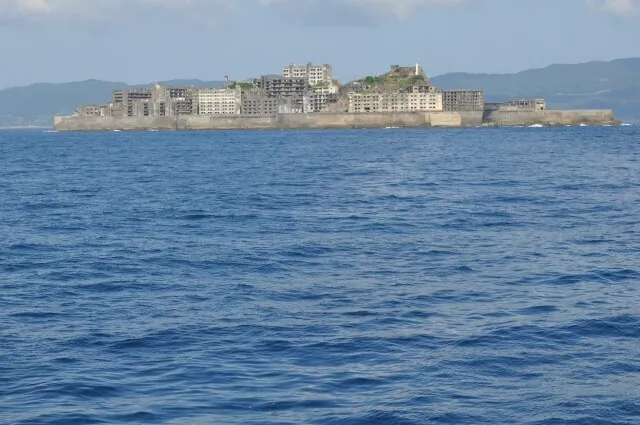
A Japanese mine in Nagasaki Prefecture where many Koreans were forced to work as laborers under harsh conditions with minimal compensation during the colonial era. (Hankyoreh archives)
In 1942, 17-year-old Lee Cheon-gu was taken from his home in Seocheon, South Chungcheong Province, to the Yawata Steel Works in Japan’s Fukuoka Prefecture.One day, he got a visit from a police officer and an official in charge of family registers at the township’s government office. “The township official told me I’d been chosen for the draft. If I ran away, I’d be causing my parents to suffer. There was nothing you could do, at least back then,” Lee said.And so Lee was taken away, with no choice in the matter. He worked at a factory that produced ammonia fertilizer. At mealtime, his only food was a little rice, half a bowl of miso soup, two strips of pickled radish, and a couple of fermented black soybeans. Unable to endure the hunger, he fled the steel works in 1943 and started doing odd jobs at the Imamura Factory in Wakamatsu Ward, which produced ironware.Following Japan’s surrender, Lee traveled to Shimonoseki in Sept. 1945 to return to Korea, but he couldn’t arrange passage by ship. Vast numbers of Koreans had congregated to Shimonoseki, and dozens of them were dying of infectious diseases each day. After being told he could accelerate his passage by clearing away corpses, Lee worked on corpse removal for ten days and was finally able to board a ship.Lee’s story appears in “I Nearly Drowned on the Motorboat,” a collection of oral accounts published in 2006 by a commission that investigated the harm caused by forced mobilization and labor during Japan’s colonial occupation of South Korea.