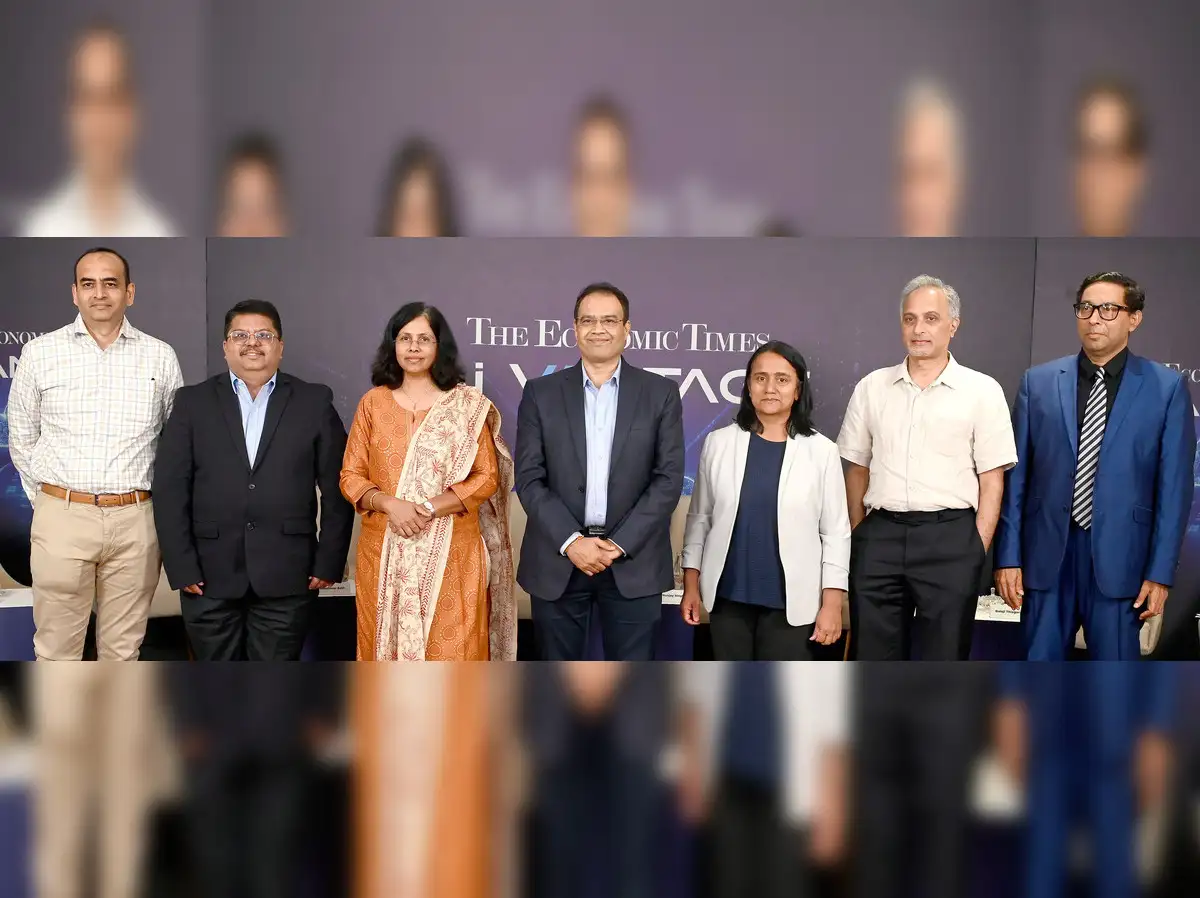
Artificial intelligence is yet to become central to how most Indian companies operate, but business leaders say the real inflection point is not far off. At an ET Power Table series dialogue in Bengaluru titled 'AI as a Board-Level Imperative: How CTOs are Managing Leadership Expectations while Driving Adoption from the Ground Up", senior executives said AI would become core to business operations within the next four to five years, depending on how quickly the technology matures.The round table brought together Sivaramakrishnan Ganapathi, managing director of garments exporter Gokaldas Exports, Venk Krishnan, chief executive of NuWare, Krishnan Venkateswaran, chief digital officer of Titan, and Satheesh Krishnamurthy, chief executive-HNI of wealth management firm 360 ONE Wealth.Titan's Venkateswaran said AI works best in repetitive, low-judgement tasks. "Wherever the task is high frequency and the level of judgement or human touch is low, AI agents are a no-brainer," he said.ET BureauPanellists at ET Power Table leadership dialogue echo ‘over reliance on Western AI platforms is a concern’He said AI can handle training, process management, and standard invoice processing, but it is not yet ready to do a core part of our business, which is talking to customers in stores. "Automation has been there for decades. AI agents are probably just somewhat more intelligent, context-aware and able to learn from what has already been done."US-headquartered IT services firm NuWare's Krishnan said the industry's bigger aspirations are still a work in progress. "Most AI models, including Anthropic, are talking about a superintelligent AI that can think and act like a human being. That is what everyone is chasing." Timelines, he added, remain uncertain. "People are predicting 2030 as the year when we will really find out what AI can and cannot do."For Ganapathi, AI is already creating value in design. "There is a huge component of design where artificial intelligence helps in taking products to market much faster," he said.AI now assists in rendering garments digitally after a designer sketches them, enabling 3D visualisation and virtual showcasing. This cuts the time between concept and buyer presentation.Ganapathi also said over-reliance on Western AI platforms is a concern. "I think that level of intelligence exists in India," he said. "Most AI models are US-based, and eventually all the data gets processed there. Are we comfortable passing all this data outside? Some of these AI systems may eventually know more about our company than we do because we are happily feeding them everything."Krishnamurthy of 360 ONE Wealth said the power of AI cuts both ways. "AI can be a beautiful or a dangerous tool, depending on who is using it," he said. Organisations that are not careful could end up incurring significant costs due to the hallucination risk, he added. "It needs prudence. It needs continuous awareness at an organisational level in terms of how we are capitalising on these capabilities."Krishnamurthy further said that AI is reshaping roles in wealth management. "With the impact of technology and AI, the relationship manager is now equipped with tools like cloud to work on proposals, drawing on all the intelligence already present in the firm. We are also able to design the portfolio," he said."The investment counsellor, instead of being just a distant touch to the client, can choose to transform himself into a wealth manager. That is a big opportunity," he added.The service RM too stands to gain, he said. "Their core skill is relationship management. Technology can act as a think tank for them, helping them move from being a plain vanilla service arm to a full relationship manager.""Every step of the way, judicious adoption of technology can be an alpha creator from a career standpoint," Krishnamurthy added.Krishnan of NuWare said the mindset of software engineers should evolve."AI has changed the landscape. There is going to be a lot of training, which we are doing, and I am sure other IT companies will follow," he said.He said being a smaller firm has its advantages. "Customers work closely with us and tell us exactly where they want our help. Domain knowledge is more critical today than ever.""I always emphasise to my employees: Learn your subject matter. If you know the subject well, there is at least a chance you will figure out how to do things," he added. Domain experts are in better shape today because of the training they can now get on the technology side, he said.
ET Power Table: Business leaders bullish on AI, say meaningful adoption is not far off
Indian businesses are gearing up for artificial intelligence to become central to their operations in the next four to five years. Leaders discussed AI's current role in design and repetitive tasks. They also highlighted future aspirations for superintelligent AI and the need for careful adoption. The technology promises to reshape roles and create new opportunities across various sectors.
729 words~3 min read