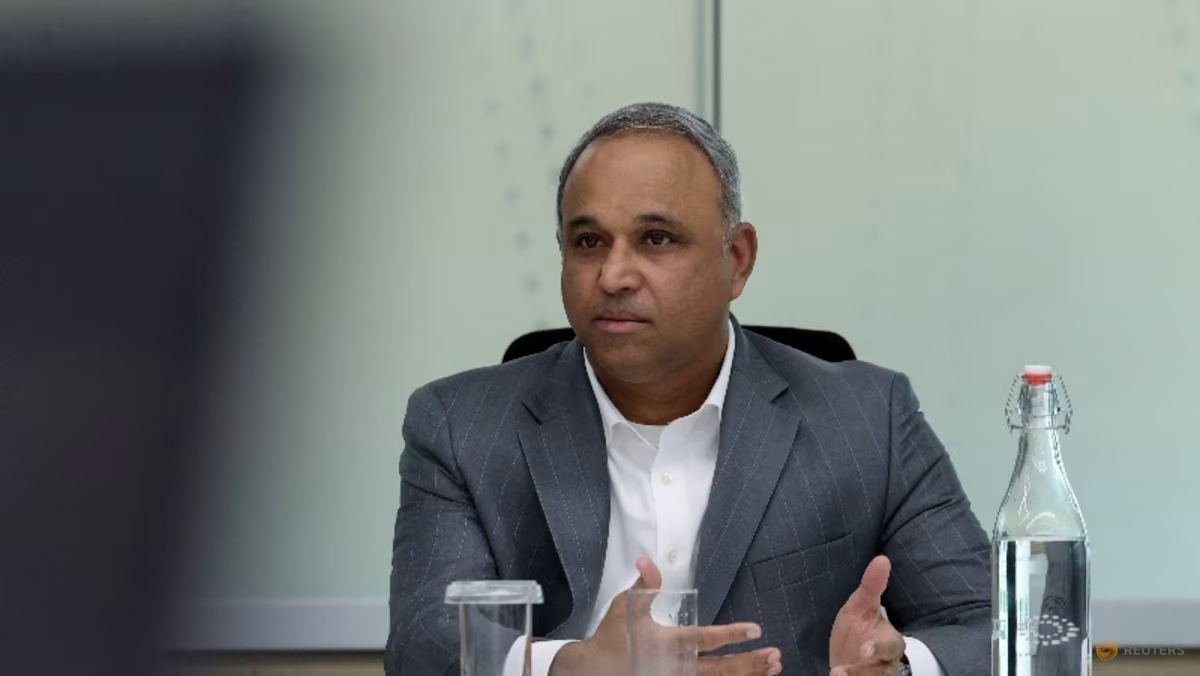
India leads globally in AI adoption, with 80% of employees using AI multiple times a week and 41% using AI daily, according to ADP Research’s latest People at Work 2026 report. This comes at time when artificial intelligence adoption at the workplace has risen significantly overall, with half of employees globally using AI multiple times a week, and one in five (20%) using it nearly every day.However, the findings also reveal a growing disconnect between AI adoption and perceived productivity. While 30% of daily AI users report being fully engaged, they are also four times more likely than non-users to say they feel less productive. This suggests that as AI takes over routine tasks, employees may feel their contributions are harder to quantify and evaluate.This shift is particularly pronounced in India, where widespread adoption means many employees are already navigating new expectations around output, value, and performance.“India is among the leading adopters of AI at work, but high adoption alone does not guarantee greater productivity. Many employees carry a quiet anxiety about the future of their careers, and whether AI is making their contribution harder to measure,” said Rahul Goyal, managing director, ADP India and Southeast Asia in a statement.“As AI takes on more routine and checklist-driven tasks, employees are increasingly focusing on work that requires judgment, creativity, and human connection. This shift calls for a rethinking of how organisations define and measure productivity. Employers have a critical role to play in helping their workforce build confidence with AI, integrate it meaningfully into daily workflows, and develop the skills needed to thrive alongside it. Ultimately, the organisations that succeed will be those that invest in making their people more adaptable, not just more efficient,” he added.Frequent AI Users Report Higher Engagement and Lower StressThe use of AI can contribute to a more positive workplace experience. According to the report, 11% of daily AI users report experiencing negative stress, roughly half the rate of non-users (23%).Frequent AI users also report stronger team dynamics. They are more likely to say they are part of a work team and more likely to report being on the “best team” at work. Daily users are also more likely than less frequent users to feel their jobs are safe from elimination, indicating a strong link between regular AI use and job confidence.AI Adoption Varies Across RegionsAI usage varies widely across markets. India (41%), Nigeria (39%), and Vietnam (36%) lead globally in terms of daily AI usage.In India, the report highlights several key trends shaping AI use at work across demographics and work types:Employees in India are optimistic about AI, with 31% feeling that AI will positively impact their job responsibilities in the coming year, second highest after Nigeria.Knowledge workers feel the most certain about AI with 37% feeling that AI will positively impact their job responsibilities, notably higher than skilled task workers (21%) and repetitive task workers (19%).Employees aged 18-39 are the most frequent AI users, with 43% of them using AI almost daily.Women in India are using AI more frequently than men, with 44% using AI nearly every day at work compared to men at 40%.The share of employees using AI nearly every day increases with firm size, with 54% of employees in large companies (1000+) using AI daily, compared with 39% in mid-sized firms (249-999) and 32% in small firms (1-249).People at Work 2026 features survey findings derived from ADP Research's annual Global Workforce Survey of more than 39,000 working adults in 36 markets to uncover global workforce sentiment.
India emerges as a global leader in workplace AI adoption: ADP Research
India leads global AI adoption, with 41% of employees using it daily. Despite this, a productivity paradox emerges, as daily users report feeling less productive. Rahul Goyal of ADP India highlights the need for organizations to redefine productivity, focusing on human skills and adaptability to build employee confidence alongside AI integration.
585 words~3 min read