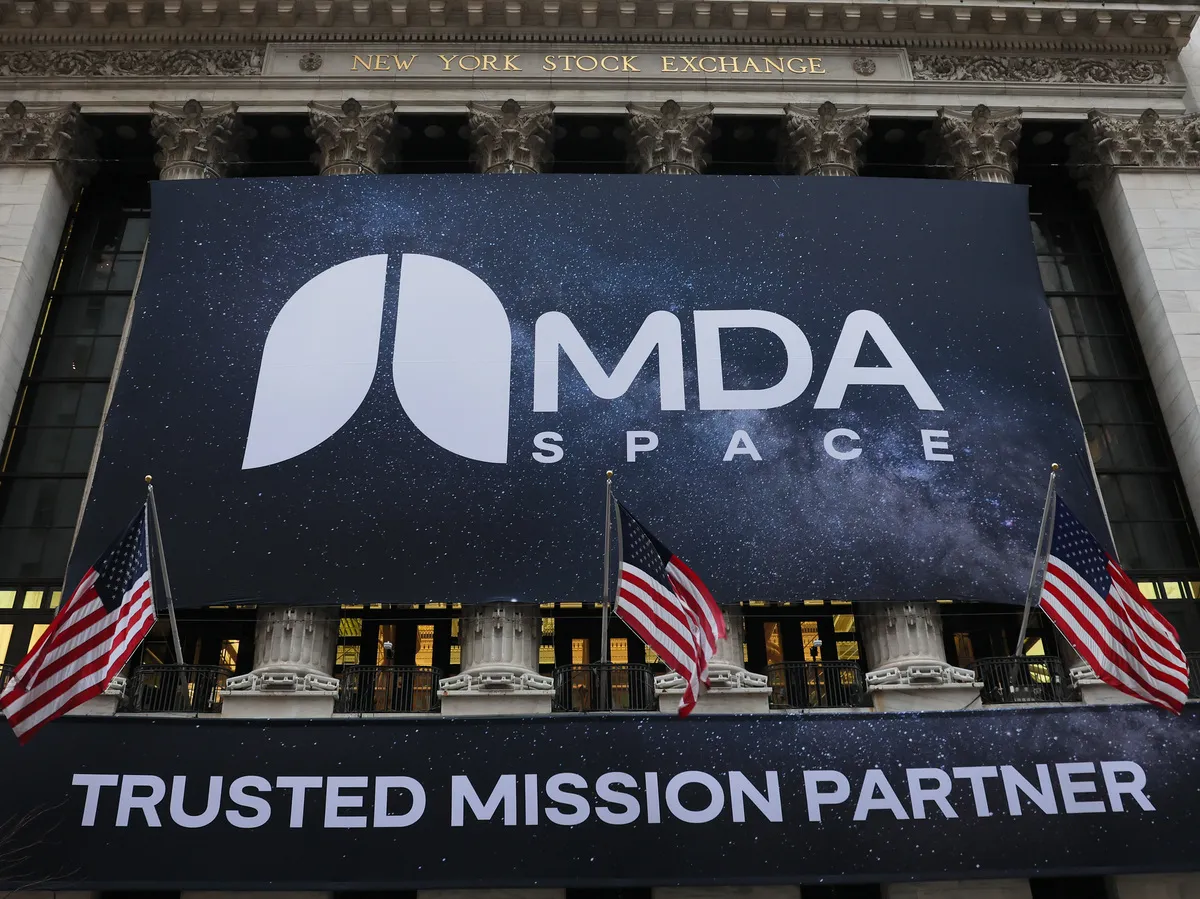
Skip to Content News Archives Economy Energy Oil & Gas Renewables Electric Vehicles Mining Commodities Agriculture Real Estate Mortgages Mortgage Rates Finance Banking Insurance Fintech Cryptocurrency Work Wealth Smart Money Wealth Management Investor Personal Finance Family Finance Retirement Taxes High Net Worth FP Comment Executive Women Puzzmo Newsletters Financial Times Business Essentials More Innovation Information Technology FP500 Podcasts Small Business Lives Told Tails Told Shopping Financial Post Store Obituaries Place a Notice Advertising Advertising With Us Advertising Solutions Postmedia Ad Manager Sponsorship Requests Classifieds Place a Classifieds ad Working Profile Settings My Subscriptions Saved Articles My Offers Newsletters Customer Service FAQ News Economy Energy Mining Real Estate Finance Work Wealth Investor FP Comment Executive Women Puzzmo Newsletters Financial Times Business Essentials HomeInnovationCanada's MDA Space pushing for more global defence, aerospace contracts in sovereign-dominated industriesOperating the world’s first large-scale digital satellite plant will give MDA a production, export and sovereignty edge You can save this article by registering for free here. Or sign-in if you have an account.MDA’s existing deals with American defence companies and its new Montreal facility position it well as an established and high-volume producer. Photo by Michael M. Santiago/Getty ImagesThe space shuttle Columbia launched for the second time from the Kennedy Space Centre in November 1981, but this time it carried a 15-metre-long, L-shaped robotic arm emblazoned with the word “Canada” on it and the red-and-white national flag.Subscribe now to read the latest news in your city and across Canada.Exclusive articles from Barbara Shecter, Joe O'Connor, Gabriel Friedman, and others.Daily content from Financial Times, the world's leading global business publication.Unlimited online access to read articles from Financial Post, National Post and 15 news sites across Canada with one account.National Post ePaper, an electronic replica of the print edition to view on any device, share and comment on.Daily puzzles, including the New York Times Crossword.Subscribe now to read the latest news in your city and across Canada.Exclusive articles from Barbara Shecter, Joe O'Connor, Gabriel Friedman and others.Daily content from Financial Times, the world's leading global business publication.Unlimited online access to read articles from Financial Post, National Post and 15 news sites across Canada with one account.National Post ePaper, an electronic replica of the print edition to view on any device, share and comment on.Daily puzzles, including the New York Times Crossword.Create an account or sign in to continue with your reading experience.Access articles from across Canada with one account.Share your thoughts and join the conversation in the comments.Enjoy additional articles per month.Get email updates from your favourite authors.Create an account or sign in to continue with your reading experience.Access articles from across Canada with one accountShare your thoughts and join the conversation in the commentsEnjoy additional articles per monthGet email updates from your favourite authorsSign In or Create an AccountorKnown as the Canadarm, it was designed and built by MDA Space Ltd., then known as Spar Aerospace Ltd., to move and fix objects in space. Future iterations played a role in the construction of the International Space Station.The Canadarm made Brampton, Ont.-based MDA a key player in the global space race and helped define it as a company critical to Canada’s identity and national security. Yet it has also been long intertwined with the United States’ nation-building projects and military-industrial complex, a feature that has shifted the company’s ownership from Canada to the United States and back.Get the latest headlines, breaking news and columns.By signing up you consent to receive the above newsletter from Postmedia Network Inc.A welcome email is on its way. If you don't see it, please check your junk folder.The next issue of Top Stories will soon be in your inbox.We encountered an issue signing you up. Please try againThat dynamic continues and MDA’s next chapter of growth — one that could allow it to hit nearly $2 billion in revenue this year — will require a delicate balancing act as a Canadian company pushing harder to court U.S. and global contracts in an industry viewed as vital to individual countries’ national security.MDA has identified a US$40-billion pipeline of global opportunities over the next five years as countries around the world shore up their sovereign space technologies amid growing geopolitical turbulence.“Canada’s only so big. A necessary part of our (company’s) future is to be able to export to the U.S., as well as Europe and the rest of the world,” said MDA chief executive Mike Greenley, who has been at the helm for a decade.Canada accounts for 63 per cent of MDA’s revenue, while the U.S. and Europe contribute 30 per cent and five per cent, respectively.Greenley said he wants U.S. and European markets to make up a much larger share and the company will likely set up subsidiaries there via acquisitions.Governments often impose high or exclusive local content requirements on satellites and other strategic technologies, but MDA’s M&A plans may allow it to manoeuvre around such concerns.Konark Gupta, an analyst at Bank of Nova Scotia, said MDA will likely buy profitable manufacturers of space products, such as satellite makers, which will make it more eligible to score government tenders.MDA’s revenue hit a record $1.63 billion in 2025, and its stock has surged more than 100 per cent over the past 12 months.“We’ve had a lot of growth in the last few years,” Greenley said. “We’ve doubled in size from 2021 to 2023, then doubled again from 2023 to 2025 and we’re in our third double now.”MDA’s major commercial satellite contracts, such as its $1.1-billion deal with Globalstar Inc. and $2.1-billion agreement with Telesat Corp. to produce LEO satellites, have juiced growth in recent years, but some analysts say its reliance on a few key contracts could become a key stumbling block.“Any risk to their three big customers could be a potential risk,” Gupta said.For example, Amazon.com Inc. in April announced it had finalized a deal to acquire Globalstar. MDA’s contract with Globalstar is set to continue, but it “might not necessarily have follow-on orders,” Thanos Moschopoulos, an analyst at BMO Capital Markets Corp., said.Last year, MDA lost a US$1.8-billion contract with EchoStar Corp. after the U.S.-based telecommunications company abruptly axed its plans to develop a space-based satellite network and sold its licences to Space Exploration Technologies Corp. (SpaceX) for US$17 billion, instead.“It’s not fun when it happens and it’s a very rare event,” Greenley said of the scrapped deal.Seth Seifman, an analyst at JPMorgan Chase & Co., said sales from MDA’s key contracts will continue to grow, but will largely wrap up at the end of 2027, so it must win more contracts since its backlog has declined.“Competition is intense and customer plans can change or experience delays,” he said in a note in April.Greenley said MDA is aiming to acquire “established companies” in the U.S. and Europe, though no acquisitions are close to completion yet. He said MDA’s US$300-million initial public offering in March on the New York Stock Exchange, its second IPO following its 2021 Toronto debut, will prepare it for upcoming M&As and help it access American investors and deeper capital pools.“When we make acquisitions in the U.S. or elsewhere in the future, and we are holding stock as currency, we can use shares or cash, which is helpful,” he said.At the same time, operating the world’s first large-scale digital satellite plant will give MDA a production, export and sovereignty edge, analysts say. This month, the company officially opened a $350-million satellite plant in Montreal that will annually produce 400 satellites.Moschopoulos said governments have realized the importance of having their own sovereign satellite infrastructure and are hesitant to trust third-party operators such as SpaceX, which provides an opening to MDA.“MDA … is certainly under consideration for some of those (contracts). That would be a big chunk of its pipeline,” he said, pointing to potential agreements with countries such as Japan, Taiwan and Germany.The company recently signed a memorandum of understanding with South Korean conglomerate Hanwha Corp. to develop military satellites for South Korea.In May, it finalized nine early contracts and received 32 letters of interest for data from its satellite constellation to be launched later this year. The agreements came from energy, natural resources and maritime industry partners across regions such as North America, Europe and Asia-Pacific.MDA also supplies the five largest U.S. defence contractors with critical satellite and space equipment such as antennas and electronic subsystems made in its Montreal factory.In January, it was shortlisted to compete for work on the U.S. Missile Defence Agency’s SHIELD program, part of U.S. President Donald Trump’s Golden Dome initiative to defend the U.S. against intercontinental ballistic missile attacks.Trump last week increased cost estimates for the project to US$1.2 trillion, allocating US$172 billion for satellites alone.Greenley said MDA is in “active discussions” with the U.S., and being an approved supplier to bid for work on this initiative guarantees MDA a “nice, strong position… in the U.S. defence sector.”MDA’s existing deals with American defence companies and its new Montreal facility position it well as an established and “high-volume producer,” according to Beacon Securities Ltd. analyst Russell Stanley.While MDA might have to contend with local content requirements abroad, Canada’s own efforts to boost government procurement of Canadian companies’ products and services will give it a leg up at home as the Mark Carney government accelerates its $82-billion push to rebuild the Canadian military and boost defence innovation.Analysts expect MDA will get more Canadian contracts given Ottawa’s recently launched $6.6-billion Defence Industrial Strategy (DIS), which aims to increase the share of defence contracts awarded to Canadian companies to 70 per cent.MDA was one of the first two companies to sign a deal with Ottawa’s newly formed Defence Industrial Agency in March and will set up space surveillance telescope sites across the country for $32 million.“Canada’s defence budget should grow nine per cent annually for a decade, and MDA is poised to be a national champion in space and outside of it,” Seifman said.MDA already holds key multimillion-dollar and multi-year contracts with the likes of the Canadian Space Agency, Department of National Defence and Royal Canadian Navy to build and operate military satellite communications systems, radar imaging satellites and optical telescopes, among other things.Yet it wants billions of dollars more. MDA launched 49North Ltd., a wholly owned defence subsidiary focused on military surveillance tech such as drones, sensors and other communications systems, earlier this year to take on large-scale, multibillion-dollar programs for the Canadian Armed Forces and other agencies.Greenley, who has worked in Canadian aerospace and defence for three decades, has little apprehension about providing defence and dual-use tech to both Canada and other nations.“We’re totally comfortable providing defence space systems to the U.S. or any other country that wants to work on its security and sovereignty,” he said. “We see many increased opportunities in Europe, Southeast Asia and the Middle East, in addition to the U.S. We will continue to pursue those and deliver to them.” Join the Conversation This website uses cookies to personalize your content (including ads), and allows us to analyze our traffic. Read more about cookies here. By continuing to use our site, you agree to our Terms of Use and Privacy Policy.
Canada's MDA Space pushing for more global defence, aerospace contracts in sovereign-dominated industries
MDA Space Ltd. is a key player in the space race, yet has also been long intertwined with the U.S. military-industrial complex. Read on
1,850 words~8 min read