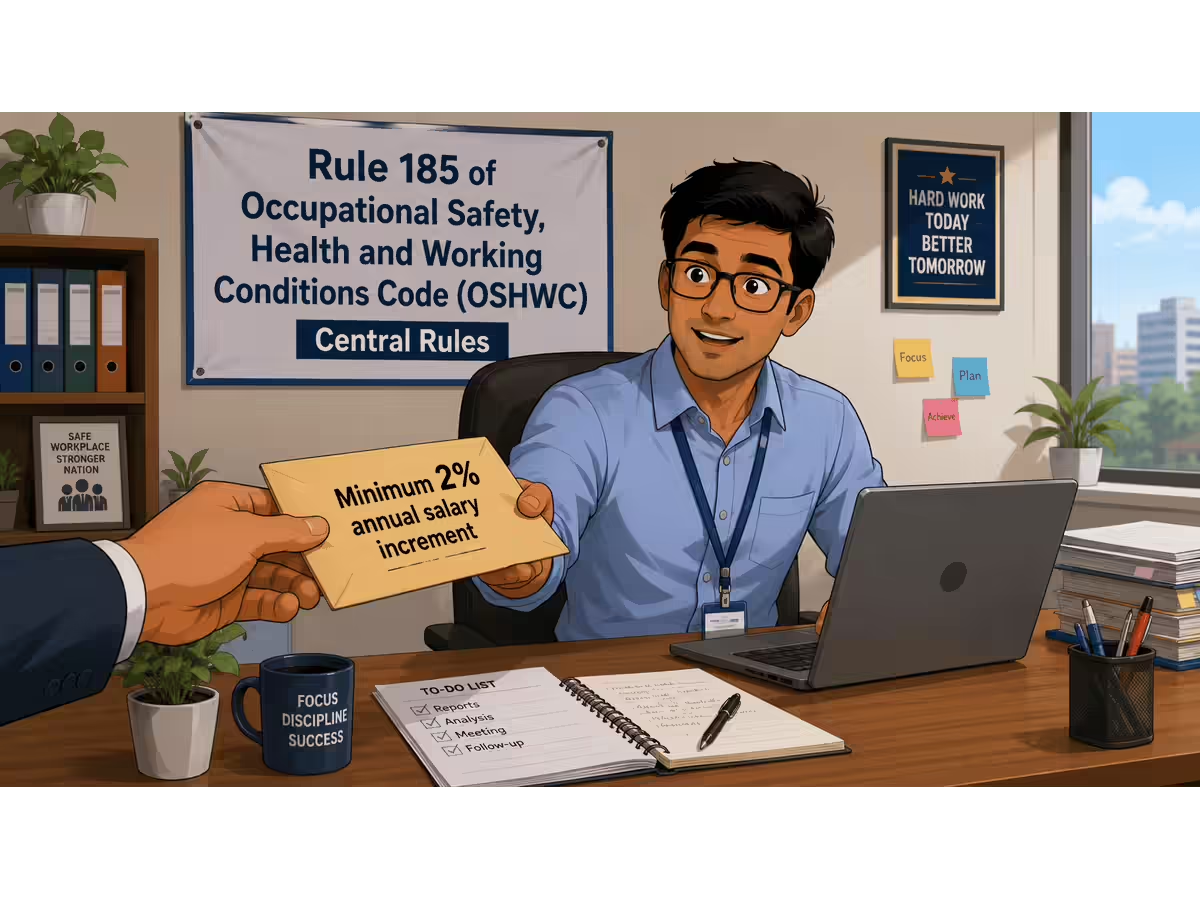
SynopsisNew labour codes from the Central Government introduce a mandatory 2% annual salary increment for regular contractual workers. This rule applies to employees of contractors working for central government establishments like railways and banks. The provision is mandatory, even if companies do not wish to offer increments. This rule does not extend to employees directly on a company's payroll.ET OnlineMinimum 2% annual salary increment for these employees working in railways, air transport service, telecommunications, banking and others under new labour code central government rules (AI generated representative image)The central government rules for the new labour codes which were notified a few days back (May 8, 2026) stated that contractual employees of a company (those not on the company’s payroll) have to be given a minimum of 2% annual salary increment.Rule 185 of Occupational Safety, Health and Working Conditions Code (OSHWC) Central Rules, mentioned that: “ Annual increment of regular worker of a contractor - A worker who is regularly employed by the contractor for any activity and employment of such worker is governed by mutually accepted standards of the condition of employment shall be such that such worker gets an annual increment of not less than two percent of their wages.”Lokesh Gulati, Partner, PwC India said to ET Wealth Online: “Yes, it is true that under new labour codes i.e. OSHWC Code 2020 read with OSHWC Central Rules 2% increment is a must for contractual employees.”However, Gulati says that the 2% annual increment under Rule 185 of the OSHWC Central Rules applies only to “regular workers of a contractor”, i.e. individuals legally employed by a third‑party contractor.Gulati says: “It therefore does not apply to employees directly on a company’s rolls, including fixed‑term hires, as these are not covered under the contractor framework envisaged in the rule.”Also read: Rules for faster full and final settlement, annual leave encashment & other provisions are already effective under new labour code even without state government notification, know what it meansIs this applicable for the entire India or state governments need to notify their own rules?According to Gulati the 2% minimum salary increment rule is not applicable to entire India and State governments need to notify their own rules.Gulati says that as this provision is mentioned in OSHWC Central Rules, 2026 which was notified on May 8, 2026 and it is only applicable to the establishment ofRailways, mines, oil fields, major ports, air transport service, telecommunications, banking and insurance company andCentral Public Sector Undertaking and subsidiaries, Corporation and autonomous bodies owned or controlled by the Central Government andEstablishment of contractors for the purpose of such establishments wherein “Central Government is appropriate government.Is the minimum 2% annual increment provision mandatory even if the company does not want to pay any increment to the said employee?Gulati says that yes, as per Rule 185 of the OSHWC Central Rule, 2026 it is mandatory.According to Gulati, the 2% annual increment under Rule 185 of the OSHWC Central Rules applies only to “regular workers of a contractor”, i.e. individuals legally employed by a third‑party contractor.Gulati says: “It therefore does not apply to employees directly on a company’s rolls, including fixed‑term hires, as these are not covered under the contractor framework envisaged in the rule.” ...more
Minimum 2% annual salary increment for these employees as per Rule 185 of Central Government’s new labour code; Know the details - The Economic Times
Companies have to mandatorily give minimum 2% annual increment to contractual employees under new labour code’s central government rules
535 words~2 min read