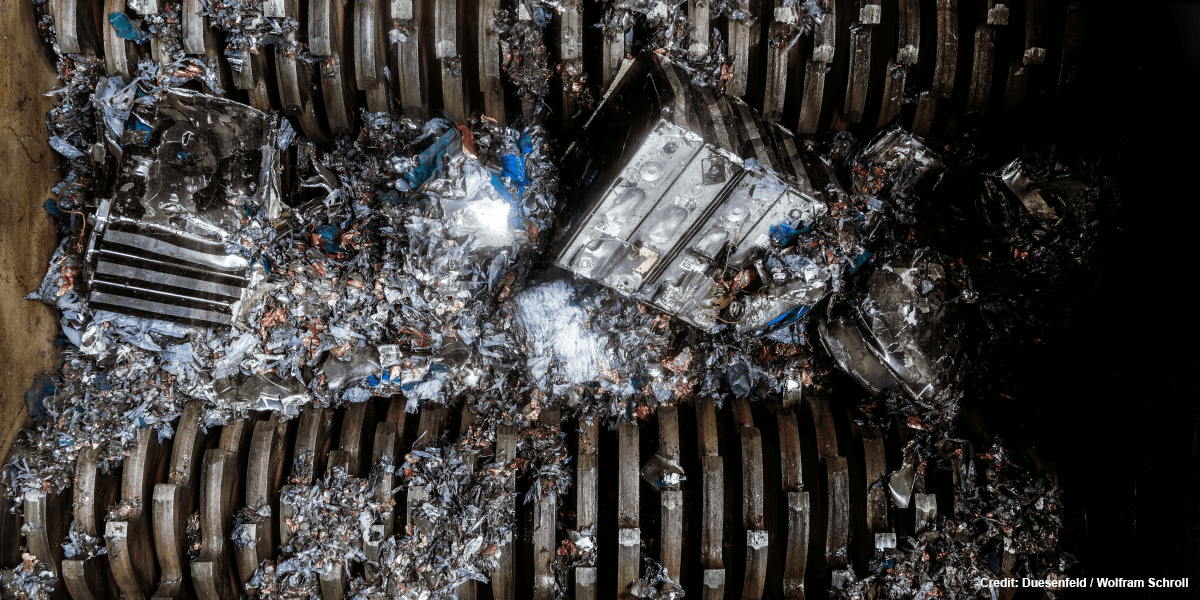
Australian battery materials recycling start-up Renewable Metals has secured $12 million AUD in series A funding to further develop its novel battery recycling line. The Perth-based company says the investment will help to establish a battery-recycling prototype plant in Western Australia and design its first commercial facility in NSW.The forecast for battery materials requiring recycling in Australia is foreseeable, with uptake in electric vehicle adoption across the country, spurred by the combination of government incentives, the war in Iran that has highlighted the island continent’s lack of petroleum reserves and dependence on oil imports, and the lack of recycling alternatives outside of China. Renewable Metals says the 12 million Australian dollar investment will support its prototype plant in Kewdale, Western Australia, planned to begin operating from mid-2026 and scale up to recycle up to 2000 tonnes of batteries per year, which the company notes is equivalent to 4000 electric car batteries.The financing round attracted even more interest than initially anticipated in an oversubscribed round, topping out at 12 million Australian dollars after originally targeting 8 million. Renewables Metals is already supported by the Australian government and the UK government. The start-up’s ties similarly span the globe with its investors. UK vehicle recycler European Metals Recycling (EMR) acquired a significant stake in the Australian-owned company in 2024, and has participated in this funding round, which was led by the Clean Energy Finance Corporation (CEFC), managed by Virescent Ventures, and supported by other existing investors Neglected Climate Opportunities and Investible, alongside new investor Climate Tech Partners.All battery chemistries on a single lineThe Perth-based battery recycling start-up has developed a new process aimed at adapting to differentiated flows of different battery chemistries. The novel approach can process NMC, LCO, and LFP batteries and feed forms, from production scrap and black mass to cells and full packs, at the same time.Blair Pritchard, Partner at Virescent Ventures, noted: “Processing NMC and LFP together has been the unsolved problem in battery recycling,” explaining that conventional approaches require separate lines for each chemistry, duplicating capital and operating costs and limiting flexibility as the market evolves.The Australian start-up says that their process enables materials to be processed as received, without pre-sorting or dismantling, enabled by a rapid discharge step. This eliminates the need for intermediate black mass production – the processing of which is highly concentrated in China and select other parts of Asia. The alkaline separation process also recycles reagents and wastewater, which avoids problematic waste streams such as sodium sulphate. This aspect is especially relevant in the US and Europe, where sodium sulphate disposal presents a high cost and regulatory burden.Pritchard notes, “Their single-line process handles both chemistries together, which is technically non-trivial and commercially significant as LFP’s share of the market continues to grow.”Modular facility approachThe Australian company is using an approach of low-capital modular plant design, which convinced the investors that the company’s platform is genuinely deployable at scale. The company says this modular construction principle enables commercial plants to be built at a fraction of the scale of conventional recycling facilities. This is meant to support deployment in “Western cost environments” while remaining globally competitive. While the platform is designed for deployment across global markets, the company particularly has regions in mind with high disposal costs and limited local refining capacity.The newly generated capital is earmarked to enable the continuous operation of the company’s commercial prototype plant in Kewdale, Western Australia. This pilot should commence full operations in 2026 through to early 2028 to generate sustained, near-commercial performance data to validate the technology and inform the design of Renewable Metals’ first commercial-scale plant, planned for the Hunter, New South Wales.The fresh finance will also accelerate the planned facility in NSW, which is undergoing a front-end engineering and design (FEED) study to create a blueprint for repeatable, globally deployable plants, while demonstrating a low-capital, modular approach. The Australian start-up says that its early scoping suggests a “markedly lower capital and operating cost profile than conventional recycling facilities.”Finally, the funding gained in the Series A financing will enable the company to expand its R&D, engineering and commercial functions to improve product quality, broaden feedstock flexibility, and “execute its global growth strategy,” says the start-up.Luan Atkinson, CEO of Renewable Metals, says the company’s process changes the economics of battery recycling. “By delivering high recovery at low cost without large, centralised facilities, we can build plants sized for near-term feedstock, and scale with the market over time,” says Atkinson. “This avoids capital-intensive overbuild while enabling a distributed network close to feedstock sources globally, reducing the cost and complexity of transporting hazardous materials.”renewable-metals.com
Australian battery recycling startup wins oversubsribed series A funding - electrive.com
Australian battery materials recycling start-up Renewable Metals has secured $12 million AUD in series A funding to further develop its novel battery
765 words~3 min read