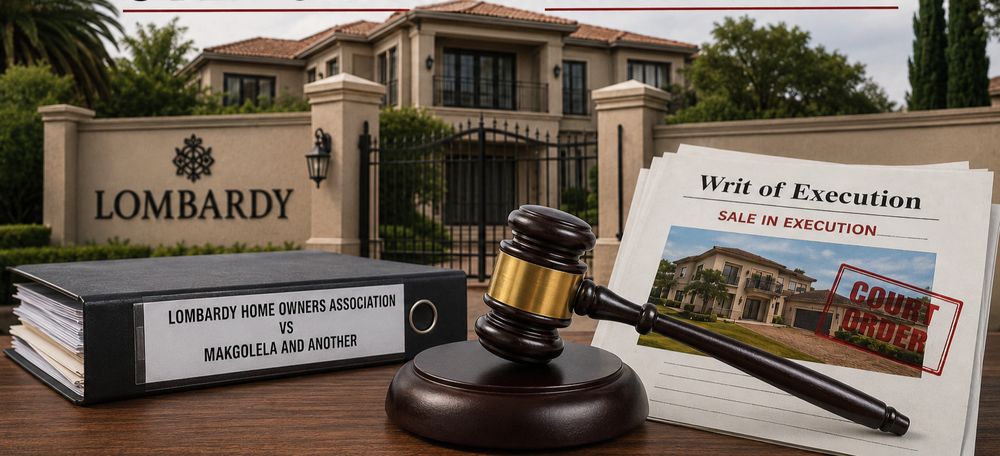
The South Gauteng High Court in Johannesburg has ordered that a luxury home in the exclusive Lombardy Estate in Pretoria be sold at public auction after its owners failed to pay hundreds of thousands of rands in overdue levies.Judge Leicester Rock Adams ruled in favour of Lombardy Home Owners Association (HOA), granting the association a further judgment of R211,662.07 against homeowners Lillian Mokgalakane Makgolela and Kingsley Makgolela.The legal friction between the Lombardy HOA and the Makgolelas is not new. The association originally secured a default judgment against the couple in March 2024 for an amount of over R333,000.Although the homeowners attempted to legally reverse that initial judgment through a rescission application, the High Court firmly dismissed their challenge in May 2025.Instead of being resolved, the financial situation rapidly worsened. By August 2025, the total outstanding arrears had climbed to nearly R545,000.In the judgment, judge Adams granted an additional monetary order of R211,662.07 against the co-owners to account for the new debt that has continued to accumulate since the original court battle. Shockingly, the court noted that by April 2026, the overall levy debt on the property statement had ballooned to a staggering R681,777.32.The court heard that while Lillian had made sporadic monthly payments between late 2025 and early 2026, those funds were only enough to cover current, ongoing estate fees. The payments failed to make any meaningful dent in the historical arrears, forcing the homeowner's association to seek the ultimate legal remedy: a forced judicial sale of the immovable property. Before a creditor can legally force the sale of an individual's primary residence, the law mandates that they must exhaust all other reasonable avenues to recover the money. This protection ensures that execution against someone's home is treated strictly as a last resort. The Lombardy HOA demonstrated to the court that it had done exactly that.The court recorded that the sheriff of the court had previously visited the property to attach movable assets like furniture or vehicles to satisfy the debt. However, Lillian informed the sheriff that she lacked the available money or assets to clear the debt. Ultimately, the sheriff was only able to attach movable items valued at a meager R3,100, resulting in a nulla bona return—a legal declaration that the debtor possesses no sufficient movable property to satisfy the judgment.In her defence, Lillian opposed the forced sale by producing a private valuation report that estimated her household's movable goods to be worth over R326,000. She further argued that she maintains a well-paying job, earning a net salary of R50,000 per month, and proposed a payment plan of R5,000 per month to gradually clear what she owed.Judge Adams, however, dismissed these arguments as practically unviable. He noted that the private valuation represented regular market value, whereas a forced Sheriff's sale would yield substantially lower returns. Furthermore, the judge pointed out that the proposed R5,000 monthly payment plan was entirely unrealistic, as the property's monthly interest and accruing levies actually exceeded that amount, meaning the debt would continue to grow indefinitely.The case required the court to engage in a delicate judicial balancing act. On one side was the association’s right to collect contractually agreed-upon levies, and on the other was the constitutional right to adequate housing, as the property serves as the primary residence for Lillian and her two daughters.However, the judge emphasised that the justice system does not allow debtors to escape legitimate court judgments indefinitely by simply claiming they will lose their house.The court added that Lombardy HOA is a collective organisation relying entirely on member levies to maintain common property and meet its corporate obligations. When individuals fail to pay, an unfair and unsustainable financial burden is shifted directly onto the paying members of the community.Crucially, financial records brought before the court revealed that the home holds significant equity. While there is a substantial home loan balance of over R1.87 million owed to Absa Home Loans, the property’s forced sale value sits around R3.1 million. By setting the official auction reserve price at R3.5 million, the court ensured that the property will not be sold for a pittance. This protective measure guarantees that after Absa, the municipality, and the HOA are paid what they are owed, enough remaining equity will be returned to Lillian to allow her to secure alternative accommodation.As a result, the judge declared their 796-square-metre property executable and set a reserve price of R3.5 million for its sale in execution.While the Lombardy HOA won the main legal battle, the court denied its request to hit Lillian with a punitive attorney-and-client costs order. Judge Adams ruled that a punitive penalty was not justified, instead ordering the respondents to pay ordinary party-and-party legal costs. [email protected]IOL NewsGet your news on the go, click here to join the IOL News WhatsApp channel.
Court orders sale of Pretoria luxury home over R681,000 in unpaid estate levies
A luxury home in Pretoria is set to be auctioned after its owners defaulted on R681,000 in estate levies, with the Johannesburg High Court ruling that the financial stability of the residential community takes precedence over the owners' personal hardship.
796 words~4 min read