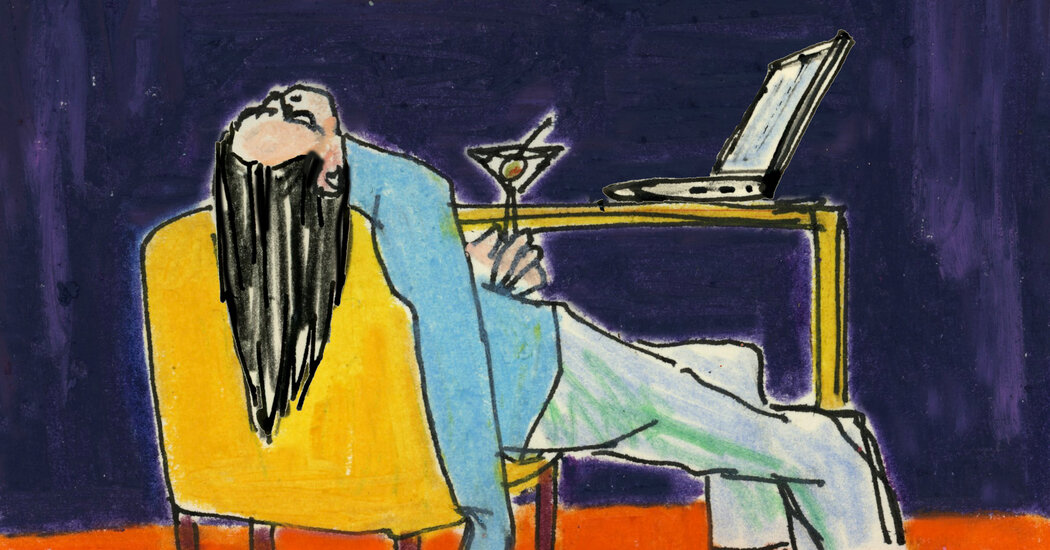
Illustration by María MedemIn an essay out today, the editor and writing coach David O’Neill reviews Lucy Ives’s unorthodox new collection of writing prompts, “three six five: prompts, acts, divinations (an inexhaustible compendium for writing).” The compendium, as much a work of literature as a practical guide, includes tasks such as reviewing an imaginary book, repeating a word until it becomes meaningless, and even penning a thirty-page sentence. Ives once directed her students to “describe something that they’d completely forgotten,” with the hope, as she described in an interview, that it be “impossible to do the exercise ‘correctly.’ ”In considering such experiments, O’Neill offers his own wisdom about the sometimes frightening act of expression. As he explains, “When writers stop performing for an imagined judge, the language loosens: the prose becomes more like riffing with a friend than giving a speech, and the unconscious pipes up with its desires and fantasies, some ugly, some dumb, some funny, some profound. All workable.” O’Neill argues that this freedom can lead to practical breakthroughs, but also to something deeper. “Figuring out what you really think,” he writes, “is one way of remembering that you’re human.”Read the essay »O’Neill’s account joins a rich archive of New Yorker pieces in which advice about writing becomes advice about, well, everything else:Zadie Smith shares a trick to writing that she first learned in school and never outgrew. It all starts with a rectangle.Louise Glück unpacks the mysterious power of writing as transformation.George Saunders reflects on the deep bonds between writers and their teachers.Andrew Solomon argues for the power of empathy: “The deeper you look into other souls—and writing is primarily an exercise in doing just that—the clearer people’s inherent dignity becomes.”Editor’s PickIllustration by Joan Wong; Source photographs from GettySam Altman Won in Court Against Elon Musk. But, Really, We All LostThe trial between these tech titans was, supposedly, about the good-faith control of artificial intelligence. But it was really about something far less grand. Gideon Lewis-Kraus, who reported from the trial, writes that “the suit was an act of vengeance, and its primary function seemed to be to make everyone involved look heinous.” Read or listen to the story »More Top StoriesAs OpenAI’s and Anthropic’s valuations soar, a shadow market of sketchy A.I. investments has begun to boom.In the Texas primary, Senator John Cornyn is trying to fight off the attorney general, Ken Paxton, in a battle to see how far to the right the state can go. James Talarico, the Democratic nominee, may benefit from the clash.In New Yorker news, Ava Kofman won a National Magazine Award last night, for her Profile of the far-right blogger Curtis Yarvin.The most clicked story in yesterday’s newsletter was about a girl in Texas who spent sixteen years in forced servitude.What Just Happened?Arsenal Football Club won the British Premier League yesterday, clinching its first title in twenty-two years. We reached out to Ishaan Tharoor, a New Yorker contributor and devoted Arsenal supporter, to take in the mood.What does this mean to fans?“I was an undergrad twenty-two years ago when I watched on a grainy internet feed as Arsenal clinched their last Premier League title. That team was dubbed ‘the Invincibles’ after not losing a single league game that season—a feat that no English team has repeated since. Their stars played with an imperiousness, swagger, and beauty that came to define Arsenal’s international image. But it didn’t last: in subsequent years, the club struggled to compete against a cast of rivals that included clubs boosted by misbegotten Russian oil money (Chelsea) and the sovereign wealth of a Gulf emirate (Manchester City). Heroes departed too soon and new iterations of the team couldn’t rekindle the magic of the late nineties and early two-thousands. Arsenal’s aesthetically pleasing style was mocked for being too naïve and soft, its fans for being too deluded and entitled. The ‘banter’ era settled in, with every collapse, every disappointment, every failure amplified in the fever swamps of social media.“Now, that era is definitively over. Arsenal, led by the manager Mikel Arteta, a former captain of the team, is all steel and grit, solidarity and endeavor. They don’t play the prettiest soccer in the league but, maybe, the most disciplined and consistent. Their victory came after finishing second in the table three years in a row, a series of heartbreaks that left Arsenal’s fan base on the verge of a nervous breakdown when it seemed, a few weeks ago, that Manchester City would once again overcome their title charge. But Arsenal rallied while City fumbled, leading to scenes of delirium yesterday in London, where tens of thousands partied through the night in the club’s home borough of Islington. A generation’s worth of pent-up frustration and simmering expectation was unleashed far afield, as well—Arsenal fans took to the streets in vast numbers in the capitals of Ethiopia, Uganda, and Kenya, and packed pubs in the late hours in metropolises from Mumbai to Mexico City.“My Brooklyn-based extended family gathered at the Fort Greene bar made nationally famous by the frequent attendance of Spike Lee and the occasional cameo by Zohran Mamdani, a lifelong Arsenal fan. The club has always been popular—as a university student in faraway Calcutta, India, in the nineteen-thirties, my late grandfather claimed to have developed a fondness for Arsenal’s title-winning sides of the time, waiting for a telegram to be tacked onto a campus bulletin board with news of scores from days prior—but its recent fallow years only intensified the dedication of its diverse, multicultural legion of supporters. Now the swagger is back, and if, two Saturdays from now, Arsenal manage to pull off an unlikely victory in the Champions League final—where they face a star-packed team from Paris that’s bankrolled by Qatar—the party the next day may be like nothing the world has ever seen.”Our Culture PicksA book: “An Inconvenient Widow: The Torment, Trial, and Triumph of Mary Todd Lincoln,” by Lois Romano, highlights the First Lady’s mental fortitude and political prowess.An opera: A remarkable new production of Samuel Barber’s 1958 opera “Vanessa” is the latest evidence of the rightful resurgence of this neglected masterpiece.A cocktail: A mini Martini, for those practicing “intentional” drinking.Daily CartoonCartoon by Adam Douglas ThompsonPuzzles & GamesToday’s Crossword Puzzle: Like an angle measuring less than ninety degrees—five letters.Shuffalo: Can you make a longer word with each new letter?Laugh Lines: Test your knowledge of classic New Yorker cartoons.P.S. Barney Frank, the politician and gay-rights champion, has died. In addition to being the first member of Congress to come out on his own terms, Frank was “a rare wit in generally humor-deficient Washington.”
Writing Advice Is Life Advice
From the daily newsletter: The hardest part of any job is starting, a maxim that might feel especially true to writers. A new book offers some goofy, avant-garde exercises to help get going.
1,098 words~5 min read