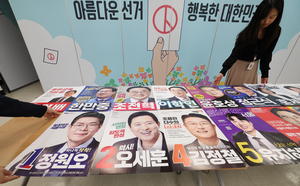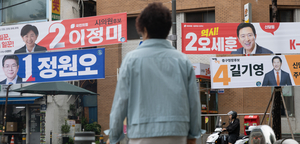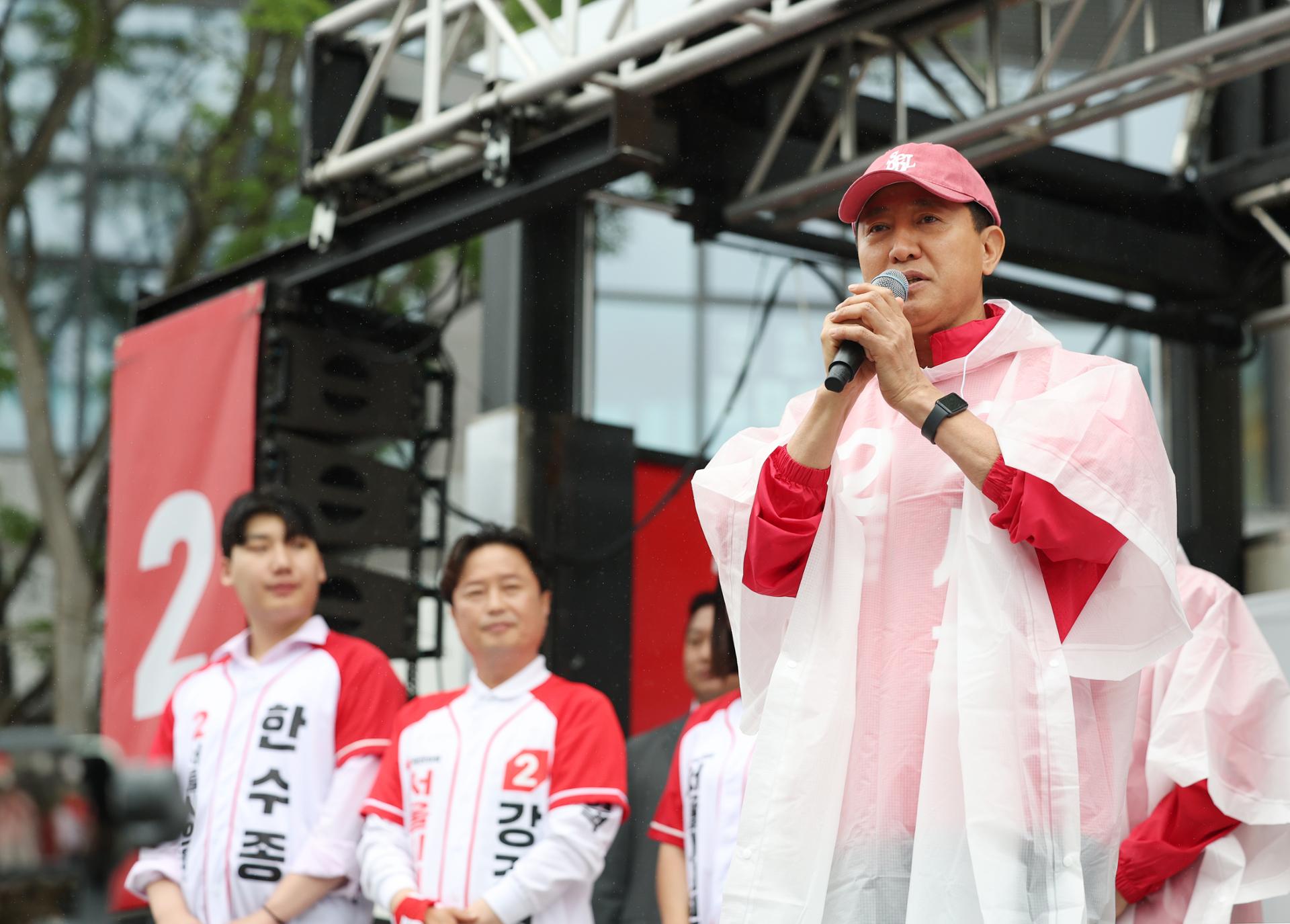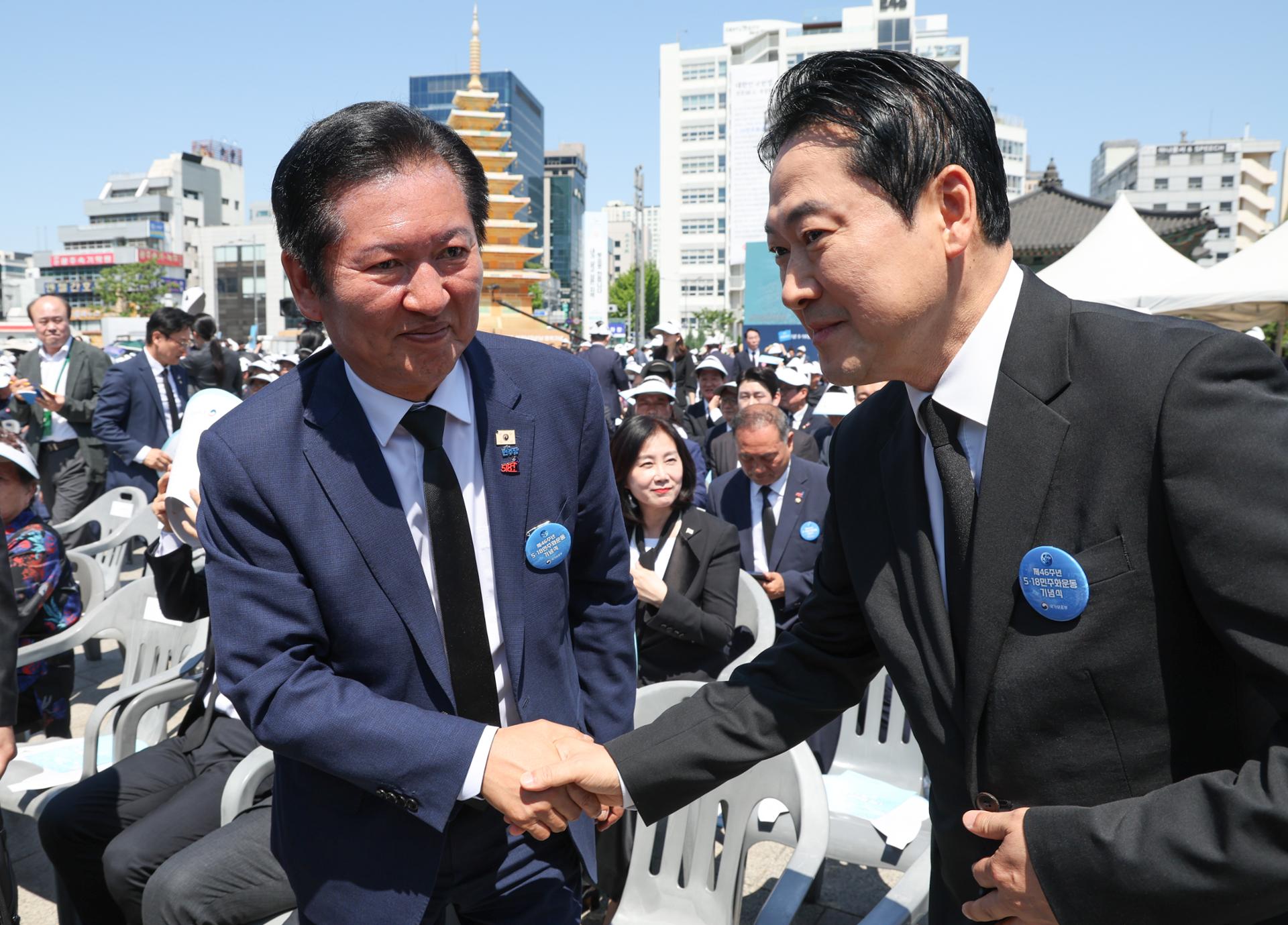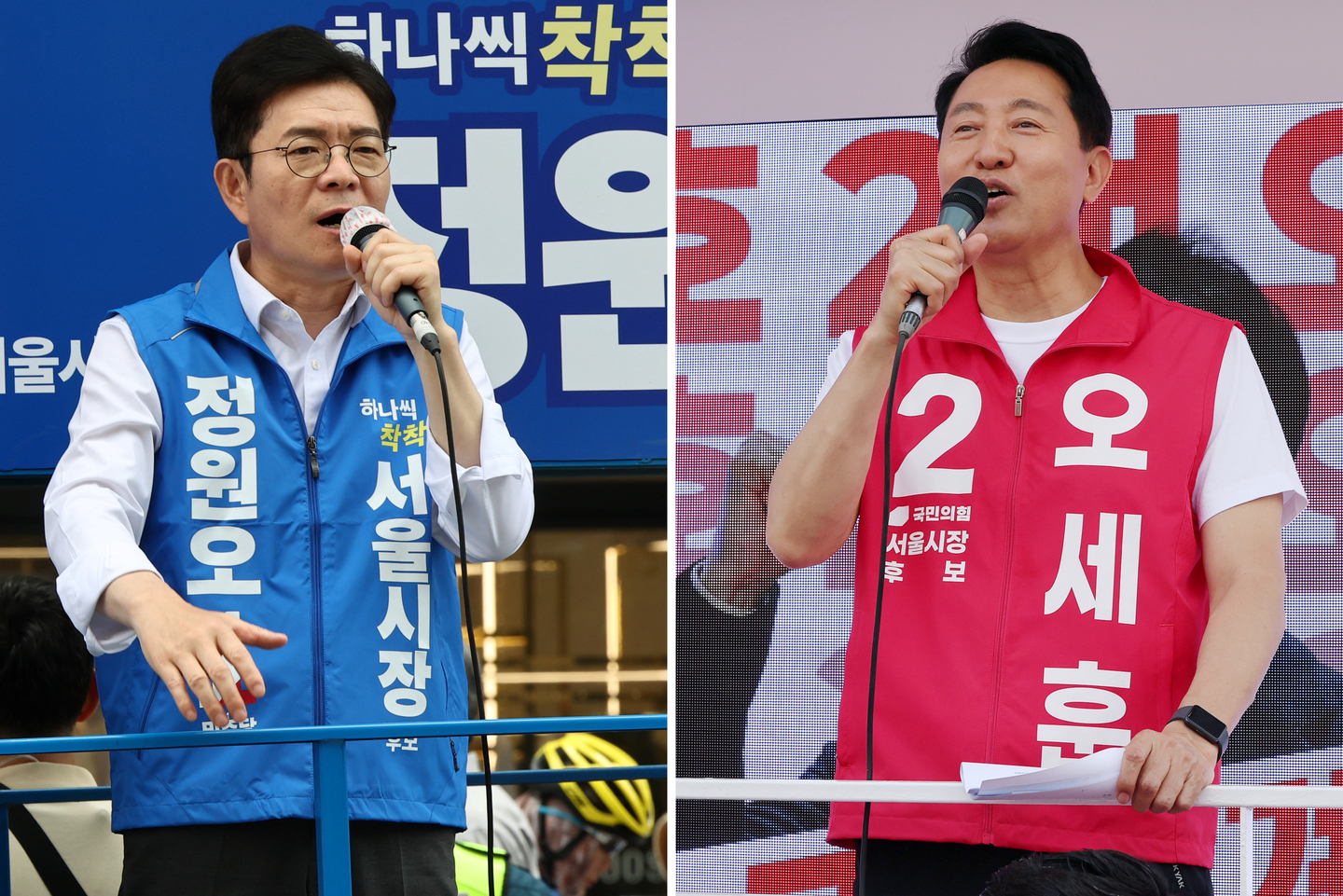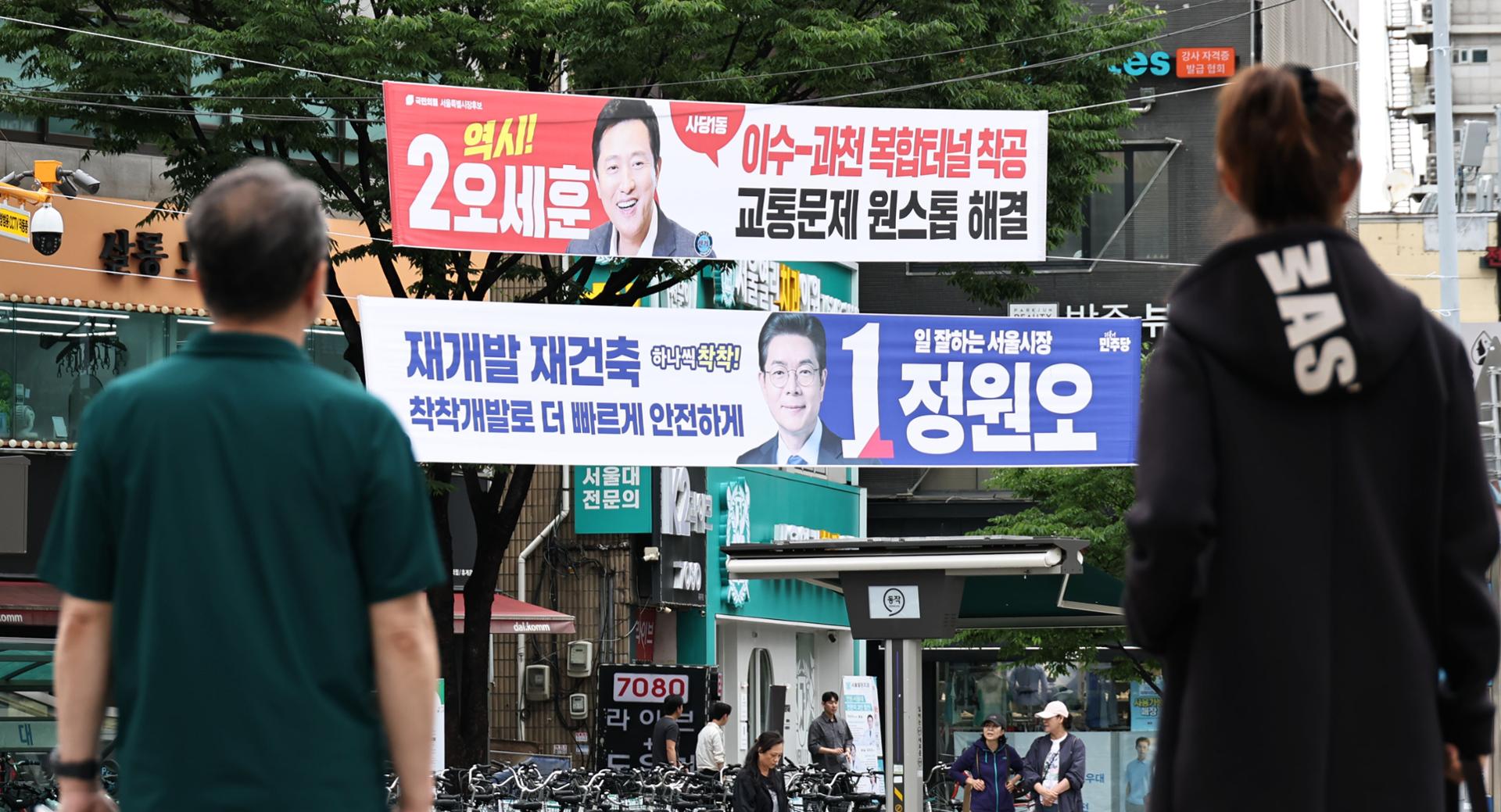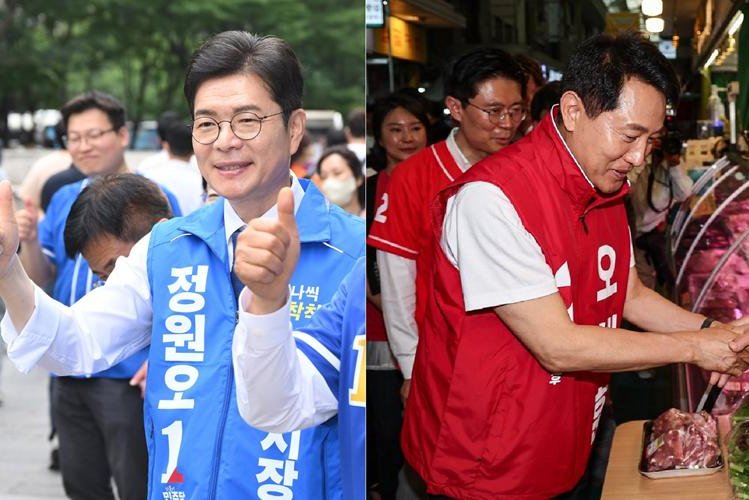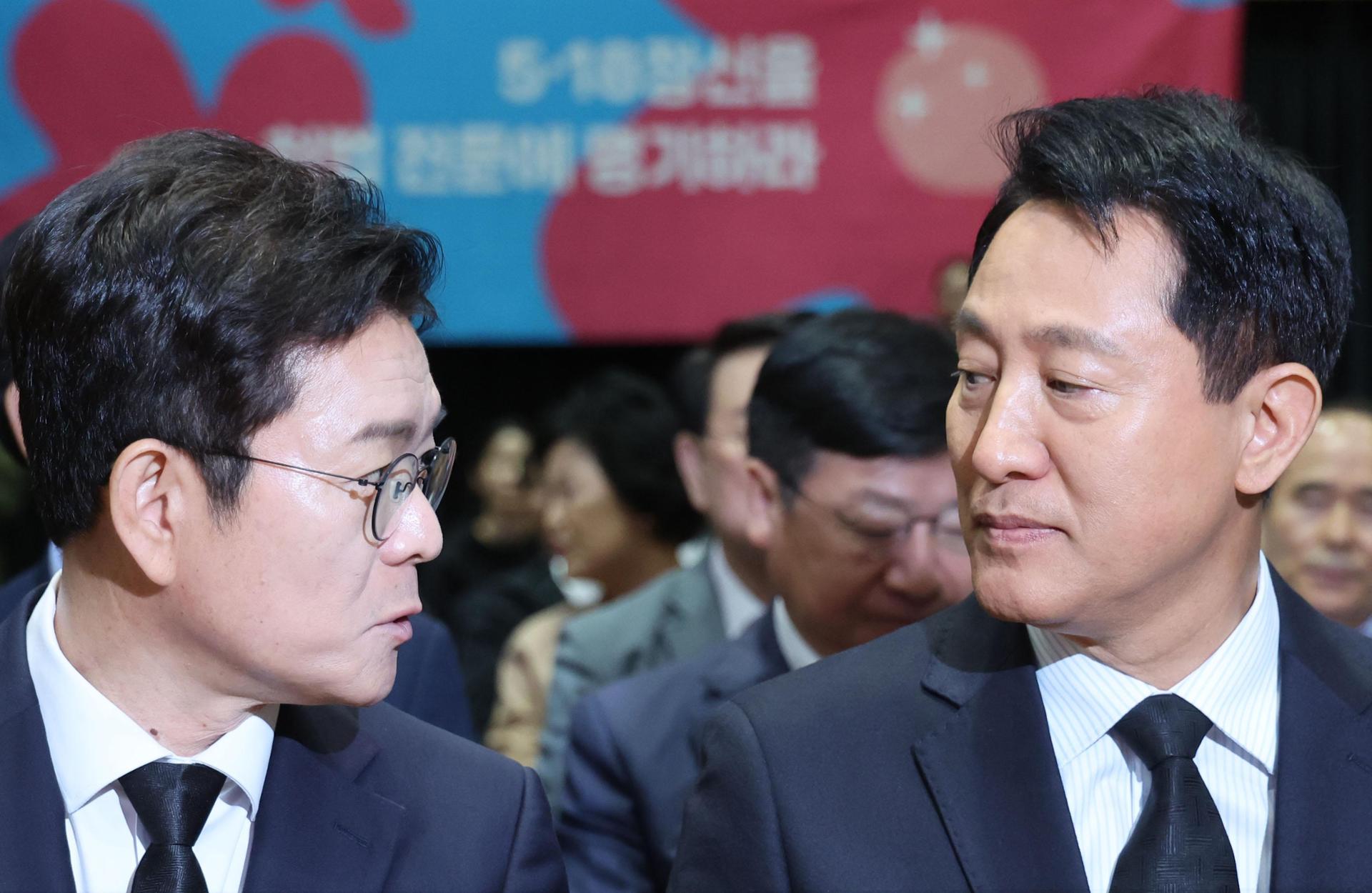
Chong Won-o, left, the Democratic Party of Korea's Seoul mayoral candidate, and incumbent Mayor Oh Se-hoon, his People Power Party rival, talk during a ceremony held to mark the 46th anniversary of the Gwangju pro-democratization movement at City Hall in Seoul, Monday. Newsis The campaign period for the June 3 local elections and parliamentary by-elections officially kicked off, Thursday, launching a nearly two-week nationwide race that both the ruling and opposition parties view as crucial to the future course of government.Candidates across the country launched full-fledged voter outreach, with campaigning set to continue through June 2.According to the National Election Commission, as of Wednesday, 7,829 people registered as candidates, of whom 7,820 remain in the race. Voters will elect 16 metropolitan and provincial chiefs, 227 mayors and county heads, 804 metropolitan council members, 2,650 local council members, 16 education superintendents and 14 members of the National Assembly.The governing liberal Democratic Party of Korea (DPK) is casting the elections as a mandate to shore up support for the Lee Jae Myung administration and secure momentum for social and economic reforms.Speaking to reporters on Wednesday, Rep. Jo Seoung-lae, one of the senior members of the party’s central election committee, called the elections a “golden time to complete Korea’s normalization” and pledged to play up the DPK’s strengths to win over voters. He also said it will be important to “sweep away the incompetent remnants of insurrection” from local offices after the illegal martial law declaration by former President Yoon Suk Yeol in 2024.“Local elections are not about checking the central government’s power,” Jo said. “They are elections to decide how to revive each (declining) region, how to shape its vision and what kind of cooperative framework to build with the central government.”Campaign leaders, including Chairman Jung Chung-rae, are launching their official campaign schedule in Seoul, which they see as the most critical battleground.A poll released on Tuesday by Metrix, a pollster, put Chong Won-o, the Seoul mayor candidate of the DPK, at 40 percent and Oh Se-hoon of the People Power Party (PPP) at 37 percent, narrowing what had been a double-digit gap just a few weeks earlier.The same trend has been observed in other cities and regions. In Busan, another significant battleground, support for the DPK’s Chun Jae-soo stood at 44 percent, compared with 35 percent for his PPP rival Park Heong-joon, the incumbent mayor.In Busan’s Buk-A constituency, where a National Assembly by-election will be held, a survey found DPK candidate Ha Jung-woo at 39 percent, PPP candidate Park Min-shik at 20 percent and independent Han Dong-hoon at 33 percent. In hypothetical head-to-head matchups, Ha led Park by 44 percent to 30 percent and narrowly topped Han by 41 percent to 39 percent.The polls, conducted on May 16 and 17, each have a margin of error of plus or minus 3.5 to 4.4 percentage points at a 95 percent confidence level. Further details are available on the National Election Survey Deliberation Commission’s website.Meanwhile, PPP leaders are framing the June 3 vote as a crucial chance to rein in the Lee administration and prevent power from becoming too heavily concentrated in the hands of one party.Early voting on May 30 and 31 will allow citizens and foreign residents who meet certain eligibility requirements to cast their ballots in advance. The government said on Wednesday that it raised the national terrorism alert level from “attention” to “caution” from May 21 to June 4. Authorities say the step is intended to strengthen security and ensure a safe environment for voters and campaign workers throughout the election period.
Campaign officially begins for June 3 elections with 7,800 candidates - The Korea Times
The campaign period for the June 3 local elections and parliamentary by-elections officially kicked off, Thursday, launching a nearly two-week nati...
593 words~3 min read