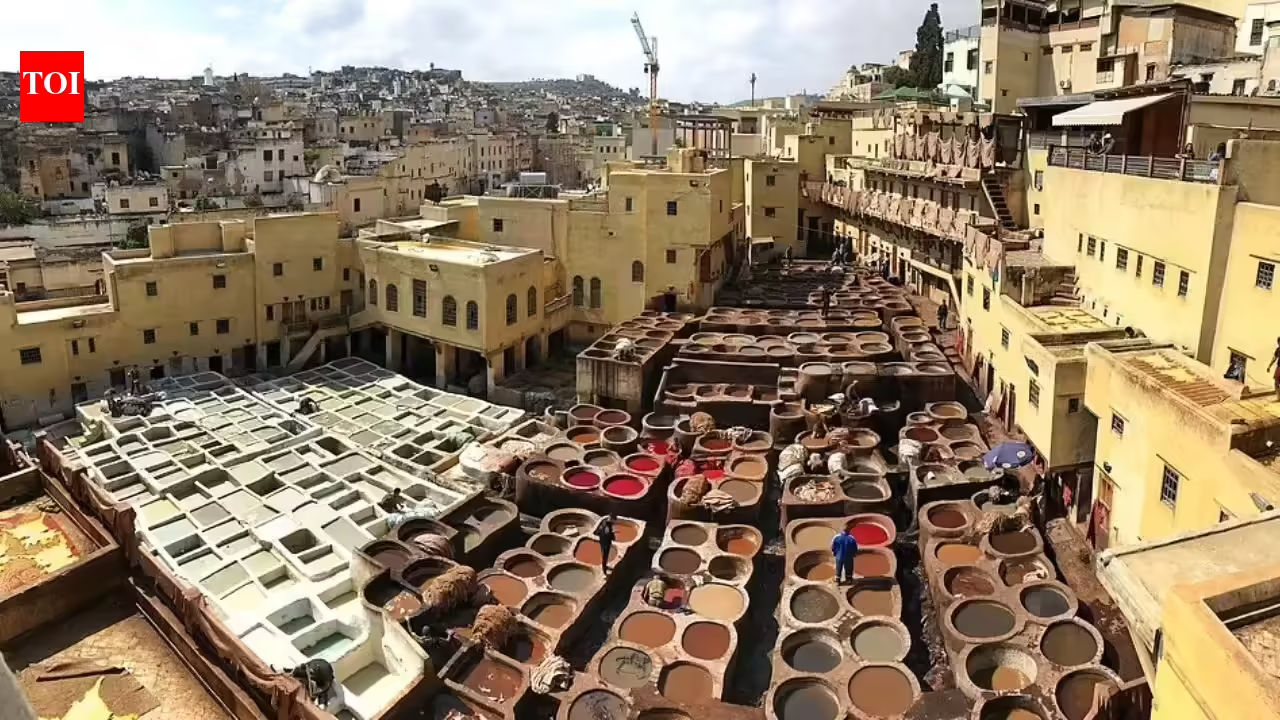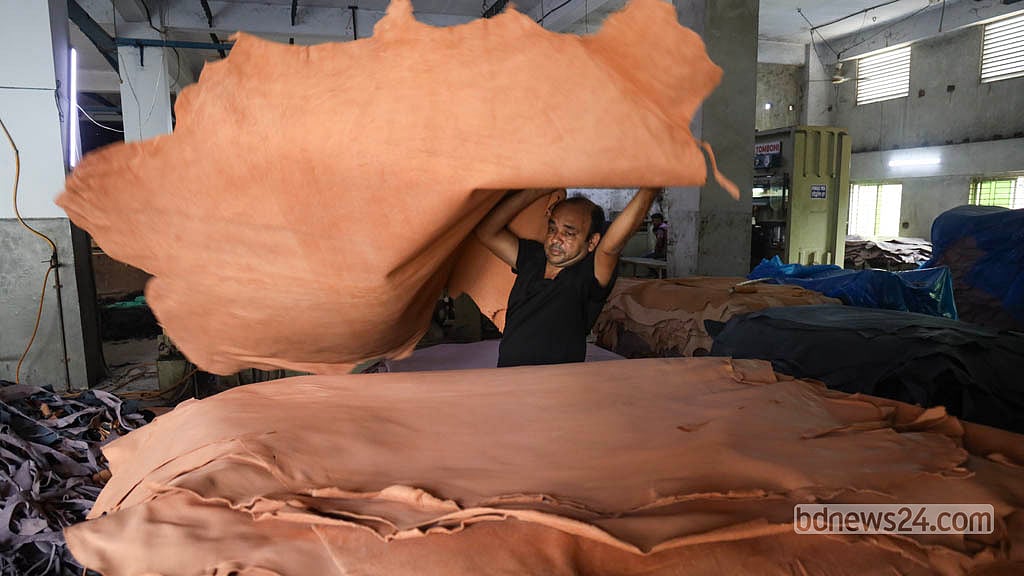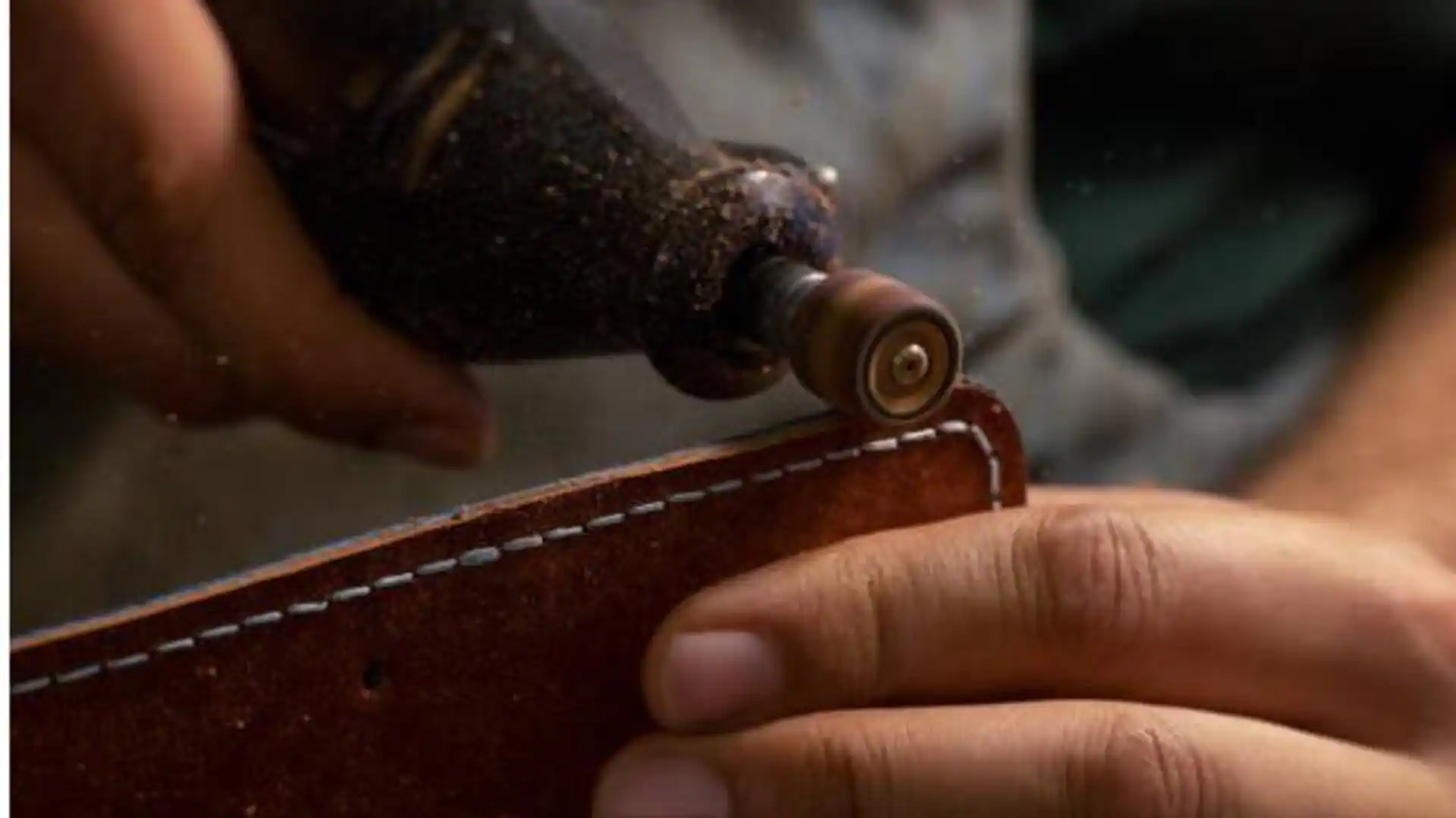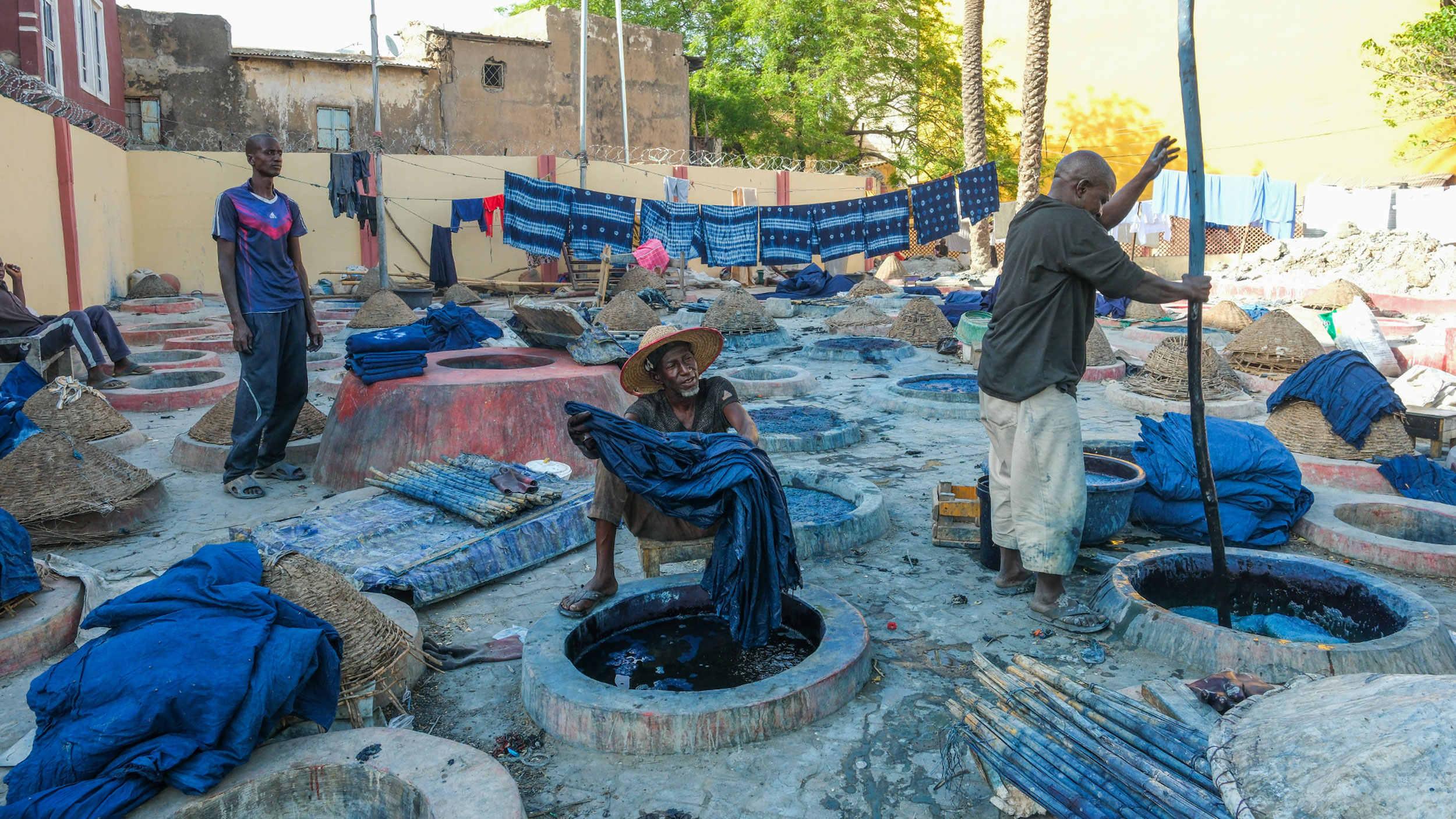
Hunched over a 20-foot-deep pit, Balla, who shared only his first name, soaked a large cotton fabric into the water-filled, 500-year-old concrete hole.He wore a wide-brimmed hat to protect himself from the harsh northern Nigeria sun. Water was rung from the fabric, which slowly took on a deep blue indigo hue.It is a craft that has been practiced for centuries in Kano — an ancient sub-Saharan trading city of 5 million people.Sadi Lawan Ismail, who is the manager of the Kofar Mata dye pits association, where he has worked his entire life, holds up an indigo fabric, Kano, Nigeria, March 18, 2026.Ricci Shryock/The WorldThe longer the fabric is left in the water, the darker blue it becomes, explained Sadi Lawan Ismail, the manager of the association for the Kofar Mata dye pits, where he has worked his entire life.“It depends on the duration of time, soaking in and out, in and out, in and out, [until it’s finished],” he said, adding that the textile is made with three all-natural ingredients.“The [first] ingredient is like a normal ash from firewood, [and also an] indigo plant and potash [a type of salt]. These three ingredients we use to make this natural dye, indigo.”Ismail said that the tradition has been passed down for generations among the Hausa group in Kano.The longer fabric is soaked in water, the darker blue it becomes.Ricci Shryock/The WorldThere are 144 small, round holes spaced throughout the dye pit area. In rooms not far from the pits, women tied off the fabric with bands. That way, when the fabric is dyed, bits of white remain, creating different designs — each with its own significance. Bride and groom designs are used for weddings. The cloud design is traditionally worn during harvest season.But Ismail said that the slow, organic process now faces competition from cheaper, imported products.“The challenge is … that more people [are buying] synthetic ones. The synthetics are cheaper than indigo because synthetics are machine-made, while indigo is handmade. It is very difficult work to make it.” He explained that it takes a lot of time to make one fabric and then you have to make the design. “It is very difficult.”In addition to the shift to synthetic fabrics, Nigerian craftsmen are also facing marketing challenges, with their products often being rebranded as European. Locals are now trying to reclaim their own heritage.In another part of Kano, another type of craftsman also worked in his own ancient textile trade. He shaved the scales off the hide of a snakeskin.Haladu Alhassan runs a 100-year-old tannery operation that produces leather made from goat, sheep, alligator and snake skins.Men work at a tannery that employs around 150 people at its artisanal operation in Kano, northern Nigeria, March 19, 2026.Ricci Shryock/The WorldSounds of workers who soaked the leather in a liquid mixture of ash, sodium chloride and dung filled the neighborhood.Alhassan said that the artisanal leather business employs 150 people and supports hundreds of residents in the surrounding community.Because much of the industry is informal, official figures on how many people work in it and what they earn are hard to come by. While artisanal leather is mostly sold domestically, 11 industrial tanneries in Kano export their wares.Companies such as God’s Little Tannery, in Kano, sell to luxury brands like Gucci and Louis Vuitton. The leather is then marketed as “Italian,” even though it is originally from Nigeria.Nigerian business owners say the labeling of Nigerian leather as Italian absolutely hurts their bottom line.Men work at a 100-year-old tannery that produces leather made from goat, sheep, alligator and snake skins in Kano, Nigeria, March 19, 2026.Ricci Shryock/The World“The craftsmanship, the raw excellence of our art and the heritage behind them are no longer credited to us,” said Isi Omiyi, who owns a Lagos-based brand that bears her name and creates handmade leather bags and shoes. “That poses a big problem. It also shifts perception.”She said that branding Nigerian leather as Italian impacts her business.“Consumers begin to associate luxury with foreign labels even when the foundation of that luxury comes from Nigeria,” she explained. “For local brands like ours, it means we must work twice as hard to re-educate the market and re-establish trust in what is inherently ours.”According to Nigeria’s export promotion agency, the country exports $600 million worth of leather annually. Italy and Spain take in more than 71% of that Nigerian leather. And so, Kano’s products often end up being marketed as European.A worker at the 500-year-old indigo dye pits places bands around the cotton before it is dyed, so that the fabrics will hold designs like the one in the background, Kano, Nigeria, March 18, 2026.Ricci Shryock/The World“The leather industry in Nigeria is rich in history and potential, but it’s not operating at its full capacity. There’s no shortage of quality, raw materials, skilled artisans. Those we have plenty [of]. The challenge lies in how much of that value we retain locally.”“The naming of Nigerian leather as Italian is a problem for us because what happens is that the true origin is erased. What that has done is shift recognition, pricing power and prestige away from the Nigerian producers to foreign markets,” Omiyi said.In Kano, Alhassan made his way among the animals whose hides he would eventually tan.His father taught him the craft, and he plans to teach his son the art of tanning.For him, this leather is 100% Nigerian.
A glimpse into the lives of northern Nigeria’s craftsmen - The World from PRX
In Kano, ancient leather tanneries and centuries-old dye pits are under threat from synthetic fabrics. Meanwhile, Nigerian leather tanners export their quality goods to Europe, where luxury brands then create products marketed as European leather. Some Nigerian business owners are now seeking to reclaim the leather as their own.
899 words~4 min read