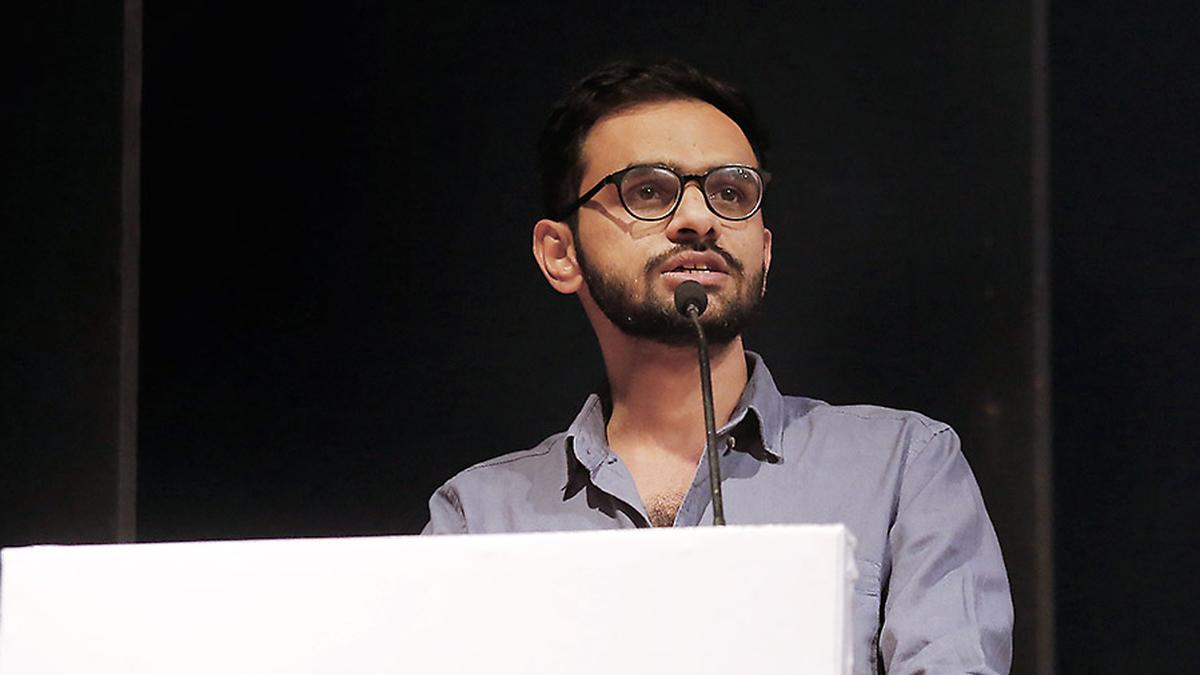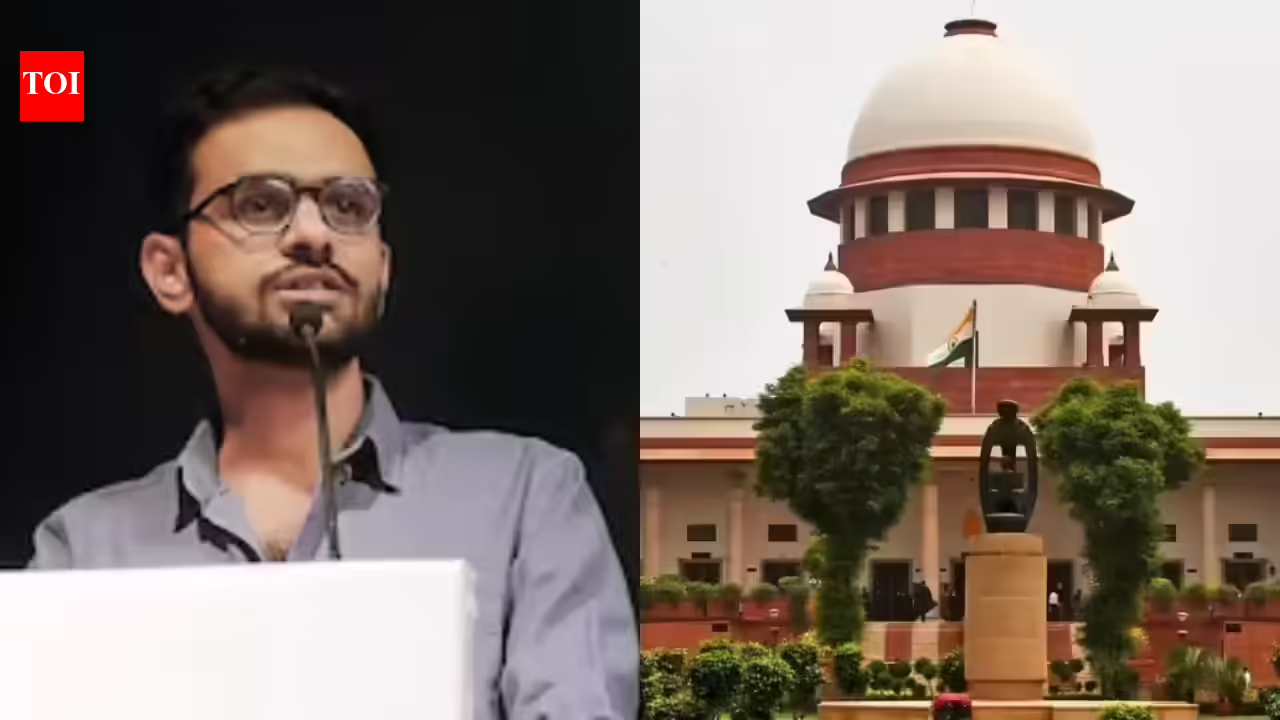
The Supreme Court has once again been drawn into a constitutional debate over the scope of personal liberty under the Unlawful Activities (Prevention) Act (UAPA), after a two-judge bench emphatically reaffirmed earlier this week that “bail is the rule and jail is the exception” even in terrorism-related prosecutions, while the Delhi police rushed to another bench hearing Delhi riots cases pressing for a resolution of the issue by a larger bench.The ruling openly questioned the reasoning adopted by another two-judge bench headed by justice Aravind Kumar in January this year while denying bail to former JNU student Umar Khalid and activist Sharjeel Imam (PTI FILE)The context is the May 18 judgment by a bench of justices BV Nagarathna and Ujjal Bhuyan granting bail to Jammu & Kashmir resident Syed Iftikhar Andrabi in a narco-terror case investigated by the National Investigation Agency. In a strongly worded ruling, the bench held that constitutional courts cannot permit Section 43D(5) of the UAPA -- the provision imposing stringent conditions for bail -- to eclipse the guarantees of liberty and speedy trial under Article 21 of the Constitution.Also Read: Clearing the air on right to bail | HT EditorialThe ruling openly questioned the reasoning adopted by another two-judge bench headed by justice Aravind Kumar in January this year while denying bail to former Jawaharlal Nehru University student Umar Khalid and activist Sharjeel Imam in the alleged larger conspiracy case linked to the 2020 northeast Delhi riots.Appearing before the Justice Kumar-led bench in a connected Delhi riots bail proceedings, additional solicitor general SV Raju has argued that differing judicial views on bail under the UAPA require authoritative settlement by a larger bench.The unfolding judicial disagreement has revived a foundational constitutional question whether statutory restrictions under anti-terror laws override the constitutional commitment to liberty and speedy trial?Constitutional courts versus statutory embargoThe core of controversy relates to Section 43D(5) of UAPA, which severely restricts grant of bail if the court finds the accusations against an accused to be “prima facie true”.For years, investigating agencies relied heavily on the Supreme Court’s 2019 judgment in National Investigation Agency Vs Zahoor Ahmad Shah Watali, which held that courts should not conduct a detailed examination of evidence while considering bail under UAPA. The ruling substantially tightened the bail threshold and was repeatedly invoked to oppose release of accused persons in terror-related prosecutions.However, the legal landscape changed significantly with the Supreme Court’s 2021 ruling in Union of India Vs KA Najeeb, delivered by a three-judge bench.In that case, the court dealt with an accused who had spent more than five years in custody while the trial showed no signs of concluding anytime soon. The bench held that constitutional courts retain the power to grant bail despite statutory restrictions where prolonged incarceration violates Article 21.The latest judgment by justices Nagarathna and Bhuyan strongly reiterates that principle and clarifies that the Najeeb judgment was never meant to be treated as a narrow exception applicable only in extraordinary facts.The court held: “Section 43-D(5) remains subordinate to Article 21 at all times and a constitutional court need not hold back bail to the accused in the garb of Section 43-D(5).”The May 18 judgment repeatedly stressed that constitutional guarantees cannot be subordinated to statutory restrictions. According to the bench, the “rigours” of Section 43D(5) “melt down” once incarceration becomes excessive and trial delays become unreasonable.Importantly, the court declared that the famous principle that “bail is the rule and jail is the exception” is not merely a procedural concept flowing from criminal law statutes but a constitutional doctrine rooted in Articles 21 and 22 and the presumption of innocence.How the court narrowed Watali and criticised later rulingsA major part of the latest judgment is devoted to clarifying what the court described as a serious misunderstanding of the Watali precedent.According to the bench, Watali arose in a very specific factual context where the high court had virtually conducted a “mini-trial” at the bail stage by evaluating the admissibility and reliability of evidence. The Supreme Court intervened in that case because the high court had exceeded the limited scrutiny permissible at the stage of bail.The latest ruling says Watali was never intended to create a near-absolute embargo on bail under UAPA.The judgment therefore criticised the interpretation adopted in subsequent decisions such as Gurwinder Singh Vs State of Punjab and the January 2026 Delhi riots ruling in the Gulfisha Fatima case.In Gurwinder Singh, a two-judge bench evolved what it termed a “twin-prong test”, holding that courts must first determine whether accusations are prima facie true before even considering ordinary bail factors such as the possibility of absconding or witness tampering.Justice Bhuyan, writing the judgment for the bench, rejected this approach outright. “With respect, this test flows neither from the text of Section 43-D(5) nor from Najeeb,” the court observed.The bench warned that if such a formulation is accepted, the State would only need to cross a low prima facie threshold to keep an accused incarcerated for years, effectively converting pre-trial detention into punishment.The judgment observed that Najeeb was actually intended to prevent precisely such a consequence.In one of the strongest passages in the ruling, the court said the later judgments appeared to have “invented and then destroyed” a proposition that Najeeb itself never laid down.“Najeeb was not warning courts against treating incarceration as the sole factor favouring bail. Instead, it was warning against treating the statutory embargo as the sole factor justifying continued detention by ignoring constitutional principles,” it said.Judicial discipline and the importance of bench strengthBeyond bail jurisprudence, the judgment also turns into an important lesson on judicial discipline and precedent within the Supreme Court itself.The bench repeatedly underscored that Najeeb, being a three-judge bench decision, is binding on all smaller benches. “A smaller bench cannot dilute, circumvent, or disregard the ratio of a larger Bench,” it held.This aspect became particularly significant because the bench directly questioned the correctness of the January 5 ruling denying bail to Khalid and Imam -- a rare occurrence in Supreme Court jurisprudence where a coordinate bench rarely expresses disagreement with a recent judgment.The court clarified that if smaller benches disagree with a larger bench ruling, the proper course is to refer the matter to the Chief Justice of India for the constitution of a larger bench rather than evolving divergent interpretations.This is precisely the opening the Delhi Police is now attempting to use.During hearings in the bail pleas of Delhi riots accused Tasleem Ahmed and Abdul Khalid Saifi, ASG Raju argued on Tuesday that the May 18 judgment and earlier rulings reflect conflicting approaches to UAPA bail and therefore require authoritative determination by a larger bench.The submissions are significant because the January 5 ruling, now criticised by the later bench, was delivered by justice Kumar himself, who continues to hear connected Delhi riots matters. The bench has presently granted time to the Delhi Police to study the May 18 judgment before proceeding further.The larger constitutional battleThe constitutional tension emerging from these judgments concerns the balance between national security and personal liberty. The State’s consistent argument has been that anti-terror laws operate differently from ordinary criminal law because the presumption of innocence must yield to national security concerns at the bail stage. ASG Raju reiterated this position before the court, arguing that Section 43D(5) represents a conscious legislative departure from ordinary criminal jurisprudence.The latest judgment, however, strongly resists any suggestion that anti-terror statutes can altogether displace constitutional guarantees.The court expressly held that Article 21 applies “irrespective of the nature of the offence”, and that constitutional courts retain ultimate responsibility to ensure that statutory restrictions do not become instruments of indefinite incarceration.The judgment also highlighted alarming conviction statistics under the UAPA. Referring to data from the National Crime Records Bureau, the bench noted that conviction rates in UAPA cases remain extremely low, particularly in Jammu & Kashmir where the annual conviction rate was said to be less than 1%.“With these kind of statistics staring at our face, the question is, should we continue the detention of the appellant or defer the consideration to a later stage, simply because the charges are serious?” the May 18 judgment asked.This reasoning reflects a growing judicial concern that prolonged pre-trial incarceration under special statutes may itself become punitive, particularly where trials move slowly, and conviction rates remain minimal.The present controversy thus marks one of the most consequential judicial debates on liberty and anti-terror laws in recent years.The May 18 ruling does far more than grant bail to one accused. It attempts to reclaim constitutional ground that the court believes has gradually narrowed through subsequent interpretations of Section 43D(5) of the UAPA.By reaffirming that “bail is the rule and jail is the exception” even in UAPA prosecutions, the bench has sought to restore the primacy of Article 21 over statutory restrictions. Equally significantly, it has reminded lower benches and courts that constitutional guarantees cannot be diluted indirectly through narrower readings of binding precedent.At the same time, the Delhi Police’s push for a larger bench indicates that the legal battle is far from over. The Supreme Court may now have to conclusively settle whether prolonged incarceration and delayed trials should override the stringent statutory barriers to bail under anti-terror laws.
Bail, liberty, and a Supreme Court split in reading UAPA
The Supreme Court said the later judgments appeared to have “invented and then destroyed” a proposition that the Najeeb verdict itself never laid down | India News
1,527 words~7 min read