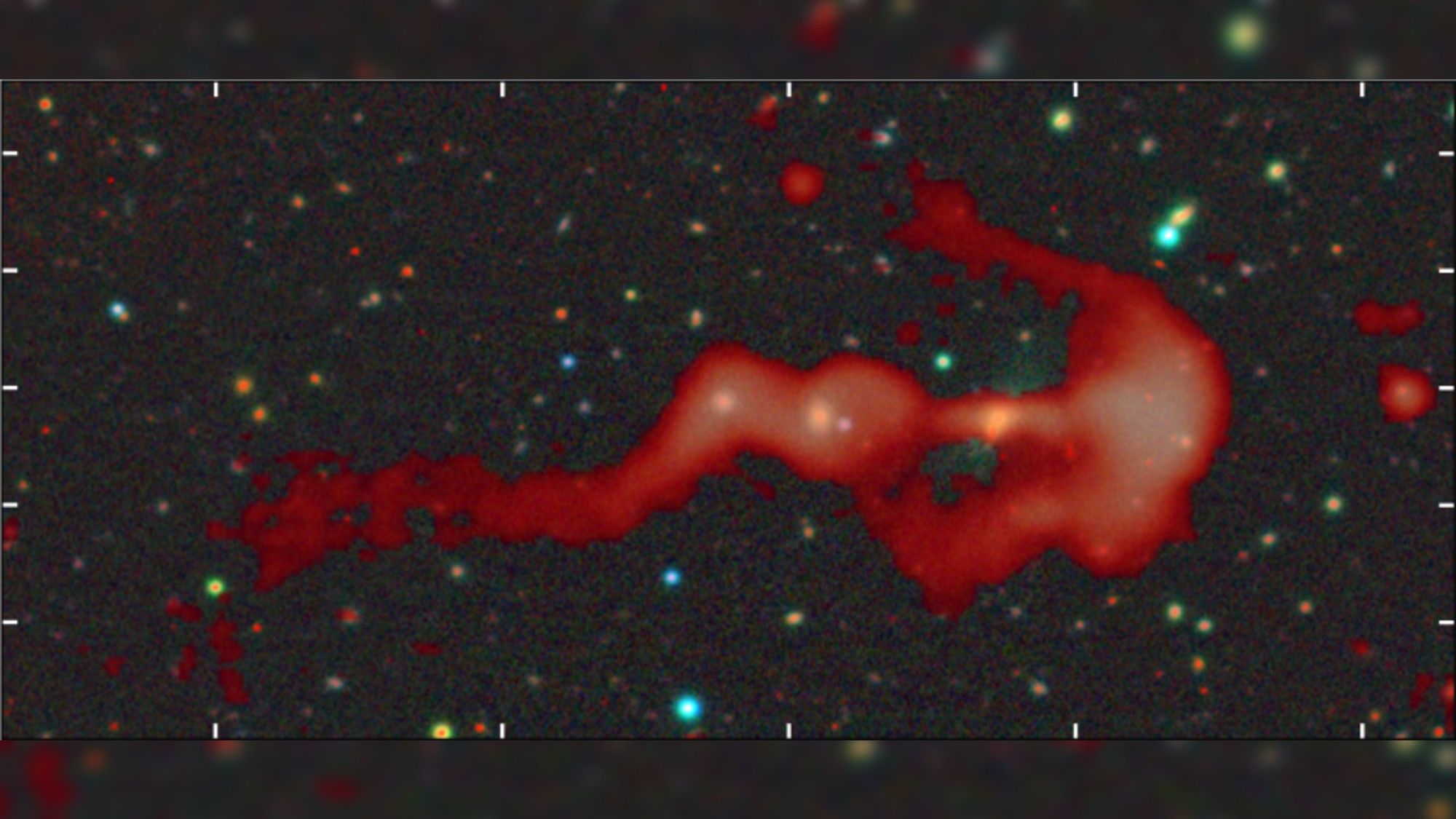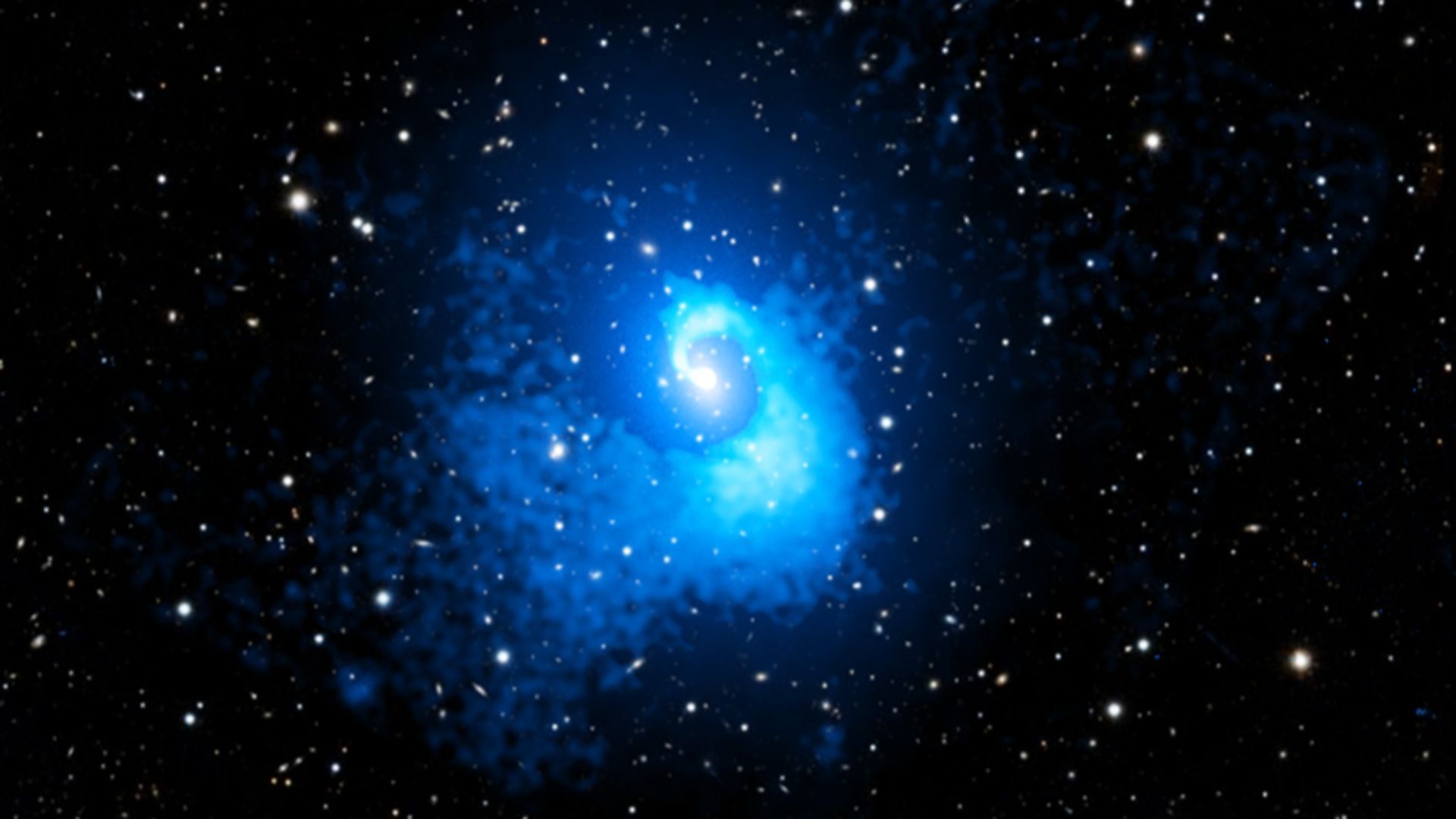
New Chandra observations reveal that galaxy cluster Abell 2029 still bears the scars of a violent collision that occurred 4 billion years ago.
(Image credit: X-ray: NASA/CXC/CfA/C. Watson et al.; Optical: PanSTARRS; Image Processing: NASA/CXC/SAO/N. Wolk and P. Edmonds)
For decades, astronomers have described the galaxy cluster Abell 2029, a vast city of galaxies in the Virgo constellation, as "the most relaxed clusters in the universe." But beneath that placid exterior, scientists have now found, the cluster is still reverberating from an ancient cosmic collision.New observations from the Chandra X-ray Observatory suggest giant "sloshing" motions in the cluster's gas — triggered by a merger roughly 4 billion years ago — may help heat the cluster alongside energy released by the supermassive black hole at its center. That could help explain why the gas in galaxy clusters does not cool as quickly as expected, the researchers say. But of note, Chandra's new data also revealed massive substructures still visible today, including gigantic spirals, shock fronts and waves of superheated gas rippling through the cluster, according to a statement released last week by Chandra X-ray Observatory.Hosting more than a thousand galaxies, Abell 2029 is among the largest known galaxy clusters, which are sprawling collections of galaxies bound together by gravity and immersed in enormous clouds of heated gas. At its center sits IC 1101, a colossal elliptical galaxy estimated to span nearly 6 million light-years across, making it one of the largest galaxies ever discovered.Astronomers have since the 1990s regarded Abell 2029 as unusually tranquil. Most recently, two studies published in 2025 using the XRISM observatory, which studies the universe in X-ray light, found extremely low levels of turbulence in the superheated gas filling the space between galaxies, suggesting the cluster had not experienced a recent major disruptive interaction such as a merger.But a third XRISM study, also published in 2025, hinted that all was not entirely calm.Researchers at that point had detected cooler pockets of gas embedded within the hotter cluster atmosphere — possible leftovers, they said, from ancient "sloshing" motions triggered by a long-ago collision.The new Chandra X-ray Observatory observations add fresh evidence to that more turbulent history, revealing that — like ripples lingering long after a stone strikes water — the scars etched into Abell 2029's superheated gas continue to tell the story of a violent cosmic encounter billions of years ago.Using 21 new X-ray observations collected in 2022 and 2023, along with archival data gathered earlier, Watson and her colleagues traced enormous structures hidden within the cluster's hot gas, including one of the longest continuous "sloshing spirals" ever observed, the study reports. The spiral stretches nearly 2 million light-years from the cluster's center.The observations also revealed a concave "bay"-like depression south of the cluster core, a broad "splash" of cooler gas extending southeastward, and evidence of a possible shock wave propagating through the cluster outskirts, according to the paper.