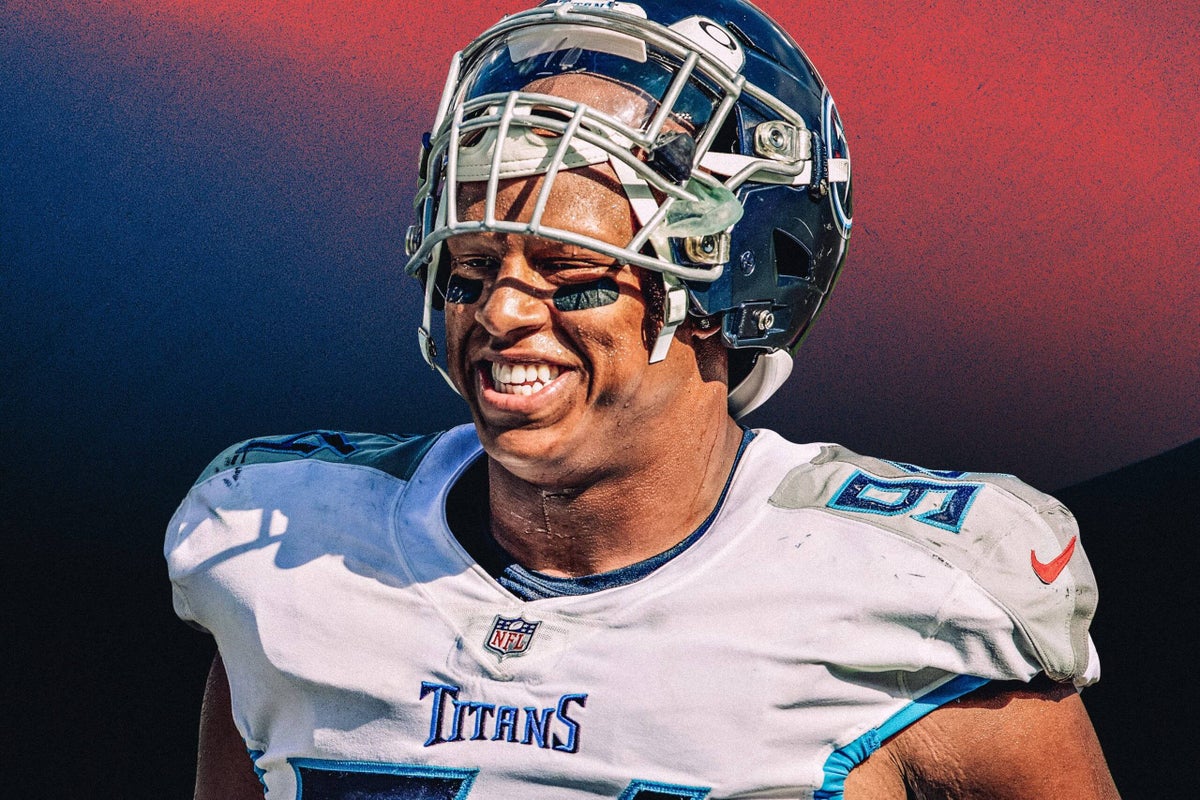
This story is part of Peak, The Athletic’s desk covering the mental side of sports. Sign up for Peak’s newsletter here.Not long after Jack Crawford retired from the NFL, he walked into a comedy club in Brooklyn. He had thought about this moment many times, but now that it was here, he tried to come up with any excuse to get out of it.I’m not ready. I’m not prepared. I need more time.His 6-foot-5 body almost shook with nerves. The open mic was in a tiny room on the second floor of a Bushwick comedy club. Crawford thought it looked like a classroom or an office space — anything but a comedy club. He added his name to the bottom of the list, then took a seat. There were maybe 12 other people in the room.“It was so underwhelming and dead,” he said.In college, Crawford played defensive end in some of the biggest stadiums in the world: Michigan, Ohio State and Penn State, his alma mater. Over 10 NFL seasons, he sacked Drew Brees, Tom Brady and Eli Manning while millions watched at home. He used to get nervous the night before every game. However, on that April day in 2023, more than two years after his final NFL game, Crawford felt nerves unlike any he had experienced previously.He had wanted to try standup for a long time, ever since he started going with his wife to a comedy club in Atlanta near the end of his NFL career. The more they went, the more Crawford saw parallels between standup and football.Both are rooted heavily in results: You prepare, you practice, but in the end, you are judged by how you perform in front of an audience. Both force the performer to focus on a singular moment, to be fully present. And both offer instant, visceral feedback.Over time, Crawford’s seed of interest in standup grew into a desire. He had to try it at least once. He watched YouTube videos and worked on material, but for a long time, fear kept him from actually attempting a routine. His mind dreamed up improbable scenarios: Someone who saw him perform would then bump into him on the streets of New York City and harshly judge him.The only reason he went to the club that day was a friend who had ambushed him after lunch: There’s an open mic starting soon down the street. Let’s go.When his name was finally called, Crawford walked to the front of the room — there was no real stage — and grabbed the microphone from the stand. To set expectations low, he announced in his British accent (he grew up in northwest London) that this was his first time performing. That drew polite applause from the handful of people there.And then, for the next five minutes, he bombed.Crawford doesn’t remember any of his jokes, although he is certain that none of them were actually jokes. At one point, something he said earned a half smile from someone in the crowd, but the rest of the time … crickets.When he finished, he put the mic back in the stand and walked outside. “It’s like you come out the other end of some kind of storm that you just couldn’t see out of,” he said. “I just felt this huge relief.”At first, it was because he had conquered his fear, and after a while, he found the courage to perform again at another open mic. “Because I knew I could get through it,” he said. “I knew it wasn’t going to be that bad.”Eventually, he realized that what he experienced was more profound and meaningful than simple relief. Let’s call it the open mic effect.“If you expose yourself to something that feels so scary,” he said, “it just has an effect on you. It just reminds you that nothing really matters that much. Nobody’s thinking about you that much. No one cares about you that much. So don’t take yourself too seriously.”The fear he felt before his first open mic, the worries about feeling judged and embarrassed? In the end, none of them were nearly as meaningful as he had made them out to be.The feeling of relief he initially experienced turned into a core belief, one he thinks can help anyone better deal with fears of failure, embarrassment and judgment: Everyone should do an open mic.Crawford chases Packers quarterback Aaron Rodgers during a game in 2020. (Photo by Dylan Buell/Getty Images)When Crawford played football, he saw it time and again: Players with all the physical tools and ability who were held back by fear of failure.He considered himself among them.“In practice I was like the All-American,” Crawford said. “But in games, I would freeze.”At 6-foot-5 and 288 pounds, Crawford was massive even by the massive standards of NFL defensive ends. He was quick, athletic and smart. He worked hard and knew the playbook. In practice, he could watch coaches teach drills and give instruction and implement it just as they had demonstrated.
A former NFL player did a disastrous open mic. He thinks everyone should try it
“If you expose yourself to something that feels so scary,” former NFL player Jack Crawford said, “it just has an effect on you."
2,248 words~10 min read