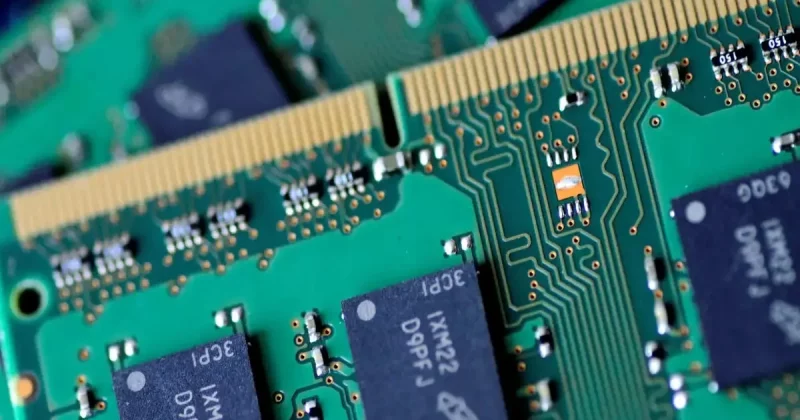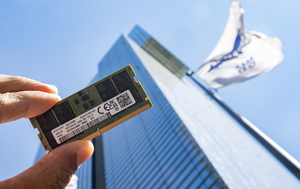
Fight over HBM profits exposes tensions between Samsung’s integrated chip strategy and performance-based pay system A Samsung DDR5 DRAM chip is shown in front of the company’s Seocho office in Seoul on April 7, when Samsung Electronics reported record preliminary first-quarter sales and operating profit, driven largely by memory chips. (The Korea Herald/Im Se-jun) Samsung Electronics has spent years selling the AI chip market a promise of integration.Memory. Logic design. Foundry manufacturing. Advanced research. One company for customers trying to secure the chips behind artificial intelligence.Inside Samsung, that same promise has become difficult to price.The last-minute mediation that collapsed Wednesday did not break down simply over the size of a bonus. By the end, the fight had narrowed to how far profits from the AI memory boom should travel inside Samsung’s Device Solutions division, which includes Memory, the profit engine behind DRAM, NAND and high-bandwidth memory; Foundry, its contract chipmaking business; and System LSI, its logic-chip design arm.Foundry and System LSI have long been viewed as loss-making units, although Samsung does not disclose DS earnings by business unit.Samsung refused to sign a mediation proposal accepted by the union, saying the demand would give excessive rewards to loss-making units and undermine its principle that “reward follows performance.” The union said it would begin its planned strike Thursday.Employees pushing for broader sharing see the dispute differently. To them, Samsung cannot sell itself as one integrated chipmaker and then pay as if advanced chips were built within tidy business-unit walls.The ratio that broke the talksThe sticking point was a ratio.The union sought a 70:30 split for a special DS bonus pool, with 70 percent shared across the division and 30 percent distributed by business-unit performance. Samsung had earlier been reported to favor 40:60, putting more weight on individual business-unit results. By the final mediation stage, reports put Samsung’s position closer to 60:40. Samsung union leader Choi Seung-ho leaves a mediation room in Sejong on Wednesday after labor talks with management collapsed ahead of a planned strike. (Yonhap) That movement still did not close the gap. A larger common pool would give Foundry, System LSI and shared research organizations a bigger claim on gains booked mainly in Memory. A larger business-unit pool would keep more of the reward in the unit generating the profit.For some employees, however, the accounting line misses how the work actually happens.One employee at a DS process design research organization said Samsung tells customers its AI chip edge comes from being an integrated semiconductor company. But in bonus talks, the employee said, “that integration suddenly disappears,” with HBM treated as though “Memory built it alone.”HBM is the clearest example. It is sold as a memory product, but employees point to the base die beneath the memory stack, a logic component that helps control data movement, as evidence that the product is not Memory’s work alone.The same employee said HBM “does not come only out of the memory business unit,” citing logic design from System LSI and foundry-side manufacturing capability as part of the technology Samsung promotes externally.The employee also said the issue extends beyond HBM. In a memory upcycle, even conventional DRAM gains can depend on earlier process development, yield improvement, equipment stability and technology transfers that do not always sit inside the profit center receiving the reward, he added.When the badge matters more than the workThe dispute is not limited to Memory versus Foundry and System LSI.A researcher at Samsung’s Semiconductor Research Center, a DS-wide research and development organization under the division’s chief technology officer, said the bonus system has long made "affiliation matter more than contribution." The center develops advanced technologies before they are transferred to business units for mass production.An engineer can move from Memory to the research center to work on next-generation DRAM or HBM, the researcher said, then later be told the bonus is lower because “the badge says research center, not Memory.”That point complicates both sides of the argument. The research center is not a loss-making business unit like Foundry or System LSI. It is a common R&D organization meant to serve future DS products. Yet employees there say they can still fall outside the most profitable business unit’s reward structure, even when they work on technologies that later support Memory.Management’s concern, however, is not groundless, a local semiconductor industry official told The Korea Herald.“Integration does not erase P&L,” the official said. Cross-unit engineering cooperation does not mean an entire business unit took part in the whole development process, he said, and an overly equalized bonus pool could weaken each unit’s “competitive discipline.”The official said Foundry still has to continue to win customers such as Tesla and Nvidia, while System LSI has to prove its own logic-chip competitiveness through products such as Exynos. If Memory’s upcycle is shared too evenly, he said, those units could lose pressure to stand on their own.
Who built Samsung’s AI boom? Bonus split divides chip unit
Samsung Electronics has spent years selling the AI chip market a promise of integration. Memory. Logic design. Foundry manufacturing. Advanced research. One com
809 words~4 min read