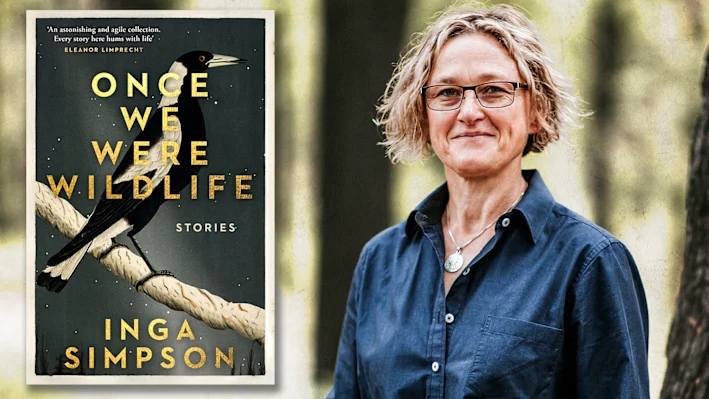
May 20, 2026 — 3:45pmInga Simpson’s latest book comprises 11 stories and one poem: the skein that connects them all is a dedication to the natural world. Simpson has often written about the environment in her fiction: The Thinning explores extinctions and a solar eclipse; Nest is set in a subtropical hinterland, The Last Woman in the World surveys a burning world and Where the Trees Were touches on Indigenous land rights and conservation. Her memoir Understory tracks her move from suburban Brisbane to the NSW coast to live among trees. Even Simpson’s illustrated books for children (The Book of Australian Trees and The Peach King) are paeans to nature.It’s no surprise then that Once We Were Wildlife continues to elaborate on the theme and proves Simpson is just as skilful at navigating the limits of a short story as she is the more generous possibilities of a novel.Australian writer Inga Simpson has a deep interest in the natural world.Red Berry PhotographyAs restless as migratory birds, Simpson’s tales roam widely. There are short stories set in Tasmania, New Zealand and India, with locations that extend across sea, sky, lakes, mountains, forest and desert and along alpine valleys, quartz caves and national parks. The variety of creatures that populate these places is similarly diverse: from Bengal tigers to herons, platypuses to eagles, moas to pademelons. A few stories focus on photographers hoping to capture that elusive shot of a wild beast in its natural habitat, or the majestic Huon pine in the right light. “Blue Crane” and “Sea Wolves” take on a fantastical spin after their respective narrators’ intense identification with the animal in question.Nature is variously depicted as restorative, transformative and ferocious, both calming and unpredictable. Death makes a surprising calling in several stories, not in a jump-scare manner, but in a way that makes narrative sense and has structural integrity.The title tale is the longest in the book and maps the trajectory of a couple’s love story. It’s not the only one that focuses on a fraying intimate connection; the opening story also follows the ebb and flow, the cresting and plummeting of a relationship working at full capacity only to drift towards the rocks: “After living life so deeply, gulping it from dawn to dusk, chasing down every wave, the biggest waves, the best waves, now they were caught in the wash”.The luminous collections comprises 11 stories and one poem.Simpson likes to play with transitions: in climate conditions, and in interpersonal communications and emotions. Extreme situations can be catalytic for change, and a poacher can turn into a protector, for instance. The natural environment is more than just pretty or treacherous background scenery for her stories; many a time, it’s a powerful character in its own right and wields great influence on those who seek out its crannies and vistas.This book continues Simpson’s lifelong devotion to monitoring the ecosystem in all its weathers, and the animals – humans and otherwise – that live together, sometimes harmoniously and other times with distrust. Ecological disasters are also covered, from bushfires and endangered animals to the melting of Antarctica. The stories in Once We Were Wildlife pulse with movement; they are visceral and sensitive to the changing colour of day and night. As with all her work, Simpson’s lyrical eye is attuned to the smallest flapping of wings and the quietest rustle in the undergrowth.Once We Were Wildlife by Inga Simpson is published by Hachette ($30). Thuy On is an arts journalist, critic, editor and poet.From our partners
This new short story collection will change how you see the world
Once We Were Wildlife proves Inga Simpson is just as masterful writing short fiction as novels.
587 words~3 min read