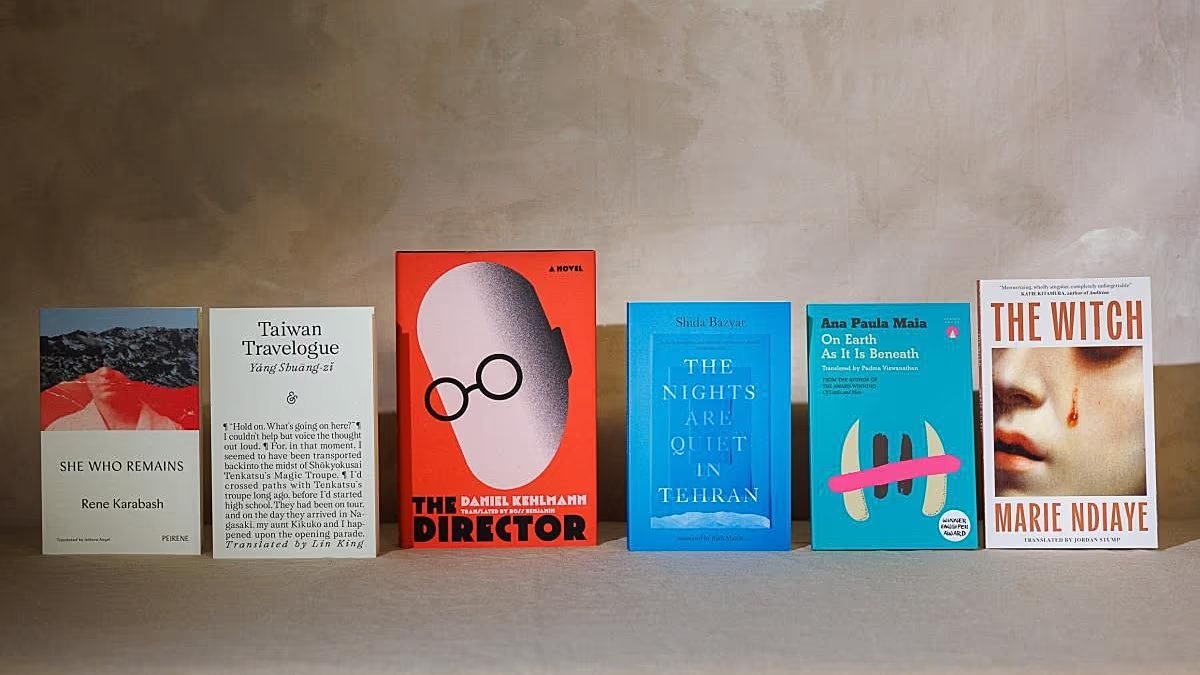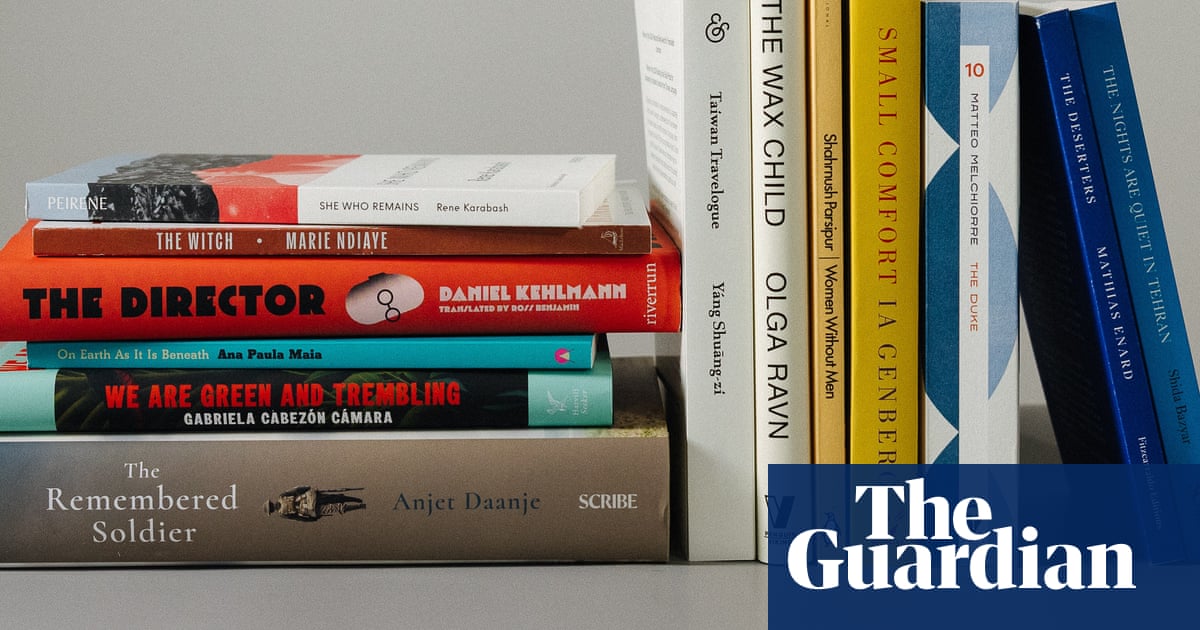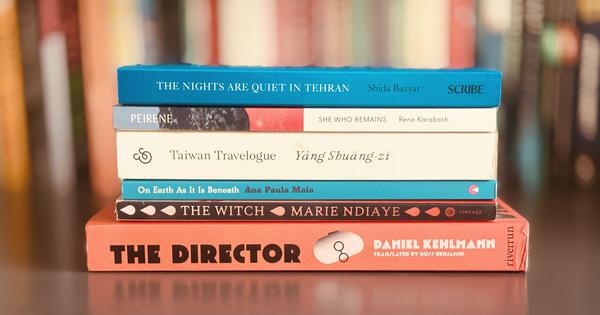
The 2026 International Booker Prize shortlist of six novels promises an expansive reading experience. From five languages and four continents, the shortlist is a reasonable starting point for discovering the many remarkable works of translated fiction that are published in the UK (and elsewhere) throughout the year.The books were originally published in these five languages: Bulgarian (She Who Remains), French (The Witch), German (The Nights Are Quiet in Tehran; The Director), Mandarin Chinese (Taiwan Travelogue) and Portuguese (On Earth As It Is Beneath).Two debut novels (The Nights Are Quiet in Tehran; She Who Remains) feature alongside a novel that was published in its original language 30 years ago (The Witch). Author/translator pairings who have previously been nominated for the International Booker Prize are The Director’s Daniel Kehlmann and Ross Benjamin (shortlisted in 2020) and The Witch’s Marie NDiaye and Jordan Stump (longlisted in 2016). Translator Ruth Martin of The Nights Are Quiet in Tehran was longlisted in 2020. Five of the six authors and four of the six translators are women. The shortlist reminds us once again that when literary awards are opened up to languages from around the world, they automatically become diverse and inclusive.Experiment with formThis year’s shortlist is most remarkable in its ingenuity in remembering some of history’s most decisive moments and how they are remembered by posterity. The Nights Are Quiet in Tehran spans the 1979 Iranian Revolution and its after-effects on a young family; The Director is a fictionalised biography of director GW Pabst, who briefly made Nazi propaganda movies; in Taiwan Travelogue, a Japanese writer’s travels through colonised Taiwan in the 1930s bring to the fore the fraughtness of the coloniser-colonised relationship, even in seemingly well-meaning friendships; while in On Earth As It Is Beneath, the reader is suspended in the yard of a Brazilian prison colony where life must be prized out of death’s jaw every day. While She Who Remains might not be addressing a single point of historical shift, it studies the price women and queers pay in traditions that enshrine patriarchal, heteronormative values as the law. The most inward-facing novel in the shortlist is The Witch, which, through the tribulations of a woman’s role as a daughter, mother, and wife, is a damning commentary on gendered expectations.What also stands out is the inventiveness of the craft. Of this, Taiwan Travelogue is the best example. Written as a travelogue–memoir–novel, with a rather complicated backstory of its own, the novel repurposes the travelogue genre to foreground the lives of the colonised even when the story is being told by the coloniser. While I did find it tiresome at times, I must admit that the novel is a rare experiment with genres.She Who Remains is another audacious play with form, with many passages reading like prose poetry. The text foregoes punctuation and flows in a mad stream of consciousness, imitating the in-between place that the narrator occupies in her own life – that of neither a man nor a woman, following strict laws of chastity she has imposed upon herself. There are no natural pauses in the story, and the reader has to decide when to stop – a small illusion of control as the story rapidly tornadoes to a catastrophic end.The Director, a fictionalised biography of a celebrated Nazi-era filmmaker, was especially illuminating to read in today’s India when propaganda has proven itself as a lucrative business opportunity. The novel offers two sides of a story – that of a director trapped in the regime’s web and that of his own convictions that stop him from registering a more vocal protest. It is both compliance and conviction that create propaganda, and even our greats are susceptible to it. Having a real person at the helm of this story humanises the conundrum of such self-preservation.The multi-voice structure of The Nights Are Quiet in Tehran gives a first-person perspective of the Iranian Revolution, which most certainly changed Iran as the citizens knew it. The political exile exacerbates the pining for home, but as the reader follows a man, a woman, and their children over the course of three decades, they see how short-lived collective memory can be – the children already having outgrown their “motherland” and the revolution is just a footnote in their lives.In On Earth As It Is Beneath and The Witch, the reader travels to literal and emotional prisons. Though it might not seem that way, these two novels set out on a very similar mission – to reveal what humans resort to when their backs are against the wall. On Earth As It Is Beneath employs realist horror for the effect while The Witch does so through elements of fantasy. It is hard to choose what fate is worse – the lifelong exploitation of the unprivileged or the longstanding tragedies of unhappy families.A range of queer experiences also finds a place in Taiwan Travelogue, while She Who Remains, of course, is a more frank exploration of it. The friendship between two women in Taiwan Travelogue hints at homosexual affection, though there is no explicit mention of it – which is keeping in period it is set in and its cultural makeup. The conflict that arises is more interpersonal in Taiwan Travelogue than it is social, as it is in She Who Remains.A win for translatorsThere are five women on the shortlist – the first time women have been nominated in such overwhelming majority – and this sits well in the Prize’s determination to recognise historically marginalised voices. The shortlist successfully dismantles sexist misconceptions about women’s writing, showing that women have consistently written about the many discontents that plague humanity. The newer authors are surprising in their creativity (Yáng Shuāng-zǐ, Shida Bazyar, Rene Karbash, Ana Paula Maia) while the more seasoned ones (Daniel Kehlmann, Marie NDiaye) can always be trusted with writing fine books that stand the test of time.The translators, too (four of them women), are remarkably adroit. I was especially envious of and awed by Padma Viswanathan for her translation of On Earth As It Is Beneath from the Portuguese. Her hand is so assured and yet so light that I savoured every sentence twice – once as a reader, and again as a writer. Lin King, translator of Taiwan Travelogue, has juggled with three languages (Japanese, Chinese, and Taiwanese Hokkien), shaping them into a cohesive whole in English. This is no mean feat. Jordan Stump’s translation of The Witch from French is of unparalleled beauty. Not a word is out of place and every sentence is rigorously mapped in his translation. Such elegance can only come from a lifetime of practice.This year’s longlist was especially competitive and some fan favourites didn’t make the shortlist – for many, their yearly reading project comprises the Prize lists. The passionate conversations online reaffirmed my belief that readers are still plentiful, and that there is an insatiable appetite for good literature. When the Prize season ends, these conversations are what I miss the most. As Shehan Karunatilaka said in an interview with Scroll, any title nominated for the Booker is as good as the winner, and this year’s shortlist is a testament to it. It is quite impossible to choose the “best of the best”, but the biggest winners of this annual Prize remain the readers who look forward to discovering new languages and writers who become portals to new worlds.
The 2026 International Booker Prize shortlist, dominated by women writers, is a portal to new worlds
When literary awards are opened up to languages from around the world, they become diverse and inclusive. This year’s winner will be announced on May 19.
1,241 words~6 min read