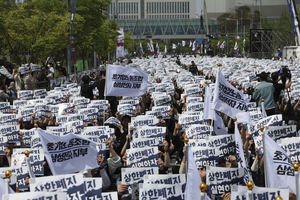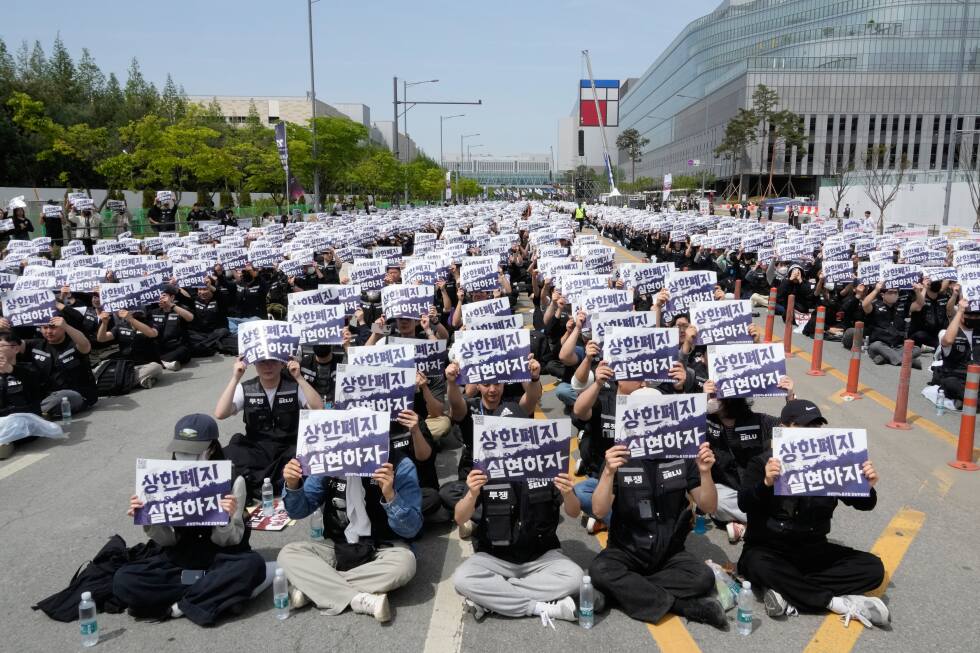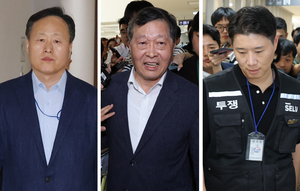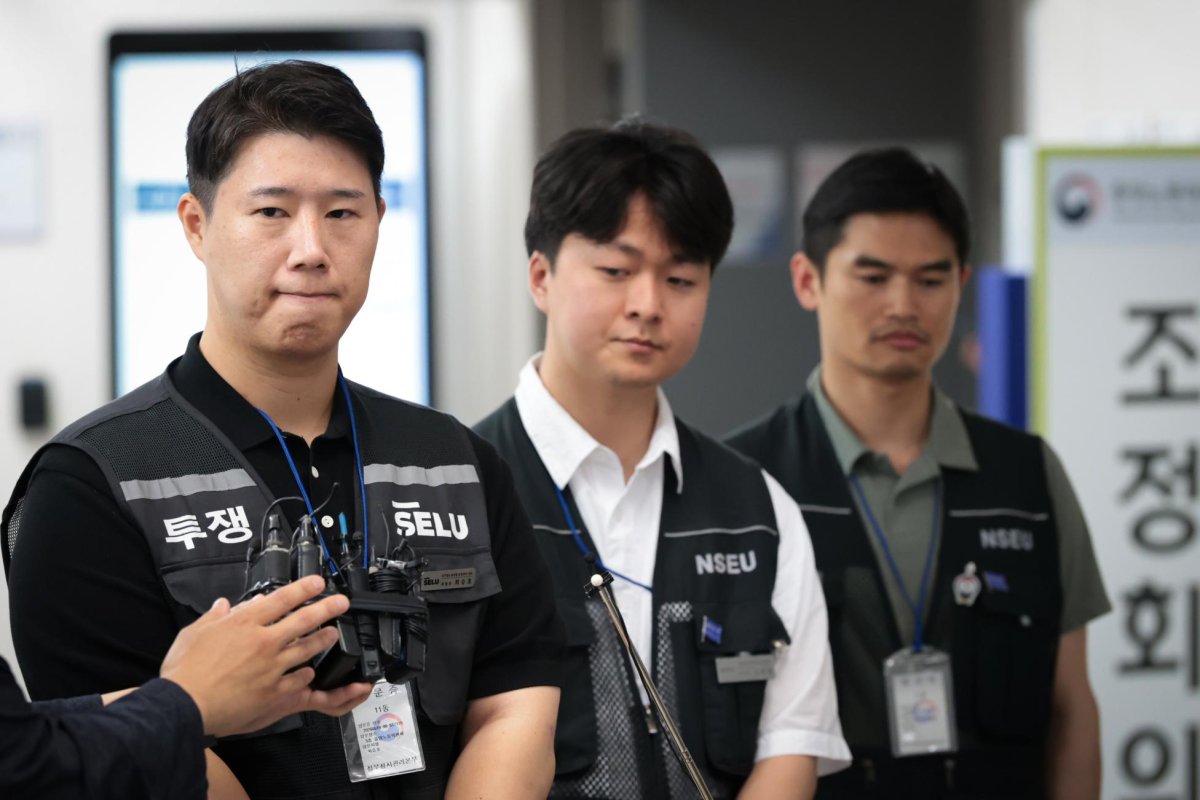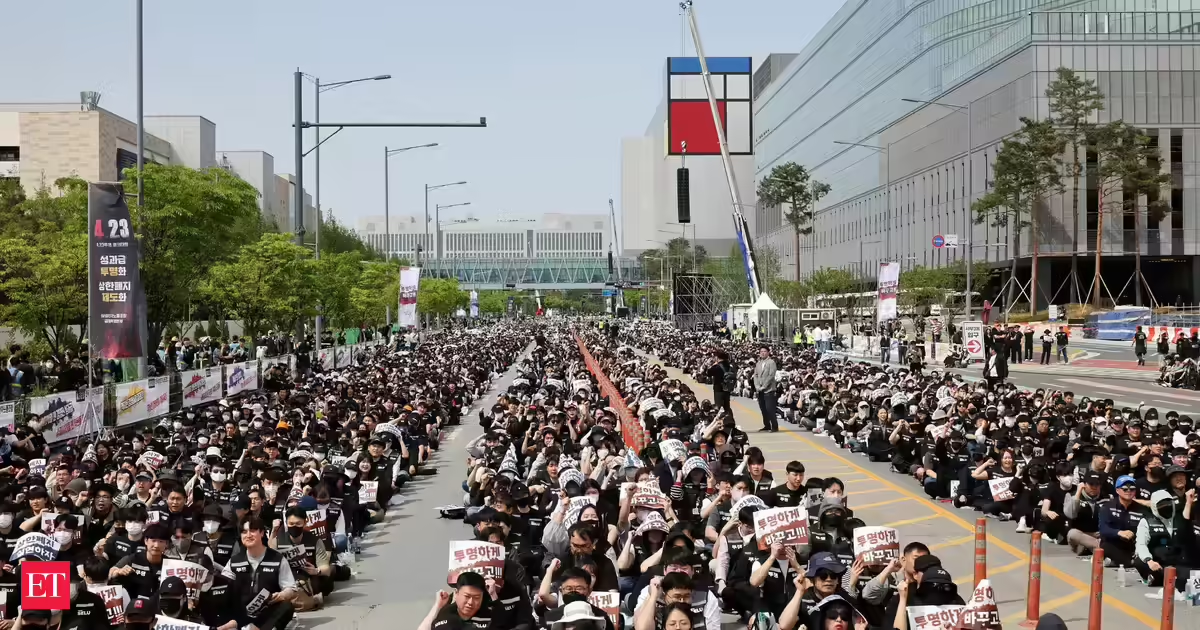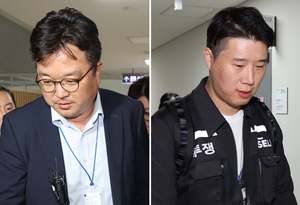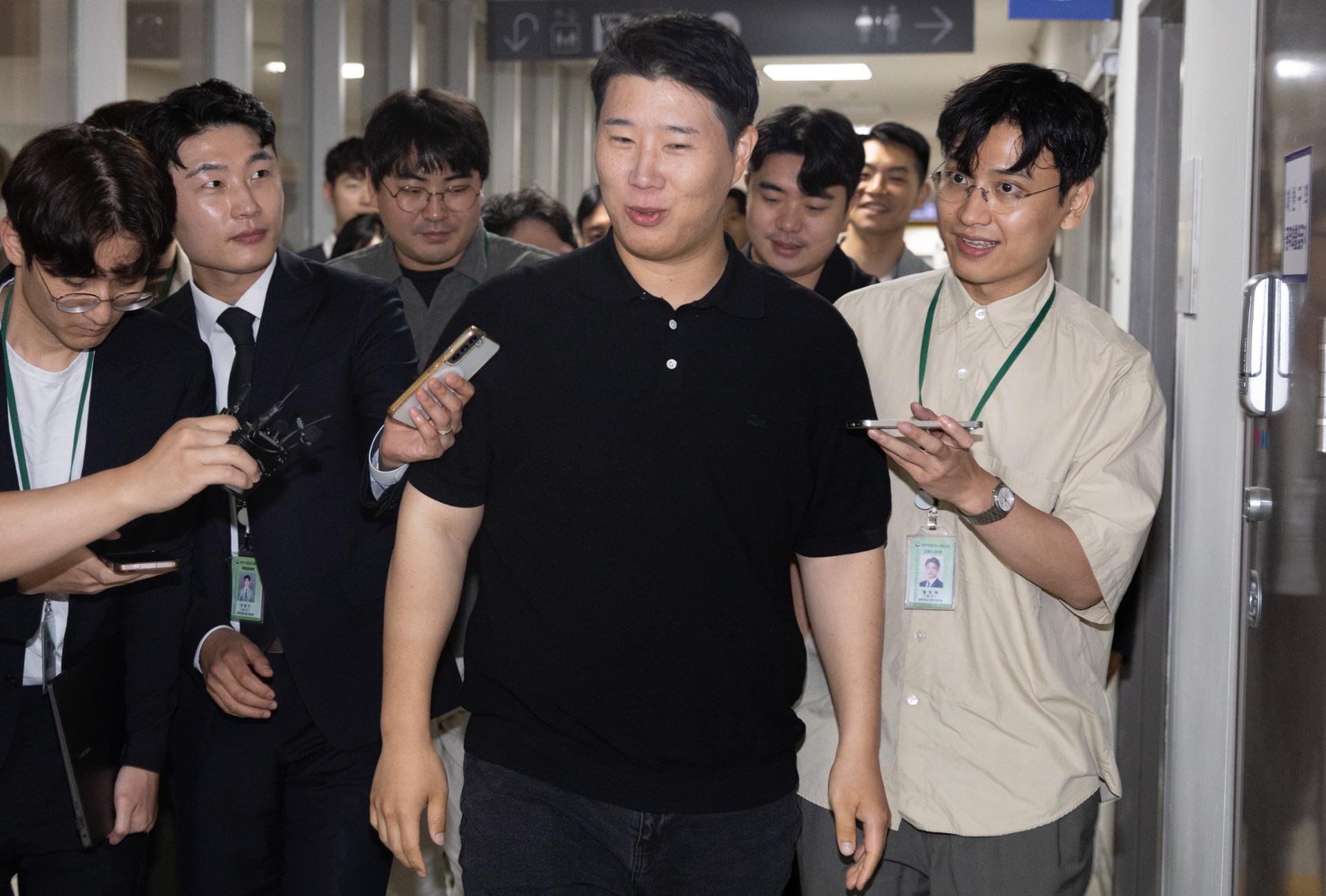
Choi Seung-ho, leader of Samsung Electronics' labor unions, center, leaves the National Labor Relations Commission (NLRC) in Sejong, Wednesday, after the company's labor and management failed to reach an agreement in an NLRC-arranged mediation session. YonhapSamsung Electronics’ labor and management on Wednesday failed to reach an agreement in their last-ditch talks, and the company’s labor unions said they will launch an 18-day strike on Thursday. Attention is now on the government, which has suggested it could invoke compulsory arbitration measures to contain fallout to the national economy.According to union leader Choi Seung-ho, the company’s labor and management ended their negotiations at around 11 a.m., Wednesday, despite extended talks in a government-arranged mediation session that began Monday. Choi claimed that the unions "had agreed to the mediation proposal presented by the National Labor Relations Commission (NLRC)" on Wednesday night, but the company requested more time, leading the two sides to continue negotiations into Wednesday. He added that the NLRC eventually ended the session as the company continued to withhold its position.The unions said they will proceed with the general strike as planned. “The unions will lawfully enter a general strike tomorrow as scheduled,” he said. “We also make clear that we will not stop efforts to reach an agreement even during the strike period.”Samsung Electronics expressed its regret for the breakdown, but blamed the unions for their "excessive demands.""The talks failed because accepting the unions’ excessive demands could undermine the company’s basic management principles," the company said in a statement. "Despite the company accepting most of the proposed performance bonuses, the unions did not back down from demands for compensation for loss-making business departments at a level that would be socially difficult to accept."The company was referring to the allocation of performance bonuses within the chipmaking Device Solutions (DS) division, which was one of the main points of contention.The unions have been demanding that the company allocate 15 percent of its operating profit for performance bonuses. For the DS Division, the unions have proposed distributing 70 percent of the performance bonus pool equally across all semiconductor business departments, while allocating the remaining 30 percent differentially based on each department’s performance. The company opposed this, because the division's foundry and chip design businesses are still struggling to narrow losses, and increasing the ratio of equal distribution would undermine the company’s performance-based compensation principles. “The company believes that abandoning such principles could negatively affect not only our company, but also other businesses and industries,” the company said, adding it will continue efforts to settle down the dispute.Samsung Electronics' semiconductor plant in Pyeongtaek, Gyeonggi Province / YonhapThe unions plan to go on strike on Thursday, with more than 47,000 union members having expressed their intention to join the walkout. Since a local court on Monday partially granted Samsung Electronics’ injunction request to block a full strike, minimum staffing levels will be maintained for deterioration prevention and safety-related operations during the strike period, but supply disruptions are still expected.Reportedly, the company has received inquiries from global clients regarding the potential impact of a strike on semiconductor supply, while rumors have even circulated that Nvidia may refuse to accept products manufactured during the strike period.The government has been reviewing a plan to invoke a compulsory arbitration measure that would suspend the strike and force labor and management into arbitration procedures.The measure, named "emergency arbitration of industrial action," is one of the strongest tools the government can use to handle labor disputes. If a strike is deemed likely to harm the national economy or disrupt citizens’ daily lives, the labor minister can invoke the emergency measure, immediately suspending collective action for 30 days.It not only halts strikes but also effectively forces labor and management into a settlement process, in which both sides are required to resume mediation sessions. If that mediation fails, the case moves to a binding arbitration process with the NLRC. At that stage, both sides must accept the commission’s compromise plan, and no legal appeal is permitted.Samsung Electronics is gearing up its preparations for containing the damage from the strike. It told the unions that at least 7,087 employees should continue working on wafer deterioration prevention and safety-related operations during the strike period. A day earlier, Suwon District Court ruled that the workforce for those areas must be maintained during the strike.Even if the government invokes emergency arbitration measures, heavy losses are still expected. Industry officials estimate that the strike could incur losses of 1 trillion won ($663 million) per day, and if the walkout continues for the full 18 days, the losses could reach as high as 100 trillion won.The recent momentum in Samsung Electronics’ profitability could also be affected.Samsung Electronics posted 57.2 trillion won in operating profit for the first quarter, up 756 percent from a year earlier, driven by soaring demand for its memory chips.In the semiconductor industry, on-time delivery is critical, and production disruptions caused by the strike could shift increased memory demand toward rivals such as SK hynix and Micron. Disruptions to Samsung’s supply could also trigger a sharp spike in DRAM prices.
Samsung Electronics unions plan to go on strike Thursday as talks collapse again - The Korea Times
Samsung Electronics’ labor and management on Wednesday failed to reach an agreement in their last-ditch talks, and the company’s labor unions said...
844 words~4 min read