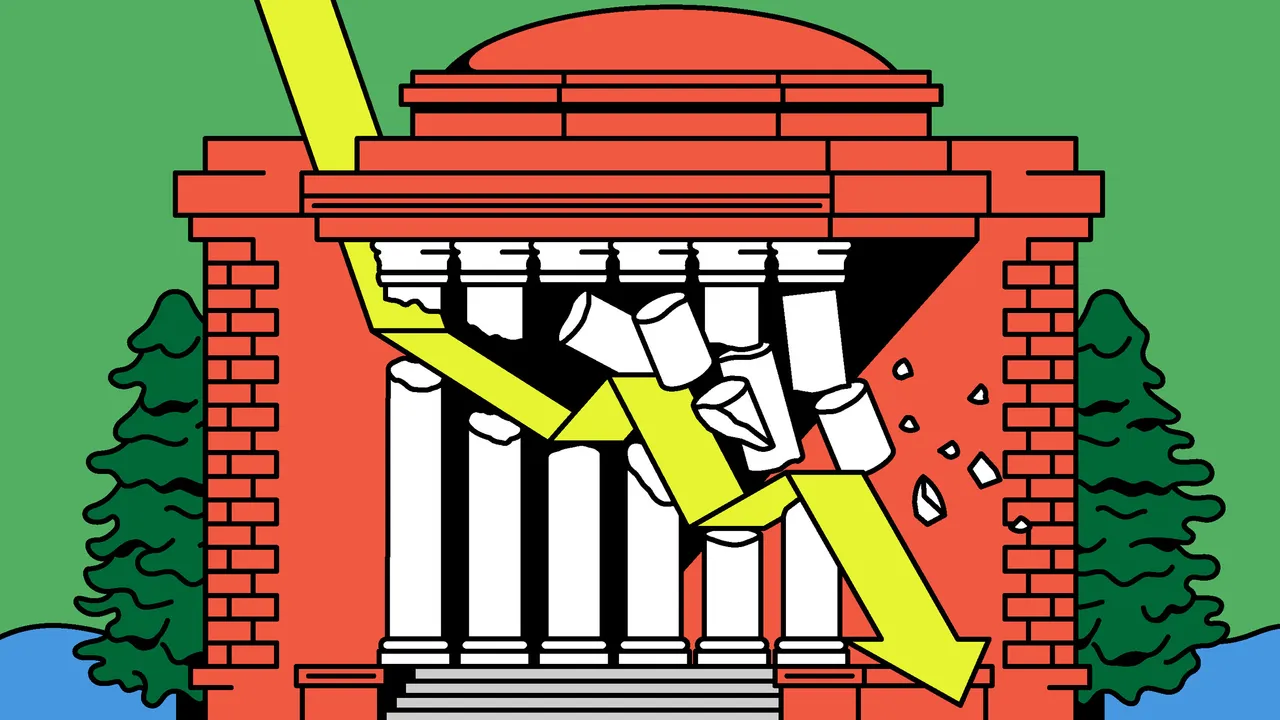
As the number of new high-school graduates drops, colleges will close, some will merge, and others may change beyond recognition.May 19, 2026Illustration by Fortunate JoaquinThis series on the future of higher education started with a simple question: Should I still be contributing to my children’s college funds? My first attempt to answer that question centered on the growing disillusionment with higher education in general. Then, in Part 2, I talked to a professor and former dean who believes that A.I. will force the academy to make a lot of difficult choices which may upend the four-year model of college, and leave us with a landscape of nimbler, bespoke institutions that will have to constantly prove their worth. This week, I want to look at something less speculative but perhaps even more doomer-ish: If my kid does want to attend college in 2035, how many schools will she actually have to choose from?A couple weeks ago, I spent a few hours at Merritt College, in Oakland, California. The campus, which spreads out across a heavily wooded part of the hills, was in light disrepair. Nothing apocalyptic, and definitely not blight, but the sort of wear that suggests budget cuts for the grounds crew: patches of unruly grass, cracks in the sidewalk. This campus is relatively new; in the early nineteen-seventies, Merritt moved to this site from its former campus in North Oakland where, famously, two students named Bobby Seale and Huey P. Newton met; they later founded the Black Panther Party for Self-Defense. Today, Merritt, like many colleges in the East Bay, is facing an extended decline in full-time student enrollment, which, in turn, has led to cutbacks. Last year, the chancellor of the Peralta Community College District, a network of four schools that includes Merritt, proposed a merger with nearby Laney College to create something called Oakland City College.Roughly a mile away as the crow flies is the site of what once was known as Mills College, which was a private, four-year liberal-arts college for women. In 2022, Mills merged with Northeastern University, in Boston, and became Mills College at Northeastern University, a name that doesn’t make much sense, at least if you care about geography. Mills and Merritt are hardly alone. Last year, at least sixteen nonprofit colleges and universities announced that they would close and seven more announced that they would merge with or be acquired by other schools. Most of the schools that have shut down are, like Mills, small, private institutions. But, during the next decade, there will be a steady drop in the number of this nation’s eighteen-year-olds, which will almost certainly lead to a spike in college closures and mergers throughout the country, not only at small private schools with less-than-élite academic reputations but also at large regional public schools.Education scholars talk about an “enrollment cliff,” and it stems from a simple demographic fact: after reaching a peak in 2007, the number of babies born annually in America generally declined for more than a decade. This means that there will not be as many eighteen-year-olds applying to college in 2029, say, as there were in 2025. Scholars and researchers disagree a bit on how steep this decline will be—the Western Interstate Commission for Higher Education projects that the number of high-school graduates will be down thirteen per cent by the end of 2041—but almost everyone agrees that a significant contraction in the country’s number of colleges is inevitable. The effect, it’s important to note, will not be evenly spread throughout the country. Some states, such as Hawaii, Illinois, California, and New York, might see their population of high-school graduates drop by more than twenty-five per cent. The South has a rosier outlook, because more people are moving there, and its Latino population, in particular, is booming.Many four-year colleges have been planning for such a transition for years. Some may hope that the decline in total high-school graduates will be offset, in part, by an increase in the percentage of those graduates who pursue a higher degree. But that number has also been dropping, thanks to a variety of factors, including the high cost of tuition and a waning faith in the value of higher education. “You’d need record-smashing attendance rates to maintain the size of incoming student cohorts,” Nathan Grawe, an economist at Carleton College who has written two books on this subject, told me. A sudden boost in birth rates wouldn’t be enough to save the colleges, either, he noted. “We are eighteen years into a drought of births,” Grawe said. “The babies not born in 2025 will not be showing up in college recruitment pools in 2043.”Analysts have tried to forecast how much academic carnage will result from this demographic bind. In a 2012 report, the consulting firm Bain & Company declared that roughly a third of American colleges were financially “unsustainable.” A widely discussed working paper put out by the Federal Reserve Bank of Philadelphia in 2024 warned of a worst-case scenario in which an abrupt fifteen-per-cent enrollment drop could lead to the closures of up to eighty colleges and universities, with the most pain being felt at small, regional private schools.There’s also some evidence that the enrollment cliff is already upon us, and that its effects could reach even well-known schools. Last week, the University of Vermont reported an expected fifteen-per-cent drop in incoming freshmen for the 2026-27 school year and a seven-per-cent drop in over-all enrollment. The school’s president, Marlene Tromp, cited a host of issues, including demographic decline and the new scarcity of international students due to the Trump Administration’s visa policies. As flagship state universities go, U.V.M., which charges more than forty-six thousand dollars a year for out-of-state tuition, was particularly vulnerable, because roughly three-quarters of its undergraduates come from out of state, a stat that means it does not have a particularly strong regional alumni network, and may not inspire the same degree of state pride as comparable schools elsewhere—attributes that can sustain enrollment at public schools. I grew up in North Carolina; many of my friends went to the University of North Carolina because their family members went, most people they knew were also going to U.N.C., and tuition was cheap. None of those attractions apply to an eighteen-year-old from the suburbs of New York City who has the University of Vermont as his third-choice school behind Syracuse and the University of Florida.U.V.M. is an extreme case, but during the past two decades flagship state schools across the country have aggressively brought in out-of-state students who usually pay higher tuition bills. More than half of the undergraduates at the University of Alabama, for instance, are not from Alabama. One of the most interesting trends in higher education is the explosion of out-of-state students who attend big flagship football universities in the South, in large part because they see college as a time to live it up, tailgate, and pledge a fraternity or sorority. But this version of the college experience really only makes sense for kids who were definitely going to attend a four-year school—namely, middle- and upper-middle-class kids with educated parents—and the trend suggests that many schools are struggling to sell students, or their parents, on educational reasons for paying them so much money.Importing higher-paying—and oftentimes higher-achieving—students benefits a school during boom times, when universities have seemingly infinite choice among applicants. But what happens when the number of applicants drops nationwide? Schools that are slightly more selective or appealing than a school like U.V.M. will start letting in students they might have rejected in prior years, which means that those students don’t end up at U.V.M., and U.V.M. gets stuck doing a difficult dance between maintaining its standards and trying to meet its tuition goals. “You can admit richer students with bad grades to keep your revenue up,” Kevin Carey, the vice-president of education and work at New America, told me. “But if your academic reputation falls, people are less willing to pay the expensive tuition.” Sure, Andover and Exeter graduates will continue to go to Harvard, Alabama football will roll on, and the electrical-engineering classrooms at U.C. Berkeley will almost certainly remain full. But unless a college is selling something that students and their families actually want, it might be facing an irreversible decline. “We are looking at a winner‑takes‑all situation,” Carey said. “Institutions that have market power will probably take advantage of the situation, because they might have fewer competitors. And institutions that don’t have the same market power are in for a lot of tough times.”Large language models, it’s often said, are mirrors that mostly reveal their users to themselves. This is certainly true for higher education, although, in that case, L.L.M.s have provided a particularly harsh reflection, one that draws the eye to academia’s myriad flaws. L.L.M.s may have allowed students to cheat in novel ways, for example, but that cheating has happened in the context of the customer-is-always-right relationship that now dictates most interactions between students and faculty—a dynamic that has also contributed to grade inflation, which effectively kills a student’s incentive to value his own work. The takeaway, then, isn’t that students are duplicitous and depraved or that technology has eroded their moral core. Rather, it’s that many of them do not see a good reason to complete their coursework. Why is that? Does it stem from a decline in the quality of instruction? In the growing realization that a four-year-degree alone won’t save them from downward mobility? Or is it that they now see the purpose of college simply as early-job credentialling, and, therefore, don’t really care if they’ve actually read Melville or whatever?Similarly, the fear that college administrators will use A.I. to replace a lot of lower-level faculty and graduate students might be well founded, and it certainly could put a lot of talented and hard-working people out of a job. But, once again, our anxiety about A.I. mostly tells a story about existing problems that are unrelated to the arrival of artificial intelligence—this time, about the fungibility of adjuncts and the overproduction of graduate students by institutions that have been exploiting cheap labor for years. And while the questions that have been asked lately about the viability of the humanities as a discipline in a future when all writing will be outsourced to Claude don’t actually say much about the value of learning to read and to think, they do suggest that young people increasingly see college as an expensive, time-consuming, and debt-mounting career-entry portal and don’t want to risk their investment on a degree that will lead to no obvious job upon graduation.When people ask whether A.I. could replace something, what they’re really asking is “Does this thing still need to exist?” That is the question facing hundreds of smaller-market colleges and universities across the country. The second question is, if a college wishes to exist, what steps can it take to insure that it survives the inevitable contraction that’s coming? Carey believes that at-risk colleges should try to get ahead of the curve and either proactively merge or, if they’re private institutions, make an effort to become public. Public institutions, which often enjoy support from local elected officials and from locals who may use the school’s facilities or campus as a civic resource, tend to be harder to shut down. But Carey doesn’t know if the culture of higher education can accommodate that type of emergency thinking. “Reputation and enrollment go hand-in-hand,” he said. “These places have a strong incentive to pretend everything is fine until five minutes before it all collapses. If they started telling people it’s not fine, students won’t enroll, and it all becomes a self-fulfilling prophecy.”Grawe agrees that higher education isn’t ready for what’s coming. “From the end of World War II through 2010, higher education experienced sixty years of uninterrupted enrollment growth,” he told me. “We don’t have leaders who have experienced anything quite like the current enrollment pressures.” He remains hopeful that higher education can adapt, and pointed to a success story out of the City University of New York, where a program called ASAP, which provides financial support, mentorship, and academic help for its students, nearly doubled associate-degree graduation rates, according to a report on results at three CUNY community colleges. Programs similar to ASAP have since been started at community colleges elsewhere, and they could help offset the over-all enrollment drop simply by retaining more students.To return to the question at the start of this column: What will the higher education landscape look like when my daughter ships off to college, if she does? There will almost certainly be fewer small private colleges, and some number of public institutions will have merged. Student enrollment will drop across the board, and certain areas of the country such as New England—which is home to a whole host of small private colleges and will be suffering from some of the harshest demographic decline—may start to be dotted by campus ghost towns. Community colleges may end up being the beneficiaries of all this, as they are typically more nimble, less weighed down by traditions and the demands of alumni, and also because they’re quite used to intense financial pressure. Large public-university systems will likely see more mergers and the closures of truly moribund campuses, but they might also see an uptick in over-all enrollment as small private colleges mostly decline or cease to exist apart from the prestigious and selective liberal-arts schools (Pomona, Amherst, and so on) that have what Carey calls “market power.”Will students on the margins find their way to cheaper, A.I.-driven credential factories? As I mentioned in the first part of this series, the effort to build those is already in progress. A.I. companies have made large marketing and infrastructure investments in education; if they have their way, a host of A.I.-education options, with classes taught and graded by L.L.M.s, will emerge. One of the deep ironies in all this is that those same universities facing drastic budget and enrollment problems might be the ones most open to replacing part of their labor force with the promises of A.I., or, perhaps, rebranding themselves as specialized institutions powered by OpenAI or some other company, in the hope of luring students who believe their only future lies in that new industry. These schools may very well be training their own replacements.If all of this comes to fruition, is that a bad outcome? Probably. Granted, I do not feel much sympathy for expensive private schools; more than any other type of school, they fail to provide value for their students, and most of them probably shouldn’t exist. And some reorganization of struggling state systems would probably help, especially if those systems begin to provide alternative pathways to obtaining a four-year degree. I’ve long been an advocate for the University of California’s community-college transfer program, which allows thousands of students, many of them from working-class families, to transfer into a U.C. school. Mergers might encourage other states to offer similar programs as a way of funnelling more students into struggling four-year campuses. This would lower the tuition burden per student, because most community colleges in this country are relatively affordable.But the class divisions already dictating almost every aspect of higher education—from admissions to funding to reputation—will likely deepen. Even if we assume that students absorb the same amount of information as before, there are other reasons why it is good for everyone to go to a place together under the guise of betterment. “These are institutions that in many cases have been in their communities for more than a century,” Carey said. “What else can we say that about?” Not every tiny college needs to be saved, nor does every regional public university have to maintain its independence. But we should ask what’s more likely under this maximalist scenario: a glorious new era of expanded community-college participation, enrollment growth at large flagship public universities, and the erosion of wildly expensive private colleges with shaky value propositions? Or a future in which the wealthy still walk around leafy campuses and chat with learned professors and the poor receive their education through a ChatGPT tutor that’s been trained to push its students toward the career paths that will most benefit OpenAI? ♦A scientist with a Ph.D. from Harvard fatally shot three of her colleagues. Then revelations about her family history came to light.
The Enrollment Cliff Is Here. Which Schools Will Survive It?
As the number of new high-school graduates drops, colleges will close, some will merge, and others may change beyond recognition.
2,731 words~12 min read