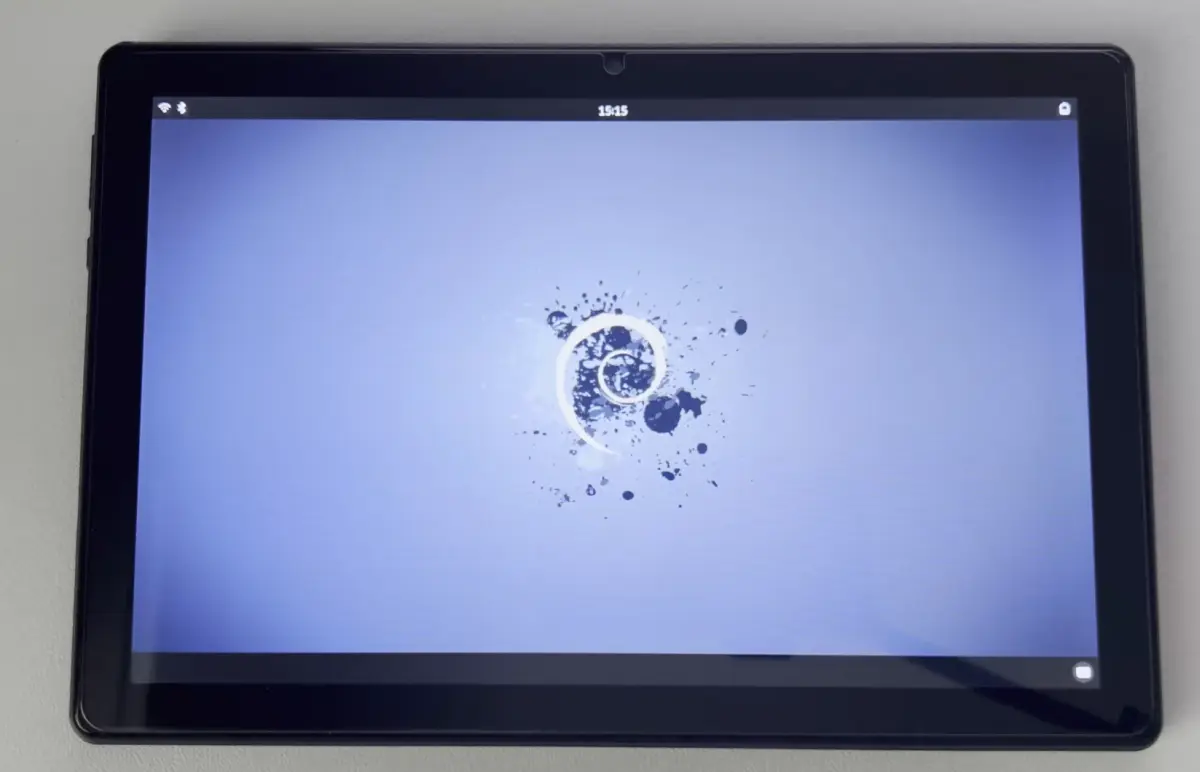
Disclosure: Some links on this page are monetized by the Skimlinks, Amazon, Rakuten Advertising, and eBay, affiliate programs, and Liliputing may earn a commission if you make a purchase after clicking on those links. All prices are subject to change, and this article only reflects the prices available at time of publication.Smartphones and tablets are basically little computers with touchscreen displays. But since most ship with mobile operating systems like Android or iPadOS, they’re often tightly tied to Google or Apple for support, services, and app stores, among other things.So developer tech4bot decided to set a cheap Android tablet free by turning porting Linux to run on it. The Doogee U10 is a budget tablet that sells for around $80 and ships with Android 14. But tech4bot’s open source software lets you install a Debian 12 “Bookworm” image to a microSD card and boot from that instead, allowing you to use it like a full-fledged (if underpowered) Linux PC.Tech4bot says the tablet can boot into a Linux desktop this way without unlocking the bootloader or replacing the Android software that’s pre-installed, allowing you to switch between operating systems by simply inserting or rejecting the SD card.The tablet is a budget model with relatively unimpressive specs including a 10.1 inch, 1280 x 800 pixel display, a 2 GHz Rockchip RK3562 quad-core Arm Cortex-A53 processor with Mali-G52 graphics and 4GB of LPDDR4 memory. And not all of the hardware is fully supported by Debian – 3D-accelerted graphics is “partially” working, with Panfrost and OpenGL ES support, and the camera “still needs calibration.”But the Linux image recognizes the CPU and NPU (with up to 1 TOPS of AI performance), WiFi, Bluetooth, mic, speakers, battery, USB port, display, and touch input, among other things.And that allows you to use the tablet for a wide range of things. The system image comes with the Phosh mobile user interface pre-installed, along with some apps including Firefox and Chromium web browsers, the Dolphin file manager, and terminal, text editor, camera, and drawing software, among other things. The KDE Plasma Discoverer software manager also makes it easy to find and install additional software without resorting to the command line.While I doubt there are a lot of people looking to use an underpowered tablet for local AI applications, it’s 2026 so of course AI plays a role here. In this case, developer tech4bot used several AI services to help develop the software… and once everything was up and running, showed the tablet running some local LLMs in a demo video and provided some benchmark results in the project description on GitHub.But mostly, I’m just happy to see any project that pushes cheap hardware to do things that it wasn’t really designed for. It could help extend the lifespan of bound-for-eWaste tablets like the Doogee U10 after they’re no longer supported by their manufacturers, or just provide a way for users to turn cheap hardware into a Linux PC without the need to buy from a specialty vendor.Of course, this isn’t the first Android device we’ve seen converted to a Linux device: there are a bunch of mobile Linux distributions available for installation on a number of smartphones and tablets that originally shipped with Android… although some are more actively supported than others.But porting Linux to run on devices with Arm-based chips is usually a lot more complicated than adding support for PCs with the latest x86 processors, because there’s typically a lot more proprietary code that varies from chip to chip (and device to device) in the Arm world. So it’s nice to see a new project that brings Android to previously unsupported device.via ergewrg and Hacker News
Turning an $80 Android tablet into a Debian Linux PC - Liliputing
Turning an $80 Android tablet into a Debian Linux PC
609 words~3 min read