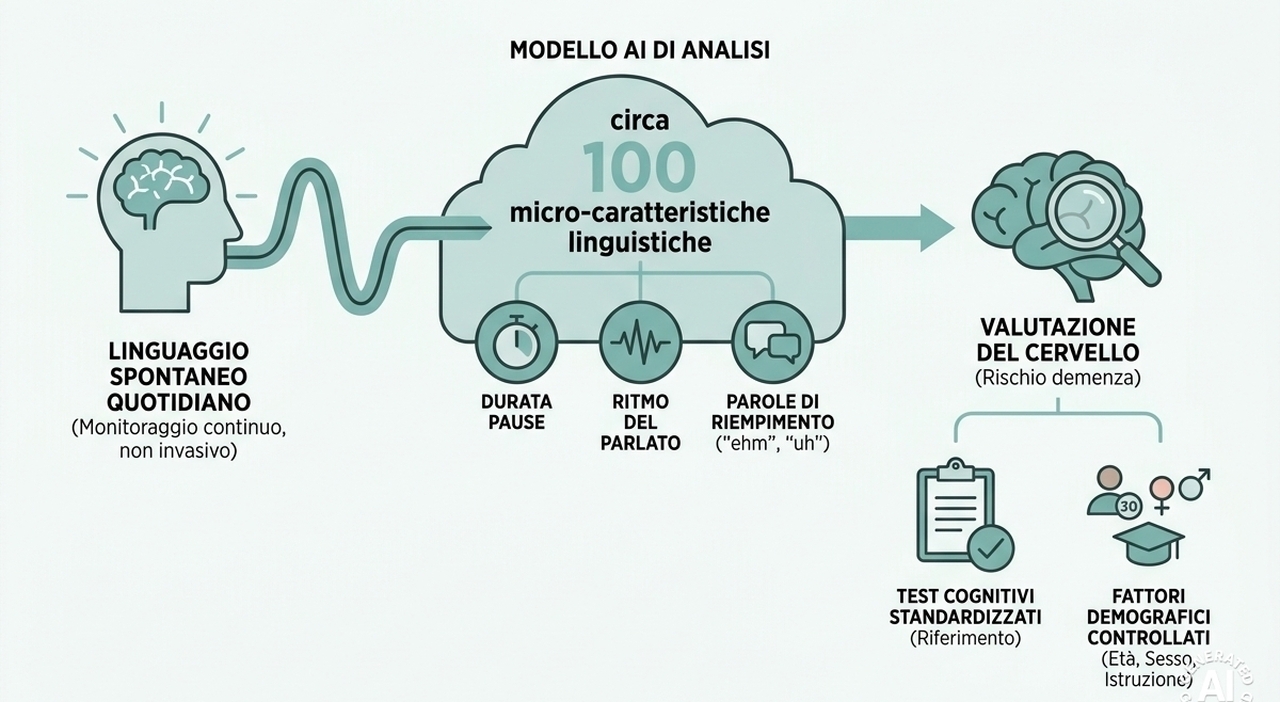
If you’re like most people, you probably rely on filler words like “um” and “uh” when speaking, whether you’re presenting at work or talking to old friends over coffee. Use of filler words can be very, very normal, but new research found that in some cases, you may want to pay closer attention to your speech patterns for the sake of your cognitive health and dementia risk. The research, which was led by experts from the Baycrest Corporate Centre for Geriatric Care, the University of Toronto and York University, found that certain speech patterns can be indicative of cognitive decline and a higher risk for dementia. Folks who participated in the study were tasked with verbally describing what they saw in different detailed images and were recorded while explaining what they were looking at.Researchers then used AI to analyze the speech patterns in the recordings, such as the use of filler words like “um” and “uh,” pauses in conversation and trouble with word-finding.Participants also completed cognitive tests; how someone performed on the speech analysis predicted how well, or not well, someone did on their cognitive tests.“We know that language is one of the domains of cognition that can be really affected by dementia, and certain types of dementia more than others, but in all types of dementia, difficulty finding common words is a feature that we look for, and that we know occurs,” said Dr. Heather Whitson, a distinguished professor in neuroscience at Duke School of Medicine in North Carolina. Whitson is not affiliated with the study.This does not mean that every forgotten word or instance of calling a restaurant by the wrong name is cause for concern, experts told HuffPost.Cavan Images via Getty ImagesNew research found that certain speech patterns could be signs of cognitive decline.“All of us, probably starting around our 20s or 30s, start doing a little bit worse over time on many formal cognitive tests, and that does not mean that we’re on the way to dementia. It’s what we often refer to as healthy aging,” said Dr. Carolyn Fredericks, an assistant professor of neurology at Yale School of Medicine in Connecticut. Fredericks is not affiliated with the study.“And some of the things that they were looking at in this study are things where everybody gets a little worse on these measures over time, but they’re picking up a signature where [in] some people, it’s just that much more so, and those are the ones who are vulnerable,” said Fredericks.Again, difficulty finding words can be a normal part of aging, stressed Whitson.“Usually it starts with proper nouns, so the person who’s saying, ‘I can remember everything about that actor, but I can’t think of their name right now,’” added Whitson.There are also limitations to this study. “Speech patterns are very dependent on culture and even families,” said Whitson, and this study doesn’t address the aspect of speech differences. For example, it’s common for folks in the south to speak slower and with more pauses than those in the north, and that is not a sign of cognitive decline. More, this data was all “drawn from one time point,” Whitson said. So, there is nothing to compare someone’s speech patterns to. Meaning, someone’s use of the word “uh” may be normal and something they picked up in childhood, not a sign of cognitive decline. Not all cognitive changes are worrisome, but there are some warning signs of dementia you should know.Again, not every “um” or pause in conversation is cause for concern, but there are some red flags that should warrant a visit to your doctor.“The kinds of things I would worry about, number one ... having a lot of difficulty expressing oneself, particularly with ordinary dictionary words, not just struggling to come up with the name of someone or the title of a book or movie,” Whitson said.Short-term memory lapses are also concerning, Whitson noted. “That usually presents with either repeating one’s questions in a very short time span,” added Whitson.“Other things is getting lost in familiar places, or repeatedly forgetting important appointments,” she said. Misplacing items and having no idea how the item got there in the first place is also a red flag, added Whitson.Since cognitive decline is a part of healthy aging, it can be hard to tell what is normal and what is not so normal. “Often it’s helpful to compare yourself to your peers,” said Fredericks.For instance, if your peers are also occasionally forgetting the name of the new dentist in town, you’re likely in good company. But, if you find yourself misplacing items frequently, and don’t see that in others you age, it’s a good idea to talk to a doctor. There are some lifestyle adjustments that can help lower your dementia risk.There are some modifiable lifestyle behaviors that can lower your risk of dementia. These are “the most actionable things that people can do in their 20s and beyond,” said Whitson.Controlling high blood pressure is an important way to lower your dementia risk, Whitson said. “There’s even evidence that strict control of blood pressure down to a top number of 120 or less is associated with reduced dementia risk,” she added.“Physical activity is one of the things that is most associated with lowering dementia risk, as well as almost every other kind of health risk,” Whitson said.“So, I always tell people, if they’re going to change one thing about their lifestyle, increasing physical activity would be the thing to do.”It’s also important to get good quality sleep and follow a nutritious diet. Fredericks recommends the Mediterranean diet or other heart-healthy diets.“Making sure that people’s vision and hearing are optimized is associated with lowering our dementia risk, which kind of makes sense because our ears and our eyes are what feeds most information and activation to our brain,” added Whitson.So, if you need glasses or hearing aids, it’s a good idea to see a doctor and get a prescription. Protecting yourself from head injury by wearing a helmet when biking, for example, or during contact sports is another way to lower risk, Whitson said, in addition to not smoking.Having regular social and intellectual stimulation is also recommended, noted Fredericks. This can impact your cognition and help your brain stay challenged and alert, Fredericks added.This AI tool these researchers used to analyze the data is “very promising,” Whitson said. A tool that can pick up patterns in speech and reveal something about our brain function and cognition has great promise, Whitson noted.But, don’t panic if you find yourself using “um” a lot or pausing in conversation. Instead, do what you can to lower your dementia risk and look out for other dementia red flags — and talk to a doctor if you are concerned.
These Common Speech Patterns Could Be Early Signs Of Cognitive Decline — And A Higher Dementia Risk
While certain filler words and speaking patterns can be normal, they can also be signs of cognitive decline and dementia risk.
1,123 words~5 min read