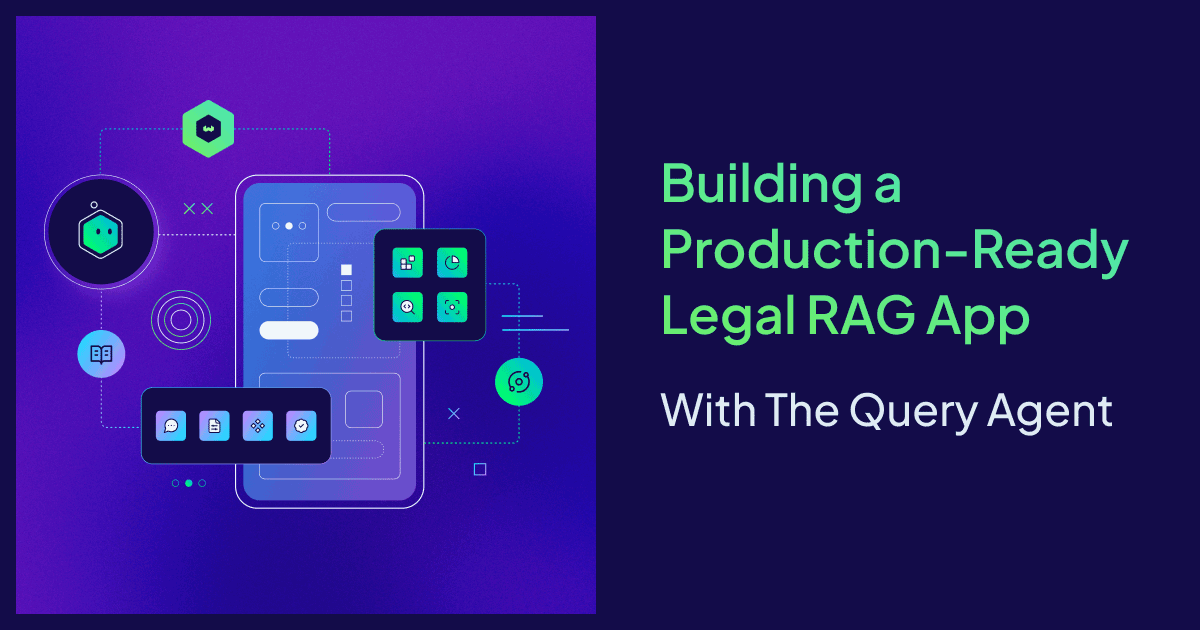
Legal research is difficult by design. Sorting through thousands of complex contracts to find a specific clause requires extreme precision and absolute security. This makes the legal domain a perfect candidate for RAG. Traditionally, building a production-ready legal assistant requires developers to orchestrate retrievers, manage conversation state, and write complex query logic, often resulting in a multi-month development cycle.
We decided to see if we could break that timeline.
When our own finance team at Weaviate asked us to help them navigate internal contracts, we used the Query Agent to turn these raw documents into a production-ready application in just 36 hours. We’ve replaced our private data with a public dataset in the demo below so you can experience this "one-prompt" legal assistant for yourself. In this post, we are showing you exactly how the architecture works and how to build it yourself.
Naive Search vs. Agentic Search: Why Legal Data Needs a Reasoning Layer
Traditional, Vanilla, or Naive RAG systems follow a linear path: taking a user’s input, creating a basic query, and performing a static search against a single collection. While this works for simple FAQ bots, it often collapses under the weight of legal documentation. Legal queries are rarely one-dimensional; they require specific filtering by date, jurisdiction, or contract type.