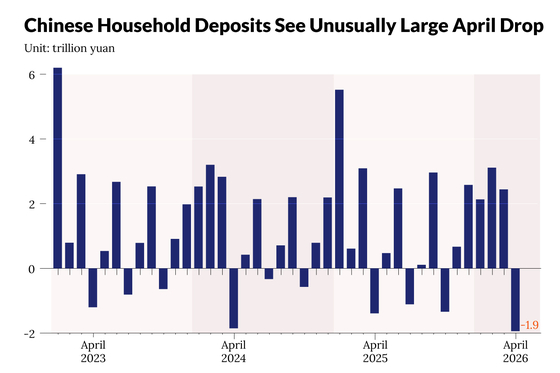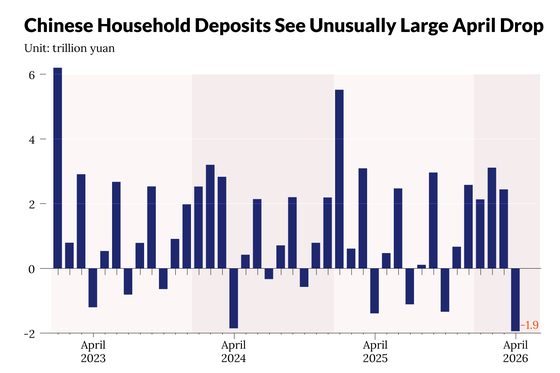
1. Chinese households are increasingly shifting funds from bank deposits to nonbank financial assets, driven by years of falling deposit rates as savers seek higher returns. [para. 1] Central bank data shows household deposits fell by 1.9 trillion yuan ($280 billion) in April, about 550 billion yuan more than the decline a year earlier. [para. 2] Meanwhile, deposits by nonbank financial institutions rose by 2.5 trillion yuan, with the increase nearly 900 billion yuan higher than the same period last year. [para. 2] Both shifts were significantly larger than normal seasonal swings. [para. 2]2. Analysts attribute these movements partly to a wave of maturing term deposits. [para. 3] Estimates from Huatai Securities Co. Ltd. suggest that more than 20 trillion yuan of two- and three-year deposits could mature this year, releasing funds that savers are now redirecting to higher-yielding alternatives. [para. 3]3. Insurance products have emerged as a major destination for funds exiting deposits. [para. 4] First-quarter premium income rose 6.2% year-on-year to 2.3 trillion yuan, with life insurance particularly attracting savers seeking relatively stable returns in the low-rate environment. [para. 4]4. Despite the shift, Chinese households remain cautious. [para. 5] Banks have retained part of the deposits through products such as gold-linked structured deposits. [para. 5] At the same time, some savers remain wary of riskier investments, even in the face of stronger stock markets and improving returns from asset management products. [para. 5] This caution tempers the pace of the rotation into nonbank financial assets. [para. 5]AI generated, for reference only
Analysis: Chinese Savers Move Beyond Bank Deposits as Rates Fall
Insurance products are attracting more household savings as falling rates erode deposit returns
253 words~1 min read