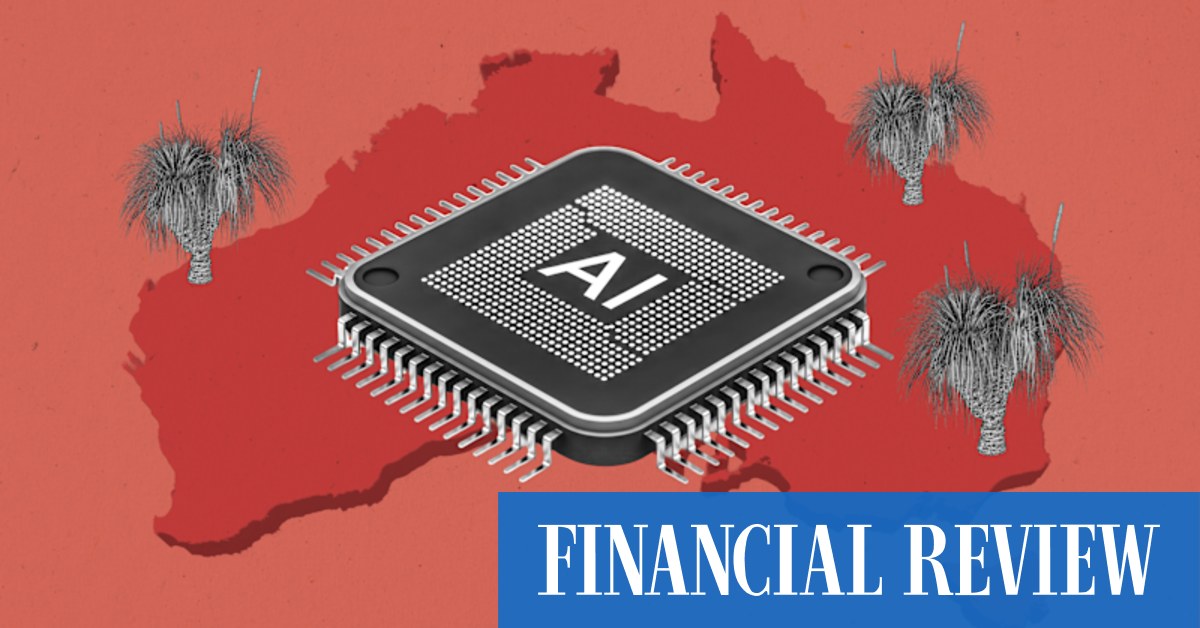
Australian insurance chatbots built in San Francisco.Locally-scanned mammograms sent to South Korea.This is the new reality for Aussie consumers, who are missing out on homegrown solutions to modern dilemmas because big business and governments aren’t backing Australian-made AI.Multiple founders of Australian AI companies, from small start-ups to venture-backed enterprises worth hundreds of millions, have told this masthead how difficult it is to get a foot in the door with Australian clients, let alone government-funded ones.Local firms said they have lost deals to foreign competitors despite having a competitive offering, attributing the rejection to their opponents’ glossy international brand recognition.Suncorp Group has inked a deal with Silicon Valley-based company Sierra, co-founded by two ex-Google employees, to provide a voice-based conversational AI, after Sierra won a competitive request for proposal process not a single Australian company was invited to.Steve Hind, co-founder of Australian ‘customer concierge’ provider Lorikeet, said “we didn’t even get an invite to the dance ” and that it was “a bit disappointing” that Suncorp appeared to have bought into the Google connection.“It’s easier for me to get from Surry Hills to Wall Street, than it is to get from Surry Hills to George Street,” he said.“Australia should look to the world for AI solutions, but we shouldn’t be so humble as to think those can’t be created in Australia.”It comes at a critical turning point in the Australian economy with tech research firm ADAPT finding the nation’s biggest companies are spending an average of four per cent of their IT budgets this year on AI.“It doesn’t sound like a lot, but think about it this way – cybersecurity accounts for 13 per cent of the overall budget … so this is a lot of money,” head of analytics Gabby Fredkin said.However the survey of 200-plus Australian information chiefs, representing a quarter of the nation’s GDP, found 75 per cent of organisations aren’t ready to adopt AI safely at scale.A Suncorp Group spokesman said: “As we continue to invest in our local AI team’s expertise and technology, we will consider all options available to improve how we deliver insurance, helping to keep our products and services accessible and affordable for our Australian customers”.The issue has raised fresh scrutiny over BreastScreen NSW’s 2022 decision to strike a $6.6 million seven-year deal with South Korean AI-powered cancer diagnostics firm Lunit, purchasing its off-the-shelf Insight MMG tool to assist radiologists in reading mammograms.Interstate counterparts BreastScreen South Australia and BreastScreen Victoria are now trialling an Australian-made artificial intelligence program BRAIx, developed at St Vincent’s Institute of Medical Research in Melbourne, to do the same.Assistant Minister for Science, Technology and the Digital Economy Andrew Charlton raised the procurement decision at a recent address at the University of Technology Sydney.Cancer Institute NSW CEO Tracey O’Brien responded: “At the time BreastScreen NSW undertook procurement, and as remains the case today, there is no TGA-approved Australian commercial provider of this technology suitable for use in a public screening program. “All data is rigorously de-identified and encrypted, and no identifiable data is sent outside NSW.”Digital Health Cooperative Research Centre CEO Annette Schmiede warned public health procurement is a “real issue” holding back investment in local solutions.The federal government could do more to hold the states accountable through their five-year hospital funding agreements, she argued.“If Australia is serious about securing a world-class, innovative digital health industry, then our procurement policies must match our ambitions,” she said.“Government purchasing power is one of the most powerful tools at our disposal – let’s start using it.”Melbourne-trained vascular surgeon Tom Kelly quit practising medicine five years ago to make his AI-powered medical transcription tool Heidi his full-time job, and the firm is now valued at over $600 million.“Australia is an incredible place to build, you just definitely have to get overseas quickly,” Dr Kelly said.“The US are the most economic customers – they’ll pay you three or four times what an Australian customer will pay you, as long as the ROI (return on investment) case stacks up.“What I’ve learned is that Australians are maybe a little bit more sceptical of innovation, and maybe less economic in how they make decisions.”Assistant Minister Charlton will convene a roundtable of the largest private sector tech buyers later this month, to examine the visibility of Australian AI capability in sectors from banking, to supermarkets, telecommunications, mining, and healthcare.“For Australia to succeed in the global economy, we need to back our local tech talent and give Australian companies the best opportunity to compete and grow,” Dr Charlton said.“The Albanese Government will continue to make the economic case for building Australian AI, rather than renting from abroad.”The Back Australia series is supported by Harvey Norman, Australian Made Campaign, Westpac, Bunnings, TechnologyOne, Coles, R.M.Williams, Minerals Council of Australia. APA Group, Department of Mining and Energy (Northern Territory) and Australian Forestry Products Association.Originally published as Australian firms losing AI race at home as giants look to Silicon Valley
Aussie-made AI lose millions to foreign rivals
Australian insurance chatbots built in San Francisco.
816 words~4 min read