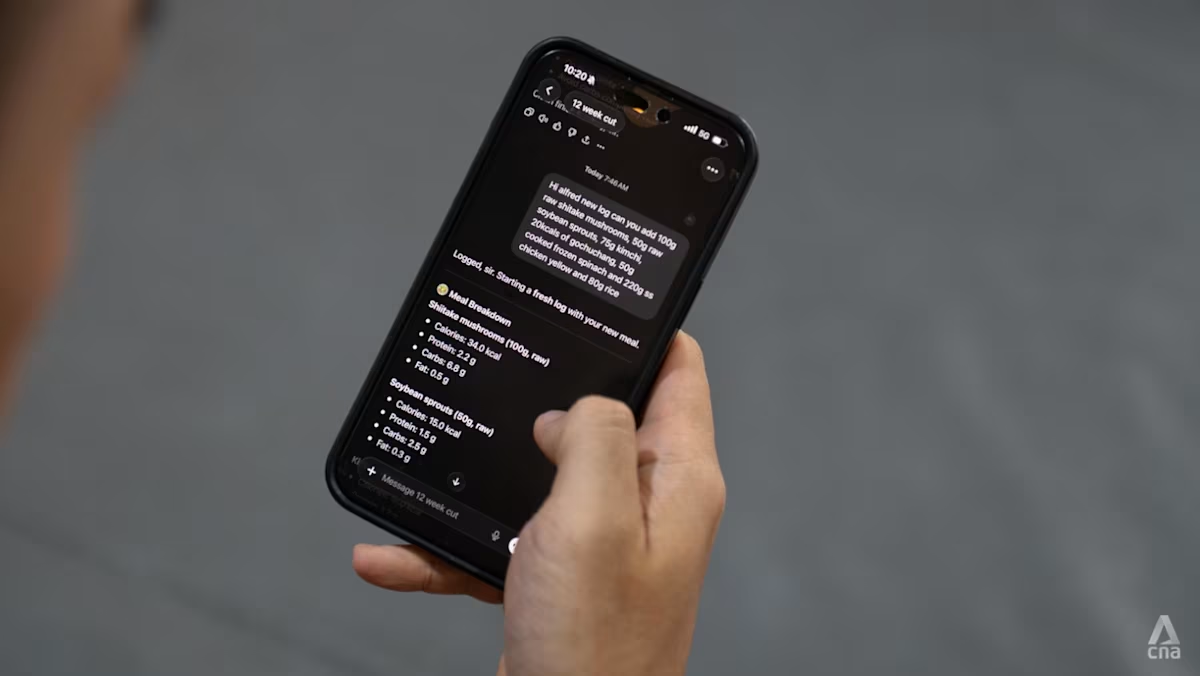
SINGAPORE - For $27 a month, Mr Joel Cutinho gets tailored advice from a coach regarding workout regimes and meals to achieve his goal of getting six-pack abs.The coach is not physically present with him in the gym, but instead is with him 24/ 7 – in his phone. His coach is the Claude Cowork chatbot, an AI tool developed by Anthropic.Since January, Mr Cutinho, 38, has been regularly feeding his digital coach detailed information about his weight, muscle mass and fat percentage – measurements taken at a gym.In return, he gets a detailed rundown of what muscle groups to work on each day, and how much protein he must consume to unlock the next level of achievements.“Until now, I’ve not been able to find such a prescriptive programme which goes down to the nitty-gritty of how I should be eating or working out,” said the senior director of a public relations firm. Within three months, Claude’s advice helped Mr Cutinho lose 5kg and cut 3 per cent of fat, while maintaining the muscle mass he needs to attain a six-pack.His comfort level with using AI tools sets the standard for the kind of competency that Singapore is working towards on a wide scale.Some workers will be proficient in using the tool as AI practitioners, researchers, developers and coders.The national goal is also for every citizen to build the confidence and judgment to use artificial intelligence well – first, in everyday life, and eventually, at work. With AI set to become ubiquitous, AI skills may soon be as essential as knowing how to use a smartphone today to make an online payment, attach a photo to an e-mail, download apps and navigate interfaces.For many, these skills have become instinctive.As AI becomes embedded in routines, similar instincts will be needed. Some of these AI skills include breaking down a problem, crafting clear prompts, checking outputs and spotting the tool’s errors, said experts.When it comes to crafting prompts, people need to know that they have to provide personalised context so that the AI does not return generalised or incorrect answers, said Professor Erik Cambria from Nanyang Technological University’s (NTU) College of Computing and Data Science.A generic prompt for a diet plan may produce a one-size-fits-all answer, the professor of AI said.For an AI-generated plan to be useful, users need to provide details such as their height, weight, body fat percentage and activity level.“If the answer is not catered for you, sometimes it can also be the wrong answer... It may assume a different metabolism and suggest steps that will not work,” Prof Cambria said, noting that such responses may be broadly correct, but not for the individual.A standee displays an advertisement for AI courses pictured at Northpoint City in Yishun on April 18.ST PHOTO: JASON QUAHAssociate Professor Trevor Yu from Nanyang Business School said AI today mirrors the early days of mobile phones and PCs, when casual use gradually built familiarity with and, eventually, reliance on the tools.“With the nature of our economy and the wide-ranging power of AI to transform different industries and different jobs, we need to have wide accessibility of these AI tools so that our citizens and workers will be comfortable when using AI in the workplace,” said Prof Yu. To accelerate that shift, the Government has announced that Singaporeans taking selected SkillsFuture AI courses will get six months’ free access to premium AI subscriptions – a move that aims to take people beyond just using AI as smarter versions of search engines.Compared with free-for-all tools, paid AI subscriptions usually open doors to more advanced models, faster responses and higher usage limits.Slated to begin in the second half of 2026, the free-access initiative will be made available to all Singaporeans aged 25 and above, with plans to later include more mature and lower-income workers. This is just one prong in the national push to build practical AI literacy.Another involves pairing workers’ existing domain expertise with AI know-how to solve real-world work problems.For a start, the Government will work with professional bodies to develop AI fluency programmes for the accountancy and legal sectors – teaching accountants to use AI in areas such as financial reporting and compliance monitoring, and lawyers to use AI for research, document review and contract management.The plan is to train some 100,000 tech-fluent workers across all sectors by 2029.The global AI realm is currently dominated by a United States-China duopoly.The US holds a strong edge in frontier large-language models (LLMs), such as OpenAI’s ChatGPT, Anthropic’s Claude, Google’s Gemini and Meta’s Llama.It also has the advantage in specialised AI chips from Nvidia.Meanwhile, China’s advances are in affordable open-source LLM alternatives, large-scale deployments and manufacturing.LLMs power many applications that understand and generate human language and code.These applications include virtual assistants for customer service support, semantic search (or search based on user’s intent and context), generating code and debugging, language translation and summarising notes.Many corporations today pay monthly subscriptions to use LLMs in all sorts of applications, including chatbots to front customer service helpdesks, human resources queries or legal research.Morgan Stanley uses OpenAI’s GPT-4 to help its wealth management advisers analyse complex research documents.Mercedes-Benz uses Google’s Gemini to power its conversational voice agent in a new line of cars.Chinese internet company Tencent uses DeepSeek’s LLM to power an in-game assistant in its mobile shooting game PeaceKeeper Elite. Alibaba’s AI model called Qwen will soon be integrated as a virtual assistant in vehicles by automakers such as BYD.A drink for you? A robot works at a booth set up along a business street in Beijing on October 22, 2025.PHOTO: AFPChina has also rapidly emerged as the global powerhouse in the production and sale of AI-powered industrial humanoid robots, accounting for the majority of the 16,000 robots deployed worldwide in 2025, according to technology research firm Counterpoint Research.In China, humanoid robots have been put to work in factories, carrying out tasks such as transporting boxes and sorting items, and also as store assistants and “robo-cops” that patrol the streets and direct traffic.Leading robot manufacturers like Unitree and AgiBot are exporting to markets worldwide.Singapore also has its own home-grown AI language model, called SEA-LION. Developed by AI Singapore, it is already being used by Indonesia’s GoTo Group and home-grown tech services firm NCS for its abilities to recognise 13 languages, including Javanese, Sudanese, Malay and Tamil.But SEA-LION is nowhere close to the US and Chinese frontier models in scale and deployment.Singapore’s true edge lies in acting as a living laboratory for test-bedding, validating and scaling industrial AI applications, rather than competing head-to-head with the US and China, said experts.Providing an AI test bed in Singapore for real-world problems is among the recommendations by the Economic Strategy Review committee to drive the country’s economic growth and workforce transformation.Experts added that Singapore’s compact size offers an advantage because its highly concentrated urban landscape facilitates collaboration to bring prototypes from labs into the real world.One example is Project MILA-S, an enterprise-grade AI system developed by Deutsche Bank and Singapore-based AI firm finaXai that can assist investment professionals in constructing their portfolio and making decisions to buy, hold or sell a stock.The solution is designed to be used internally within institutions rather than as a standalone consumer application.NTU’s Prof Cambria said: “Singapore has a highly concentrated financial ecosystem, where global banks, asset managers, fintech companies and digital asset initiatives operate in close proximity.”He added that this is an ideal environment for scaling such institutional AI applications in real-world settings.More than 70 companies from around the world have also set up centres of excellence in Singapore to develop and validate similarly innovative AI uses.Most are drawn here because of the Government’s pro-business stance, availability of top talent and heavy investment in AI, said Professor Venky Shankararaman, Singapore Management University’s vice-provost of education and professor of information systems for education.He added: “With these three factors, you don’t need large pieces of land to test-bed.”Plans are already under way to push AI adoption in four key sectors – advanced manufacturing, finance, healthcare, and connectivity and logistics – under the National AI Council chaired by Prime Minister Lawrence Wong.Singapore is also home to physical test beds for robots, such as Punggol Digital District, which has an estatewide operating system that works with all robots for navigating roads and lifts.The Open Digital Platform, which allows different systems to talk to one another, has attracted companies such as dConstruct Robotics which are testing robots for concierge services, delivery and surveillance.Robots from dConstruct Robotics on display at a robotics fair called RoboSG!, at Punggol Digital District on March 14, 2025.PHOTO: ST FILEAnother similar system is the Robotics Middleware Framework, which was funded by Singapore’s National Robotics Programme (NRP) and developed with partners such as Changi General Hospital, Centre for Healthcare Assistive and Robotics Technology, and Synapxe to become the world’s first standard platform for robotics interoperability.It has been integrated in robots doing cleaning, delivery and teleconsultation at Changi Airport and Changi General Hospital.NRP director Chan U-Gene said: “Robots from different makers may not be able to communicate with each other. But with such systems, companies from different countries can collaborate and validate their solutions here.”For instance, Chinese robotics firms AgiBot and Anhui Huazhi Tiancheng Technology are working with NCS to pilot robots in local fields such as social services, smart buildings and public safety.Singapore also aims to pioneer transparent technology, which is seen in how Project MILA-S justifies its financial advice using concrete data such as stock trend analysis, executive commentary and geopolitical developments.This ability to explain the logic behind AI-generated insights is known as “explainable AI”.Singapore is well placed to push the envelope for such “explainable AI”, said Prof Cambria, noting how the nation has been driving the development of global standards for the safe deployment of AI.“Accuracy and transparency are important for every application, not just in finance,” he added. “We need to know how much we can trust the output of these tools.”AI Verify, Singapore’s flagship AI governance testing framework, is one such effort in this area. It combines technical tests and process checks into a software toolkit, which can be embedded to operate directly within companies’ systems and check AI models for explainability, bias and robustness.The toolkit has helped to test AI models used by companies such as Dell Technologies, IBM and Singapore Airlines.It is hoped that these infrastructure and frameworks, together with AI-fluent workers, will set Singapore apart.Compared with other developed economies, Singapore ranks high in per capita use of AI tools such as Anthropic’s Claude and OpenAI’s ChatGPT, as well as in regulatory readiness and investments in AI, relative to the country’s size.OpenAI’s data shows that about one in four people in Singapore uses ChatGPT weekly.However, enterprise adoption of AI still lags behind other countries such as Denmark, Finland and Sweden. Around 70 per cent of firms here still have not adopted AI in their operations, according to a recent survey by the Ministry of Manpower.Even though the technology offers clear benefits, experts have cautioned that over-reliance on AI can erode users’ cognitive capabilities and judgment.This can also happen among highly skilled workers like doctors, said Professor Jungpil Hahn from the National University of Singapore’s School of Computing.This phenomenon, called deskilling, was documented in a study published in The Lancet Gastroenterology and Hepatology in August 2025, which found that doctors who used AI tools to detect pre-cancerous growths became less adept at identifying them on their own over time.To guard against deskilling, the National University Health System has rolled out AI-free periods since late 2024, during which clinical staff are not allowed to use AI tools.Prof Hahn said: “Having explicit days or periods where you know you have to do the task without AI actually forces the institutions, companies or organisations to maintain that capability level.”Companies should also consider tracking their workers’ capabilities before and after AI use, he added.The challenge, then, is not avoiding AI, but learning how to use it without losing critical skills. This will require countries and societies to implement guard rails and rethink how we can work alongside AI.Prof Cambria said: “We are still learning about how to best use AI, and how to set up AI guard rails. So it’s still early stages, but definitely, we need to learn because there’s no escape, and there’s no turning back again. We cannot go back to an era where AI is not there.”
Living with AI: What is Singapore’s strategy to stand out in the global AI race?
There's been a broad national push to attain AI literacy, to ensure Singaporeans and businesses don’t get left behind. Read more at straitstimes.com. Read more at straitstimes.com.
2,061 words~9 min read