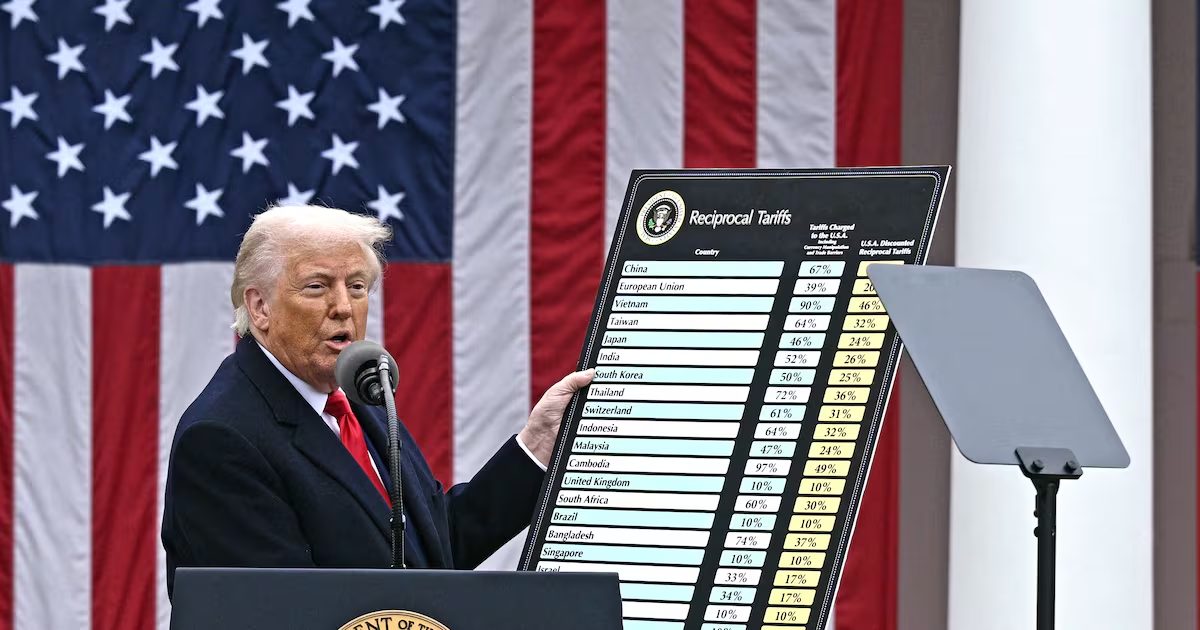
It is hard to believe that US president Donald Trump’s Rose Garden speech- and subsequent efforts to “rebalance” the global trading flows- took place just over a year ago. In the volatile world of international trade, that year feels like a lifetime. The ebbs and flows of protectionism have a way of warping our sense of time, yet they serve as a stark reminder of why we cannot afford complacency. As a small, open economy, it is a necessity to understand where our future lies. European Movement Ireland’s most recent research shows that Irish attitudes toward the European Union remain overwhelmingly positive, at 82 per cent, with trade consistently seen as the EU’s strongest area of performance. While this has dipped slightly from the post-Brexit peak of more than 90 per cent, it remains a bedrock of our national identity. In part, the slight cooling may be due to the Republic’s extraordinary wealth right now. Our current trajectory shows we are on course to be the wealthiest state per capita in Europe by 2030. The Irish economy has trebled in the past 12 years, representing a remarkable business and economic success story. We rightly credit many domestic factors and our historical ties to the US, and in this context it is vital that the EU swiftly concludes its ongoing trilogue negotiations to implement the EU-US Joint Framework Agreement. However, the fundamental impetus for our growth has been the pursuit of globalisation and an unshakeable openness to global opportunities. The past year alone has shown us a seismic shift in international relations. The unpredictability of the US attitude to globalisation, coupled with the broader competitiveness challenges for Europe outlined in the Mario Draghi report, presents a real risk to how Ireland charts its future. With 85 per cent of future economic growth predicted to take place outside of Europe, a proactive, outward-looking common trade policy- paired with the ability to attract investment- remains among the EU’s most powerful assets. With China as a formidable strategic competitor, Europe has rightly moved to strengthen bilateral partnerships and rapidly accelerated its trade agenda to secure Europe and Ireland’s economic future, even if it isn’t always fully appreciated. This has culminated in the recent provisional application of the EU-Mercosur interim trade agreement, alongside the landmark conclusion of free trade negotiations with Australia and India in past 12 months. These deals enhance trade co-operation with third countries and deliver the market diversification that Irish businesses desperately need. As we edge closer to the State assuming the EU presidency, we must acknowledge that Europe is the engine propelling our future economic opportunities. Of course, it is not perfect; Ireland will need to use its voice within Europe to resist the development of any broad protectionist policies, such as wide scale application of “European preference” criteria, particularly at a time of such geopolitical change, high energy costs and AI disruption. While Ibec disagreed with the Government’s decision to vote against the Mercosur trade agreement, the European Commission’s decision last week to proceed with a provisional implementation of the agreement is a vital milestone. This ensures that years of negotiations will not be lost, acting as a stand-alone agreement until the full deal enters into force. The benefits for Europe are substantial, including the elimination of tariffs on more than 91 per cent of EU goods. This will save businesses €4 billion annually and create immediate export opportunities, particularly in our world-leading pharmaceuticals and chemicals sectors. Mercosur now provides access to a market with a combined GDP of €2.2 trillion and 273 million consumers. [ Mercosur is good for Ireland but Micheál Martin is afraid to say itOpens in new window ]For Ireland, this means a boost to trade in services covering finance, telecommunications and transport, enabling Irish firms to expand on equal terms with domestic competitors. During our upcoming presidency, Irish business leaders will be clear in their support for the full implementation of the broader EU-Mercosur deal. While the Government must continue to engage with sensitive sectors to ensure safeguards are in place, we cannot ignore the raw materials and market access this deal secures. It may have also gone under the radar that the final phase of Ceta, the major free-trade deal between the EU and Canada, is currently progressing through the final legislative stages in Ireland. If Mercosur has been met with trepidation in certain quarters, we only have to look at the benefits already gained from Ceta. Since 2017, two-way trade between Ireland and Canada has jumped from roughly €3.2 billion to a projected €12 billion in 2026. With 99 per cent of all tariffs eliminated, Irish exports such as dairy and machinery are cheaper in Canada, and Irish companies can now bid for Canadian government contracts at federal, provincial and municipal levels – an opportunity rarely granted to non-Canadian firms. Furthermore, Ceta protects the integrity of our heritage through geographical indications, ensuring that products such as Irish whiskey and Irish cream cannot be imitated by Canadian producers. It also includes specific supports for small and medium enterprises to help them navigate the complexities of accessing the Canadian market. [ Mark Carney tells Irish business leaders of Canada’s desire for closer trade linksOpens in new window ]As a small, open economy, Ireland’s future is written in these types of agreements. We must use the Irish presidency to act as a leading voice for an EU that continues to support a rules-based international trading system and maintains close dialogue and co-operation with key trading partners like the US, while also remaining well aligned with Europe’s need to pursue new trading alliances. The EU is attempting to show real agility and adaptability in the changing global trading order. We must use the coming presidency to reaffirm this commitment. It is, after all, in Ireland’s interest, too. Danny McCoy is chief executive of Ibec
Danny McCoy: Ireland should use EU presidency to support push for new trade deals
It is in State’s interest that EU continues to support rules-based trading and maintains close co-operation with key partners such as US
977 words~4 min read