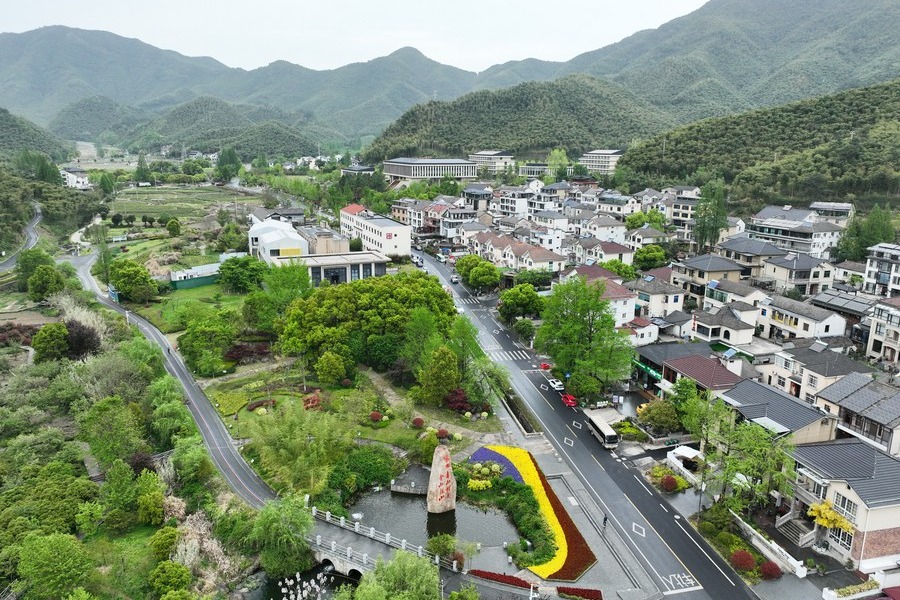
This aerial photo taken on April 13, 2023 shows Yucun village of Anji county, Huzhou city, East China's Zhejiang province. [Photo/Xinhua]
Since reform and opening-up, China has emphasized a development-oriented approach to poverty alleviation. In contemporary China, labor is the main determinant of distribution, with individuals paid according to their work. For this reason, poverty reduction is achieved primarily by enabling people to earn income through useful employment.
At the same time, China has balanced its development-driven measures with welfare-oriented tools.
For example, as not all rural households could support themselves through work, the minimum living allowance system, known as the dibao system, was extended to rural areas in 2007. This program provided unconditional cash transfers to the rural poor.
In 2003, a new rural cooperative medical system — an affordable public insurance program for rural residents that covers inpatient services and catastrophic illnesses, with rising reimbursement rates — was put in place. By 2013, this program had covered nearly 99 percent of the rural population.