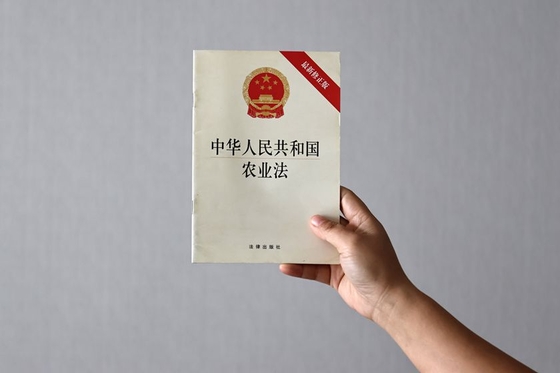
1. China is revising its foundational Agriculture Law for the first time in 14 years; the draft was submitted to the 22nd session of the 14th National People’s Congress Standing Committee and is open for public comment until May 29 [para. 1][para. 3].2. Enacted in 1993, with major revision in 2002 and minor changes in 2009 and 2012, the current law has 99 articles in 13 chapters; the draft expands to 110 articles in 14 chapters, splitting one chapter into "Protection of Agricultural Resources such as Land" and "Agricultural Green Development" [para. 2][para. 3].3. The revision incorporates new perspectives, recognizing transmission of agricultural heritage as a core function and mandating inheritance of traditional Chinese farming culture [para. 4].4. Food security definition broadens from staple grains to a macro-food approach, aligning with the 2023 Food Security Law [para. 5].5. Agriculture now includes new business models like ecotourism and leisure agriculture, promoting integration of rural primary, secondary, and tertiary industries to optimize economy and county-level industries [para. 6].6. Unlike the 2002 revision's focus on surplus rural labor transfer to non-agricultural sectors via township enterprises, the draft drops "surplus labor," emphasizing rural labor mobility, multichannel employment, and a unified urban-rural human resources market with equal services [para. 7][para. 8].7. Recent policies elevated to law include interprovincial compensation for grain-producing areas via financial transfers in the 15th Five-Year Plan, compensating for lost land development rights; pilots treat funds as local fiscal revenue [para. 9][para. 10].8. New arable land protection compensation rewards operators and collectives for farmland duties and high yields, detailed in the ongoing Arable Land Protection and Quality Improvement Law draft [para. 11].9. Agriculture-related bonds are encouraged for funding, with government bonds prioritizing modern agriculture, reflecting recent superlong sovereign and local bonds [para. 12].10. Amid extreme weather, the draft mandates agricultural disaster prevention in rural infrastructure and proactive climate change measures, per 15th Five-Year Plan [para. 13].11. Farmers' income growth is central, aiming to narrow urban-rural gaps and advance common prosperity [para. 14].12. Rural migrant workers gain mandates for equal employment rights, pay, wage protection, and social security [para. 15].13. Grain producers get a comprehensive income safeguard via price-support (not protection), multitiered insurance with subsidies for rice, wheat, corn, soybeans, and state-backed risk dispersion [para. 16].14. Prohibits forced destruction of young crops or prime-bearing fruit trees to resolve land conflicts [para. 17].15. Enhances rural social security with unified urban-rural compulsory education funding, better school food safety, compensation for expropriated land farmers, and shift from rural cooperative medical to national insurance framework [para. 18].AI generated, for reference only
China Overhauls Agriculture Law to Secure Food Supply and Boost Rural Incomes
The sweeping revision aims to codify financial compensation for grain-producing regions and integrate rural labor markets
424 words~2 min read