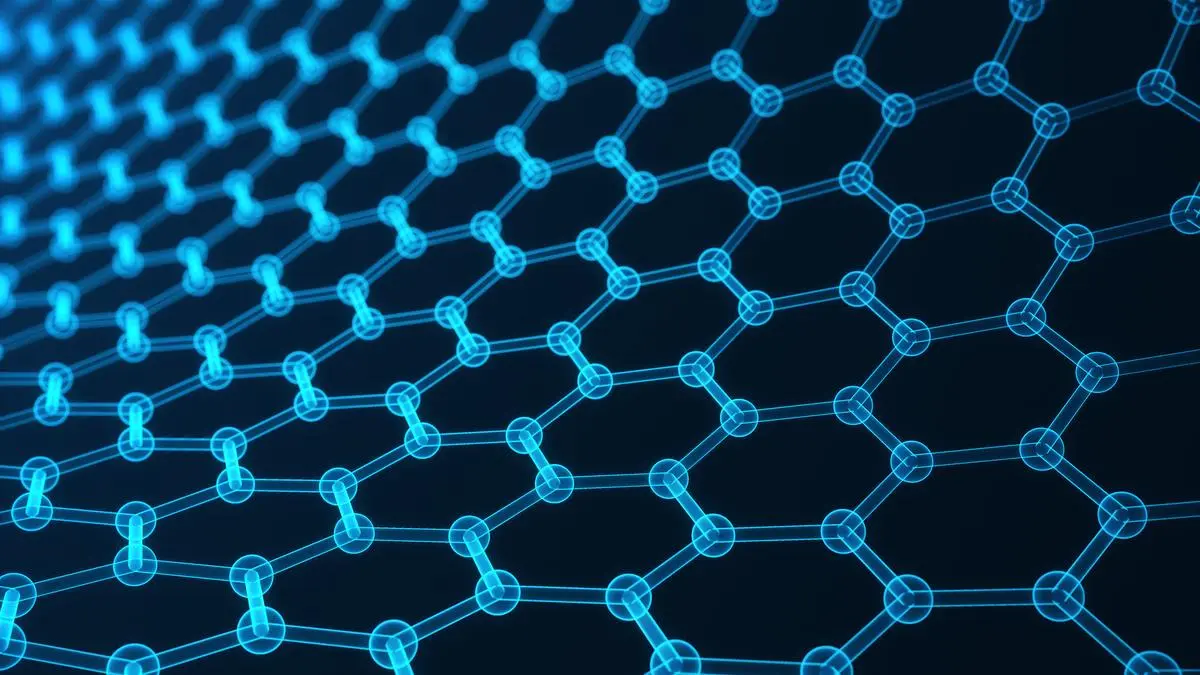
Graphene atomic structure
| Photo Credit:
Rost-9D
It is commonly known that lithium-ion (Li-i) batteries can be recycled. But the focus is mostly on salvaging nickel, cobalt and manganese. Their poor cousin graphite is generally ignored; it cannot be reused in new Li-i batteries as it loses the structure needed to function effectively.However, this ‘spent’ graphite finds use in a different application. It can help extend the life of a methanol fuel cell.Ordinarily, graphite needs to be ‘exfoliated’ before it can be used in a fuel cell. Exfoliation in this context means the breaking down of bulk graphite into several layers so as to increase the available surface area. Greater the surface area, the better the conductive support in a cell.The exfoliation of fresh graphite consumes significant amounts of energy. A spent Li-i battery, on the other hand, gives you ready-made exfoliated graphite after the mechanical stress it has undergone in the battery through repeated use. In other words, the very reason graphite is discarded from batteries makes it useful in fuel cells.Methanol fuel cells typically suffer from a ‘leakage’ of methanol, leading to its interaction with the platinum used in the cell, making the precious metal less effective. Leaking past the membrane separating the anode and the cathode, methanol oxidises to form carbon monoxide, which ‘poisons’ the expensive platinum. This affects the cell’s efficiency and longevity.Prof Raman Vedarajan leads a team working on this issue at the Advanced Research Centre for Powder Metallurgy and New Materials (ARCI), under the government’s Department of Science and Technology. Says Prof Vedarajan, “In collaboration with the Institute of Minerals and Materials Technology, we cleaned the spent graphite of metallic contaminants and applied it as a ‘scavenger’ in the DMFC (direct methanol fuel cell).”He explains that the “exfoliated graphite helps capture the permeating methanol before it reaches the platinum catalyst”.Asked how the new piece of research helped save on cost and/or effort, he replies, “DMFCs typically run for about 15,000 cycles. Using exfoliated graphite can help extend the life of these cells to 20,000 or even 25,000 cycles.”The research has been validated in a lab. According to Prof Vedarajan, “There is sufficient proof that it can work, so a prototype is being built.” This could help manufacturers not only reduce battery waste but also address another environmental headache — fuel cell inefficiency.Published on May 18, 2026