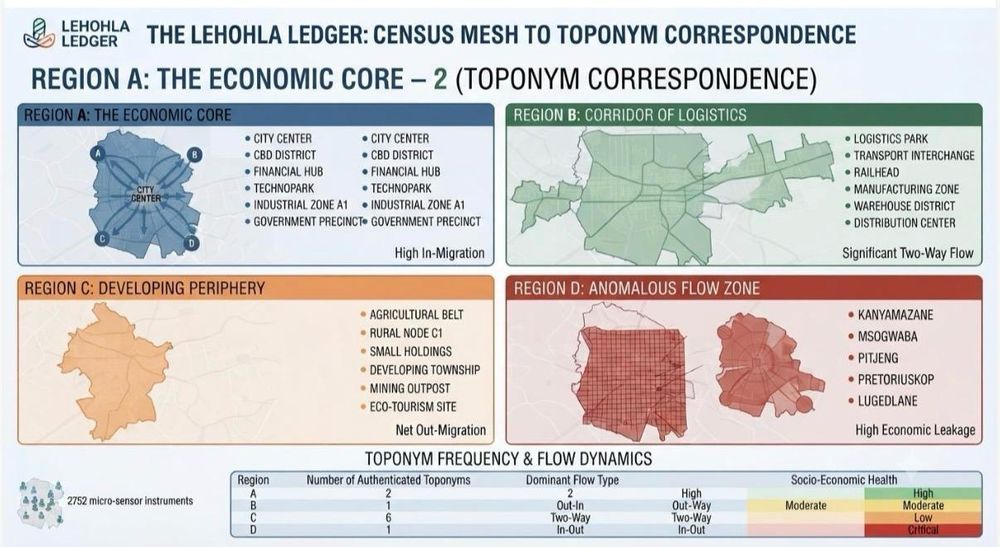
Explore how Zipf’s Law, a cornerstone of urban hierarchy theory, fails to accurately depict South Africa’s complex spatial economy, revealing deeper issues of inequality and economic decay.
In the theater of regional science, few laws carry the gravitas of Zipf’s Law.
It is the gold standard for urban hierarchies, suggesting that in a functioning economy, the second-largest city will be half the size of the first, and so on.
It implies a natural, almost organic, rank-size regularity.
However, as my recent intellectual banter with Azania Matiwane suggests, applying this "law" to South Africa without the rigour of the Lehohla Ledger is like admiring the smoothness of a veil while ignoring the disfigured face beneath it.