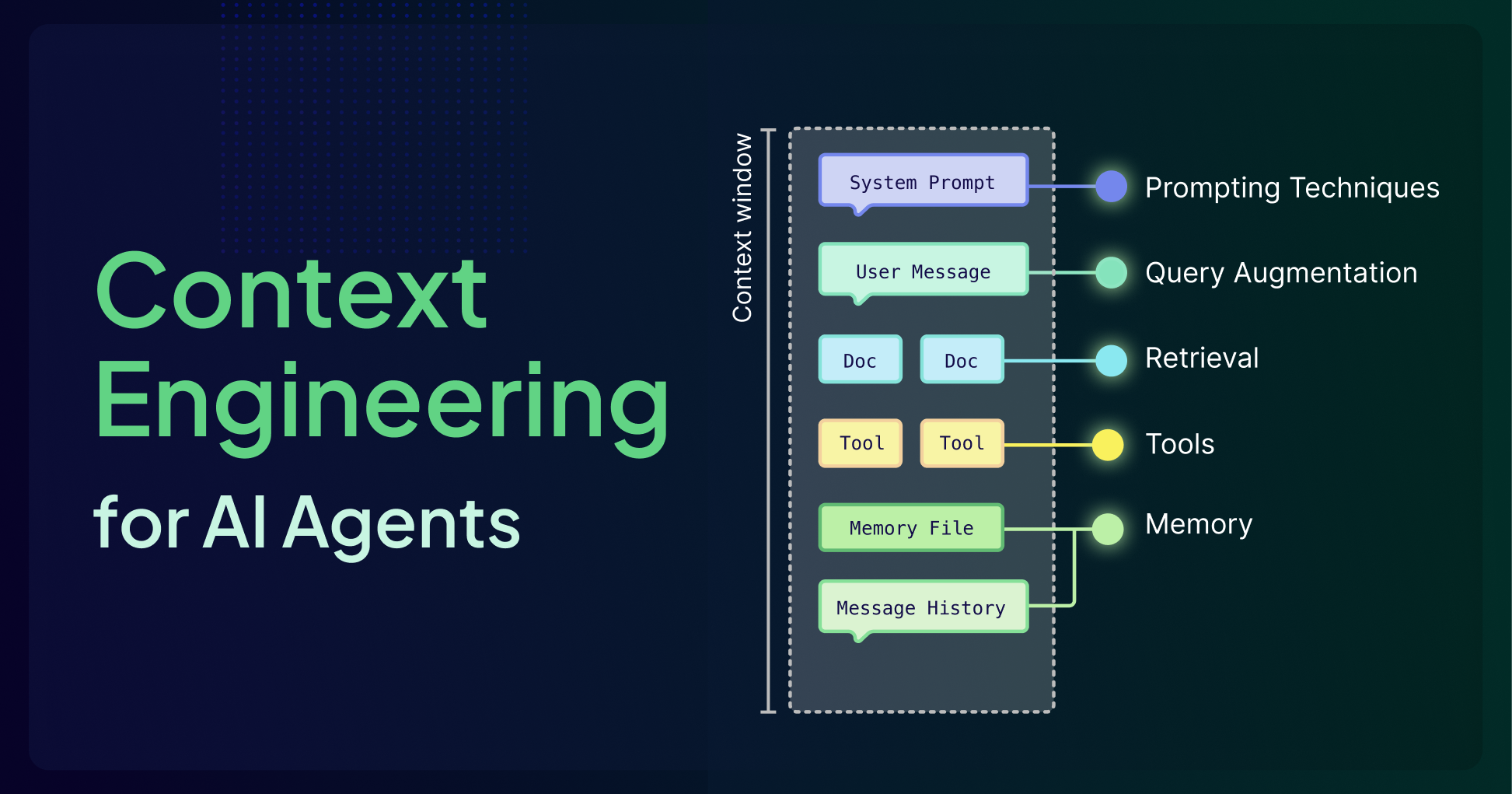
Putting the Pieces TogetherLLMs are getting better, faster, and smarter, and as they do, we need new ways to use them.Applications people build with them have transitioned from asking LLMs to write to letting LLMs drive actions. With that, comes new challenges in developing what are called agentic applications.Context engineering is a term that attempts to describe the architecting necessary to support building accurate LLM applications. But what does context engineering involve?Hallucinations Constrain AI ApplicationsMuch has been made of the potential of agents to complete tasks and revolutionize industries. Still, if there’s one thing that has passed the test of time, it’s that LLM applications will always fail without the relevant information. And in those failures, come hallucinations.Multiple tool calls, messages, and competing objectives blur instructions in agentic applications. Due to these diverse integrations all competing for a fixed (literal!) attention span for a model, a need arises for engineering their integration. Absent this, models default to their world knowledge and information to generate results, which can result in unintended consequences.Context engineering is an umbrella term for a series of techniques to maintain the necessary information needed for an agent to complete tasks successfully. Harrison Chase from LangChain breaks down context engineering into a few parts:actions the LLM can take (tool use)instructions from the user (prompt engineering)data related to the task at hand, like code, documents, produced artifacts, etc (retrieval)historical artifacts like conversation memory or user facts (long and short term memory)data produced by subagents, or other intermediate task or tool outputs (agentic architectures)Context Engineering requires putting together many building blocks of context generated from various resources, into a finite context windowAll of these must fit into a finite context window for applications to succeed.Retrieval and vector databases are uniquely impactful for these applications, as they help retrieve the external information in various modalities and representations necessary to ground responses with context. But just having the context isn’t enough.Organizing, filtering, deleting, and processing this information so that an LLM can continue to focus on the task at hand is context engineering.Applying Lessons from Retrieval-augmented Generation to Context EngineeringNow if you’re reading this far, you might think, oh no!! Another technique for the aspiring AI engineer to learn, the horror! How will you ever catch up!?!Not to fear. If you’ve built any search or retrieval-augmented generation application before, you already know a lot of the principles for context engineering! In fact, we can make the argument that context engineering is just a step-up abstraction of prompt engineering for RAG applications.How, you ask?Imagine you’ve built an application for helping answer incoming customer support tickets. It’s architected as follows:Take an incoming user query, and query your semantic search which indexes documents from your companypass the retrieved context to an LLM, like Claude or OpenAIAnswer user queries using the contextAccordingly, the application has access to a knowledge base of information that might include previous support tickets, company documentation, and other information critical to respond to users.You might use a prompt like this:You are a customer support agent tasked with helping users solve their problems.
What is Context Engineering? | Pinecone
Learn about context engineering and how to apply it to your AI Applications.
1,359 words~6 min read