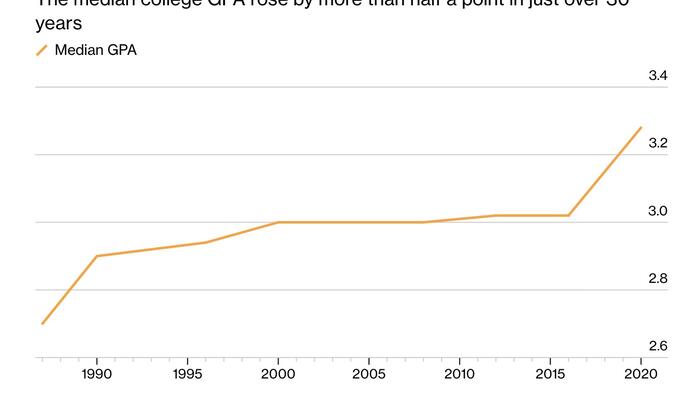
America’s oldest and most prestigious university may soon be deliberately taking many of its students down a notch. This week, Harvard faculty members are voting on a contentious proposal to rein in rampant grade inflation, which would dramatically change how the highest marks are awarded to undergraduate students. Other universities have tried and failed to implement grade caps, and the faculty who designed Harvard’s plan have tried to learn from their mistakes. The proposed changes include not only a cap on how many A grades teachers can give to students, but an entirely new system for ranking which undergrads are really the best of the best. Not surprisingly, the proposal has prompted fierce debate within the Harvard community and beyond. Here’s a primer on what’s happening and the arguments for and against limiting A’s.
Faculty are voting on three separate provisions of a proposal made by Harvard’s faculty grading subcommittee, which would make major changes to how the school evaluates undergraduates. Each only requires a simple majority to pass.
(1) A “20 percent plus 4” cap on A grades Instructors would only be able to award A’s to 20 percent of undergraduate students enrolled in a course, with the option of awarding A’s to an additional four students per course, regardless of the size of the class. That provision is meant meant to protect students enrolled in small seminars.