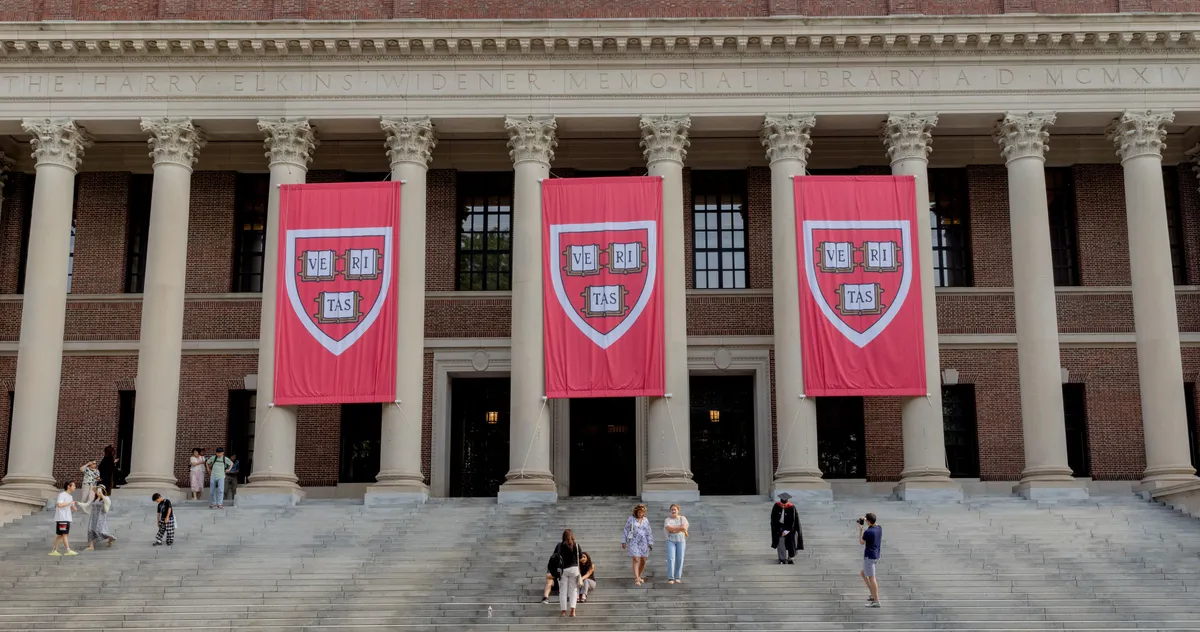
Harvard University is making several changes to its plan to fight undergraduate grade inflation, including delaying for one year a proposed 20% cap on A grades in a given class.gettyHarvard University plans to postpone its proposed cap on the number of A grades faculty can assign to undergraduates in any given course for one year. That’s one of the substantial changes to the university’s recent grading standards proposal that Dean of Undergraduate Education Amanda Claybaugh announced on Monday, according to The Harvard Crimson. In a coordinated attempt to fight grade inflation, a Harvard faculty committee had recommended that faculty limit the number of A grades they would hand out in every undergraduate class to 20%, plus an allowance of up to four additional A’s per class. In a 19-page report released in February, the committee had proposed two major changes to Harvard’s grading system: a 20% cap on A grades, emphasizing that A’s should be reserved for work of “extraordinary distinction,” andranking students by their percentile standing in each course, a numeric summary that would then be used in place of a grade point average to calculate internal university honors. Because small courses are more likely to “attract advanced and highly motivated students,” the committee further recommended giving faculty the flexibility to assign an additional four A grades above the 20% limit for each class. For example, in a class with 20 students, 8 A grades would be permitted, while in a course of 100, the instructor could allocate 20+4 = 24 A’s.No caps were proposed for other grades, and two earlier suggestions that had been discussed — allowing the use of A+ grades and listing median course grades on student transcripts — were not included in the February report.RevisionsThe revised grading plan, which was revealed following weeks of campus debate and student criticism of the original proposal, makes three changes.MORE FOR YOU1. It delays implementation of the cap on A grades for one year, pushing back the effective date from the 2026-27 academic year to the fall of 2027.2. It allows a new “SAT+” grade for instructors who wanted to opt out of the cap on A grades for their course. While the original plan would have permitted them to use a “satisfactory/unsatisfactory” evaluation system rather than letter grades, the SAT+ grades would allow faculty to make an evaluative differentiation between students who course performance is superior compared to those whose work only meets the “satisfactory” threshold. However, the distinction between SAT and SAT+ grades will not count toward internal recognitions like honors or other requirements.3. It revises how the 20% cap on A grades will be calculated. The cap will now apply to the total number of undergraduates enrolled in a course, including students taking it on a pass/fail basis, rather than only those receiving letter grades.The revised proposal will be voted on by the Faculty of Arts and Sciences next week.BackgroundThe original grading proposal came on the heels of a 25-page report, released last October by Dean Claybaugh, which found that grade inflation had become a serious problem at Harvard and was undermining the key functions of a good grading system. More than 60% of all undergraduate grades at Harvard were A’s in 2024-25 – more than double the level of 20 years ago. According to The Crimson, the proportion of students receiving A grades has risen by 20 percentage points since 2015. While the Class of 2015 had a median graduating GPA grade of 3.64, the Class of 2025 stood at a 3.83 average. Since the 2016-2017 academic year, the median Harvard College GPA has been an A. Last fall, after the university encouraged faculty to clamp down on the number of A grades they handed out, the share of A’s dropped from 60.2% in the 2024-2025 academic year to 53.4% in fall, 2025, according to The Crimson. Nonetheless, Harvard leaders concluded that more needed to be done to restore rigor in student evaluations by employing a grading system that at the top end made meaningful distinctions in evaluating academic performance.The committee emphasized that the recommendations were intended to serve both the internal and external roles of a rigorous grading system.The internal use provides information about students’ performance for university purposes, such as “determining levels of honors, selecting recipients of awards and prizes, and establishing eligibility for fellowships and scholarships." Such uses "only make sense if GPA is a meaningful signal of relative performance," wrote the committee.The external role of grades helps inform external audiences about student performance. But the report suggested that grade compression was causing employers and graduate and professional school admissions officers to complain that “Harvard transcripts no longer provide them useful information about the performance and distinction of Harvard students, forcing them to rely on informal networks ofinformation that advantage students with better networking connections.”Harvard faculty have been generally supportive of the grading proposal, although some have raised concerns about how it might affect small, upper-division courses. Students, on the other hand, were quick to condemn the original recommendations. A Harvard Undergraduate Association survey found that almost 85% of the nearly 800 respondents said they would “definitely not” support the policy. Grade inflation has been recognized as a national problem for years, and it’s not unique to Harvard. It’s been occurring at all kinds of colleges and universities and in almost every undergraduate major. According to one review, citing statistics from the National Center for Education Statistics, while the the average college GPA was 2.81 in 1990, it had increased to 3.15 by 2020.
Harvard University Plans To Delay Its Cap On A Grades For One Year
Harvard University is planning to postpone for one year its proposed cap on the number of A grades faculty can assign to undergraduates in any given course.
922 words~4 min read