The hallowed history of student pranks (often known as hacks) at MIT includes the annual Baker House Piano Drop and the MIT weather balloon at the Harvard-Yale football game in 1982. One hack that has shown remarkable staying power in local lore is the 1958 measurement of the Massachusetts Ave. Bridge in “smoots,” a now accepted unit of meausrement named for the 5-foot, 7-inch Oliver R. Smoot Jr. ’62. Then a first-year pledge at the Lambda Chi Alpha fraternity, Smoot famously laid down hundreds of times across the span one storied night as his peers painted markers across the bridge, totaling 364.4 smoots (plus 1 ear). Nearly 70 years later, the smoot markings remain.
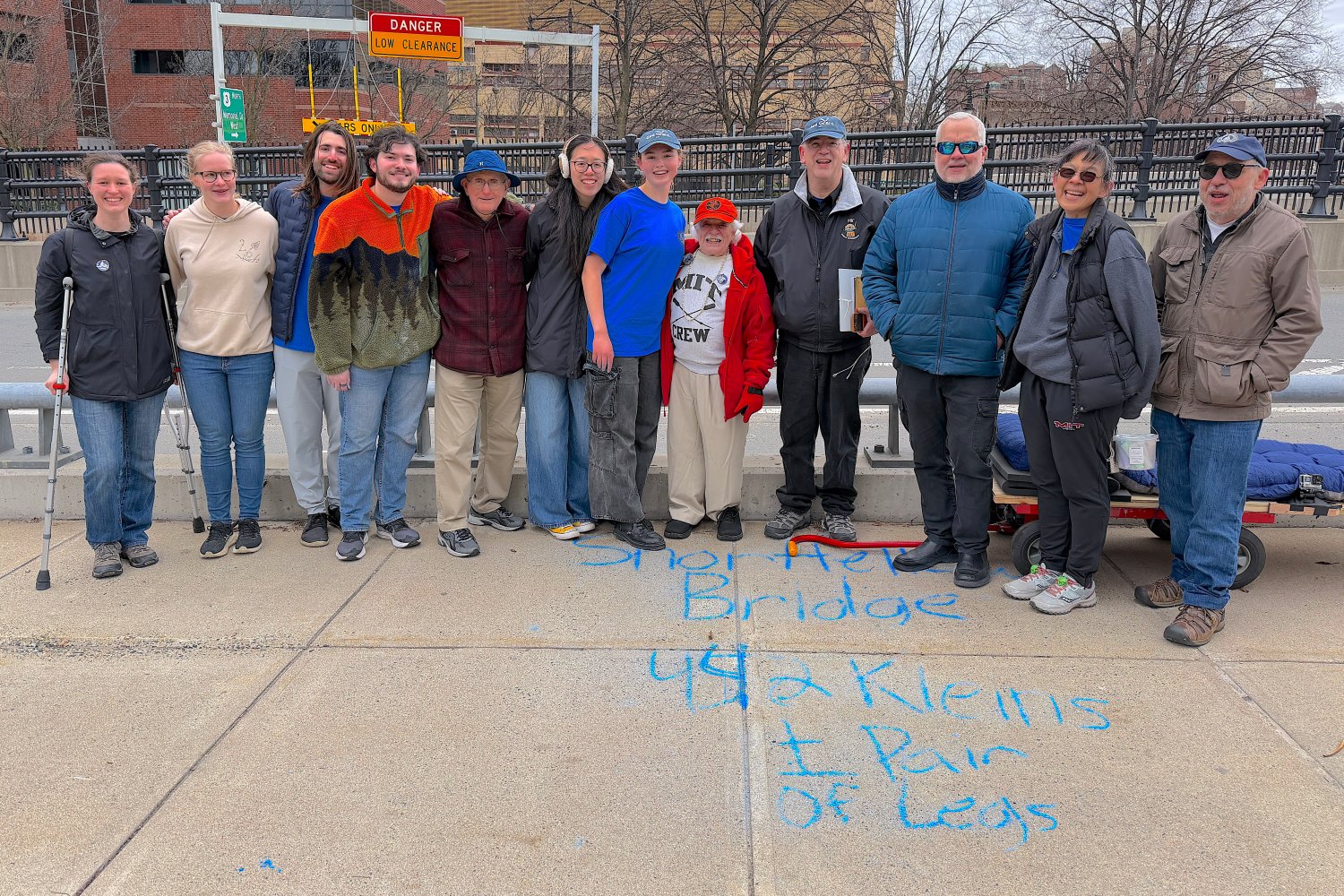
On April 4, an MIT team set out on a similar journey across the Charles River to pull off a new hack, this time measuring the Longfellow Bridge in “kleins.” This new measurement is named after Smoot’s classmate Martin Klein ’62. One klein (4 feet, 9.5 inches) is equal to 0.85820896 smoots. The expedition was undertaken in honor of both Smoot and the 85th birthday of Klein.
Known as the father of commercial side-scan sonar, Martin Klein serves on the MIT Sea Grant Advisory Board and the MIT Museum Collections Committee. He is a life fellow of both the Marine Technology Society and the Explorers Club, an international organization dedicated to the advancement of field exploration and scientific inquiry. His sonar technology has been used worldwide to help locate countless famous shipwrecks, including the Titanic, the World War I ocean liner RMS Lusitania, and the treasure-laden Nuestra Señora de Atocha.