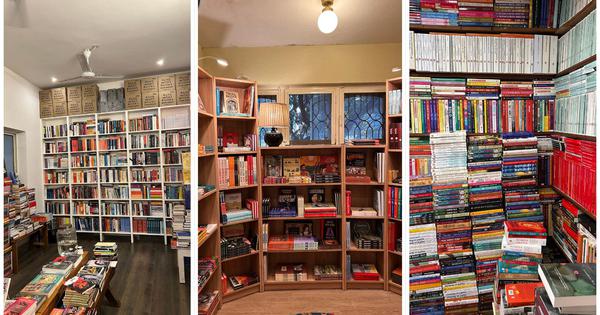
The recent heavy rainfall in Bangalore that flooded the city’s beloved bookstore, Bookworm, became national news. Patrons and booklovers alike wrote to its proprietor, sending wishes, offering financial support and orders to buy books. Readers in Bangalore also went to the store the day after to rescue injured books. India in bookstoresBookworm is one of the few independent bookstores in the city and indeed, all of India. An independent bookstore is defined simply as a bookstore run independently and not by a big retail chain. There are other markers too. It is often incredibly well curated: it simply cannot have all the new releases cramming its shelves, and curation becomes a way to contain its multitudes. In beautiful Margao, Goa, Dogears has curated shelves on, among other things: marginalised voices in literature, on books about books, and books on cities. The bookshop assistants draw attention to how the shelves have been stacked. Shoes have to be left outside.The location of a bookstore sometimes dictates the existence of specific stacks. Dogears has a section dedicated to the history, literature, and the being of Goa. There is also an entire floor dedicated to pre-owned books and children’s books. Relatedly, situated on the iconic Assi Ghat in Benares, Harmony has a staggering collection on Benares and an even more impressive collection on critical and literary theory and philosophy. Setting up shop at the nearby Banaras Hindu University for conferences is one way of ensuring footfall, but it has not restricted itself to being the hotspot for just students and professors. Further east from Benares in Bhubaneswar, Walking Bookfairs derives its name from its origins: it was a bookstore on wheels for several years. This is reminiscent of a lost reading culture: books in motion, carried by porters from house to house, books being bought at fairs. About the centrality of fairs, Tyler Williams writes:Attendees came to satisfy not only their sense of devotion but also a desire for the pleasures to be derived from music, storytelling, food, and purchasing goods. It is difficult to estimate the extent to which books were a regular commodity in the precolonial period, but the ubiquity of printed books for sale at religious festivals during the colonial period suggests that a market existed. There is no doubt that religious professionals used these festivals as an opportunity to trade in books: as indicated by the colophons in manuscripts, it was common for monks and other peripatetic religious professionals to copy manuscripts while attending. The more holy men at a religious festival, the better the chances of finding a desired work from which to make or commission a copy.Books were not only bought, but also copied and written by religious professionals. The burgeoning print culture of the 19th century created readers in women. The fairs became a site where women thronged and found books. Francesca Orsini cites Yashoda Devi, the bestselling ayurvedic sexologist of the 20th century, who lamented these throngs:For two to three years, I sent my books on women’s education to the Magh mela on the banks of the Triveni. The women who came to purchase books went away after seeing my stall. They named juicy novels and used to demand them specifically, as well as the likes of Albela Gavaiya and Ghazal sangrah [two songbooks]. Shops that sold such useless novels reported brisk sales.Outside of fairs, readers encountered books at other public places like the bazaar, where “chapbook sellers doubled as storytellers, and storytellers kept some books for sale as they stood at crossroads in bazaars and fairs, blaring out their wares and their tales.” Public gatherings are still active sites of bookselling: Deekshabhoomi, Nagpur, the historic site where BR Ambedkar embraced Buddhism, is thronged by lakhs on Dhamma Chakra Pravartan Divas. Tejaswini Tabhane writes, “hundreds of booksellers can be found distributing anti-caste literature at impromptu stalls”.Bookstores also developed as a natural extension of the printing press boom in cities like Kolkata, Banaras, Allahabad, Agra, and Lucknow. Nawal Kishore Press, the publishing behemoth of the 19th century, had a bookstore on site at the press in Lucknow. The location of the press and the bookstore has recently been fashioned to a series of cafés and luxury boutiques. The complex is called “Le Press”.Cultivating romanceBut books were not always bought; they were prominently circulated through libraries. At the turn of the 20th century, Kamala Satthianadhan single-handedly ran an English-language women’s magazine, The Indian Ladies Magazine, out of a small town where books only travelled through a library route. In a memoir of her mother’s life, Satthianadhan’s daughter Padmini Sengupta describes the quiet excitement that accompanied the arrival of a “library box”:Kamala, therefore, subscribed to the Literary Society of Madras and a large box would arrive by train every few days. Kamala was a prolific and fast reader. Sometimes I would sit on her lap and watch her eyes travel across the page at a speed which I could scarcely follow. How, I used to wonder, could she so rapidly take in the sense of what she was reading. As soon as she finished her books she would return the box to Madras, and in the meanwhile a second box would arrive. Two boxes were thus kept in constant service. I would always be there when a box was opened, in the leisure hours after our early dinner. The books thrilled me though I could understand little if anything of what was written in them.Independent bookstores as a place to stand, browse, and read are, therefore, just one recent iteration. Chain bookstores represent another such iteration, often imagined as mall-based bookshops; their earliest versions can arguably be traced to iconic establishments like AH Wheeler & Co. and Higginbothams. The story of Wheeler extends beyond the big metros to other cities and towns, its rhetorical ubiquity prompting Lalu Prasad Yadav to quip in 2004: “Angrez chala gaya lekin Wheeler rah gaya” (The British have left but Wheeler remains behind).The case against or for Wheeler may be rooted in anti-colonial rhetoric or even nostalgia for some but its greatest contribution has been access to pleasure. I was always in love with books but intimidated by bookshops. Travel meant access to books, and apart from libraries, railway stations and movement legitimised the right to read for pleasure (there was no place for it otherwise in a home like mine). Current-day Wheeler stalls are struggling, leading to many contract renewals as multi-purpose stalls (MSP): more packaged snacks than books. Wheeler’s five-year contract with the Mumbai division of the railways to function concluded on March 31, and Wheeler stalls are all set to be phased out.The threat of financial instability is never far from either chain or independent bookstores. In this context, cultivating the romance of the independent bookstore is not only useful but necessary: it is a mark by which bookstores find their users. Independent bookstores with thousands of social media followers speak to this market. Upmarket Khan Market, a bastion of well-heeled shoppers (it remains one of India’s most expensive retail locations), is home to Bahrisons Booksellers, a bookstore born in 1952 from the hard work of refugees. The postcard-perfect Faqir Chand Bookstore is also nestled in the same market. The charm of physical books, an aesthetic setup – independent bookstores, with their carefully cultivated identities and tactile environments, are well-positioned to meet this demand.In college, when I had little money, I was more at home at the open-faced bookstores displaying their pirated and second-hand wares on the streets of Daryaganj and Connaught Place. I was put at ease by the wonderful proprietor and keepers of The Bookworm, where I was taught that it was okay to just look. No problem. No charge. The Bookworm shut down in 2008. Emboldened, I spoke to the proprietor of Fact and Fiction about procuring books from abroad. Fact and Fiction too shut its doors in 2015.These days, I buy all my books from the exceptionally well-curated bookshop, The Bookshop Inc. The rule is broken on special occasions when I learn of an independent bookstore when I’m travelling.Aakriti Mandhwani is an Associate Professor at the School of Humanities and Social Sciences, Shiv Nadar University. She is the author of Everyday Reading: Middlebrow Magazines and Book Publishing in Post-Independence India.
How lovingly curated independent bookstores are helping reading culture grow in India
Writer Aakriti Mandhwani writes about her trysts with India’s various independent bookstores.
1,381 words~6 min read