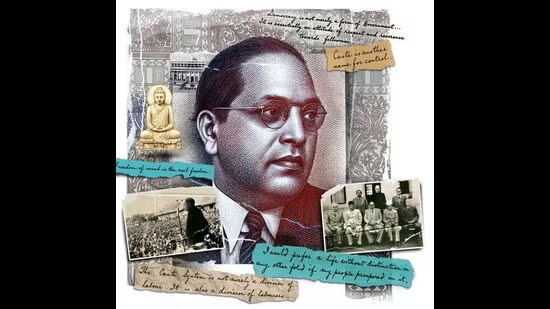
He was told, in a hundred different ways and from an early age, that he occupied a place at the bottom of an order that was both natural and sacred.(Above left) Ambedkar delivers a speech. (Above right) Ambedkar, at centre, with members of the drafting committee of the Constitution, in an image from 1947. (Images: Wikimedia; HT Imaging: Puneet Kumar)He was made to sit apart and on the floor in classrooms, denied water from common pots, turned away from guesthouses, and barred from facilities in tourist spots. He spent years trying to create a space for marginalised castes — organising, petitioning, negotiating — only to watch platitudes arrive and evaporate.Bhimrao Ramji Ambedkar watched caste operate as the architecture of daily life, shaping thirst, silence, death.In 1935, something shifted. He was still smarting from the moral coercion of Mahatma Gandhi’s fast unto death, which saw him yield and sign the Poona Pact in 1932 (which eliminated separate electorates for “depressed classes” and replaced them with reserved seats within a general electorate).He was growing steadily exasperated with Hindu society, cynical about the intentions of so-called reformers, and disillusioned with the Congress. A flurry of temple-entry movements had been stonewalled. Meanwhile, caste reformers were excitedly dining with Dalits in token events that did little to alter anything outside their circle.Frustrated, the jurist and economist changed tack. He toured the country to mobilise the depressed classes, even as he was named principal of Bombay’s Government Law College. Stalked by tragedy — his wife Ramabai Ambedkar died in 1935, aged 37, and of their five children, only one survived — he dove deeper into his mission to free his people from the fetters of caste. Clashes with Gandhi ensued.At a conference in Yeola, Nashik, in October, Ambedkar told the crowd that he had been born a Hindu but would not die one — a thunderclap that made news around the world, sparking outpourings of both support and condemnation. Among the flood of letters was one from a prominent reformer. Ambedkar would be a nonentity if he converted; his celebrity was tied to “untouchability”, the reformer said.His ability and eminence were the fruit of his labour and intellect, and therefore he would preserve his individuality in any fold, Ambedkar replied. “I would prefer a life without distinction in any other fold if my people prospered in it,” he added.***Two months earlier, in August, Dalits in a village in present-day Gujarat had walked four children from their community to the local school.The Bombay Presidency had cleared the way with a new law, and the tense day passed without incident. But the next morning, all caste Hindu families withdrew their children from the institute. Five days later, one of the Dalit parents was thrashed.When men from the community went to the district headquarters to file a complaint, caste Hindus stormed their homes with sticks and spears. Women and the elderly were beaten and warned. A social boycott was announced the following day.The villagers “refused to engage them as labourers; they refused to sell them foodstuffs. They refused to give them facilities for grazing their cattle and they used to commit stray assaults on untouchable men and women. The caste Hindus in their frenzy poured kerosene oil in the well from which the untouchables used to get their supply of drinking water,” Ambedkar later wrote.When Gandhi was informed, he advised the lower-caste villagers to leave, as a form of protest, and sent Vallabhbhai Patel to mediate. Ambedkar was incensed and accused Patel of siding with the caste Hindus and pressuring the marginalised to withdraw their criminal complaint. “The result was that the untouchables suffered and their tyrants escaped with the aid of Mr. Gandhi’s friend, Mr. Vallabhbhai Patel,” he wrote.These atrocities were fresh in his mind when an invitation landed on his desk in December, from the Jat Pat Todak Mandal, a reformist organisation headquartered in Lahore. Surprised by the missive asking him to preside over its 1936 annual conference, Ambedkar refused at first, reiterating his commitment to not lead events organised by caste Hindus. But the persistence of the Mandal, in particular its secretary Sant Ram, a zealous reformer pushing for inter-caste dining and marriage, persuaded him.By February 1936, Ambedkar’s address was ready, but the event was in trouble.The Mandal was receiving hundreds of letters from supporters and opponents alike, with the latter decrying the invitation to Ambedkar, who had by then repeated multiple times his intention to renounce Hinduism. With several Arya Samaj leaders in its ranks and Gandhi as a patron, the Mandal was now in an uncomfortable position. Members tried to obtain the presidential address and persuade Ambedkar to remove sections criticising Hinduism, and failed. “I did not expect that your Mandal would be so upset because I have spoken of the destruction of the Hindu religion. I thought it was only fools who were afraid of words,” Ambedkar wrote in a letter, in April.As summer approached, it was clear that the meeting was doomed. The Mandal eventually cancelled it altogether.By May, however, Ambedkar had already printed 1,500 copies of his speech, with the intention of handing them out to attendees, as he had been invited to do.Faced with a pile of prints of an address that would now never be delivered, he remained undaunted. He put the copies on the market, under the title Annihilation of Caste: An Undelivered Speech.***In the ocean of writing left behind by the great constitutionalist, the slim 50-page volume stands out for its lucidity and revolutionary invocation.Annihilation of Caste lived through cheap booklets in English and regional translations. They turned up in hinterland homes — parents spending a few rupees on a child’s birthday, rural libraries restocking it for young readers, mothers buying presents for daughters — firing the imaginations of generations of Indians.Both impressive and alarming in its reading of contemporary society, the book makes three vital arguments. First, it investigated the obstacles facing genuine reform, and criticised those who favoured economic growth over social change. There could be no upliftment without the annihilation of caste, he argued, because this structure created a society in which large sections were invested in the oppression of others. In doing so, he added, it divided society, and weakened India. “There is charity, but it begins with caste and ends with caste. There is sympathy, but not for men of other castes,” he wrote.Second, the text engaged deeply with ideas of public spirit and nationhood. “Caste has made public opinion impossible. A Hindu’s public is his caste. His responsibility is only to his caste,” he wrote. This wilted social morality and belief in justice, sapping society’s capacity to mobilise in its own defence. Ambedkar argued there was no use winning swaraj if it could not be defended — something made impossible by the cleavers of caste.“You cannot build anything on the foundations of caste. You cannot build up a nation, you cannot build up a morality,” he wrote. “Anything that you will build on the foundations of caste will crack, and will never be a whole.”Third, the text made a crucial distinction between principled faith, and rules derived from scripture. It laid down a five-step programme for religious reform centred on freeing the priesthood from caste dogma. “I must not be understood to hold the opinion that there is no necessity for a religion. On the contrary, I agree with Burke when he says that ‘True religion is the foundation of society, the basis on which all true Civil Government rests, and both their sanction.’ Consequently, when I urge that these ancient rules of life be annulled, I am anxious that their place shall be taken by a Religion of Principles, which alone can lay claim to being a true Religion,” he wrote.It was the unquestioning acceptance of scripture that was the problem, the book noted. “How are you going to break up caste, if people are not free to consider whether it accords with reason? How are you going to break up caste, if people are not free to consider whether it accords with morality? The wall built around caste is impregnable, and the material of which it is built contains none of the combustible stuff of reason and morality.”***Annihilation of Caste is many things at once.It is a treatise, rigorous, footnoted, willing to follow an argument into uncomfortable rooms. It is a compass, orienting the reader not toward making caste gentler but towards its extinction. It is a mirror held up to Hinduism and a prognosis of a republic yet to be born.It is a love letter to reason and enlightenment.It is a promise to a people, of a radically new social compact that would, in time, be delivered in the Constitution. And beneath it all, it is a deeply personal document by a man who experienced caste not as a cause or a source of demographic anxiety but as a plain fact of life.Through the remaining two decades of that life, Ambedkar would adhere unwaveringly to the path he outlined. Through upheavals of politics, Partition and the burden of Constitution-framing, he would continue to search for a new spiritual home for his people. He would clash with Gandhi, and then with Gandhi’s protégé, Jawaharlal Nehru. (Find an edition of Annihilation of Caste that contains the letters exchanged between Ambedkar and Gandhi; they are unexpectedly thrilling, filled with rage, passion and scathing wit.)The battle, nonetheless, would only be partly won.Less than two months before his death, Ambedkar led about 400,000 followers into Buddhism, on October 14, 1956. “For a week prior… thousands of men, women and children… had been hourly pouring into Nagpur… poor people selling their trinkets for the transport and for white sarees and white shirts, the dress prescribed by their leader… They were happy like travellers going home,” his biographer Dhananjay Keer would later write.The new Republic, however, would betray some of the faith Ambedkar had reposed in it.Untouchability continued despite a constitutional decree. The accident of birth still cemented the prospect of life. Inter-caste unions remain rare, and those brave enough to violate caste strictures are still hunted down and threatened, punished, forced to recant, or killed.Dalits are attacked for sitting cross-legged, studying, having a moustache or a motorcycle, creating social-media profiles, riding a horse to their wedding, drinking water, wearing their hair long, or attempting to choose their own profession.Such social hostilities sit uncomfortably with the political veneration of Ambedkar in an India that has jailed people for repeating his speeches verbatim. Meanwhile, the growth of his following — Ambedkarites, they call themselves — has produced the bizarre spectacle of genuflection by leaders who see little worth in Dalit people beyond their demographic weight.Yet Annihilation of Caste burns brightly in the hearts of those it was written for.To Dalits, it remains a north star. It gives moral ballast to the Republic, seeding newer struggles for equality, including those for LGBTQ+ rights. It steels the hearts of new generations, learning about a man who refused to stop dreaming; refused to temper his words, his rage or his determination to effect change.As part of his sharp disagreement with Annihilation of Caste, Gandhi wrote in Harijan in July 1936: “Ambedkar is not the man to allow himself to be forgotten.” In ways he never intended, Gandhi turned out to be right about that.
Warrior, rebel, north star: Celebrating BR Ambedkar as Annihilation of Caste turns 90
See how the manifesto was born (from a speech he wasn’t allowed to deliver); how it defined his path; how reality compares with the dream it held out for India.
1,885 words~9 min read