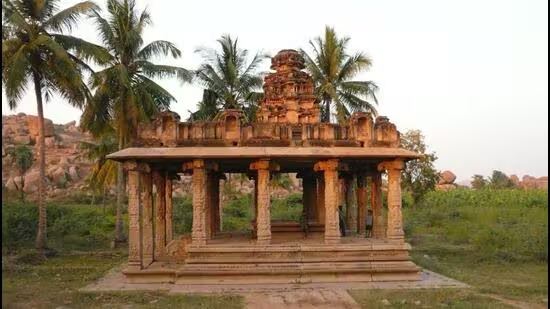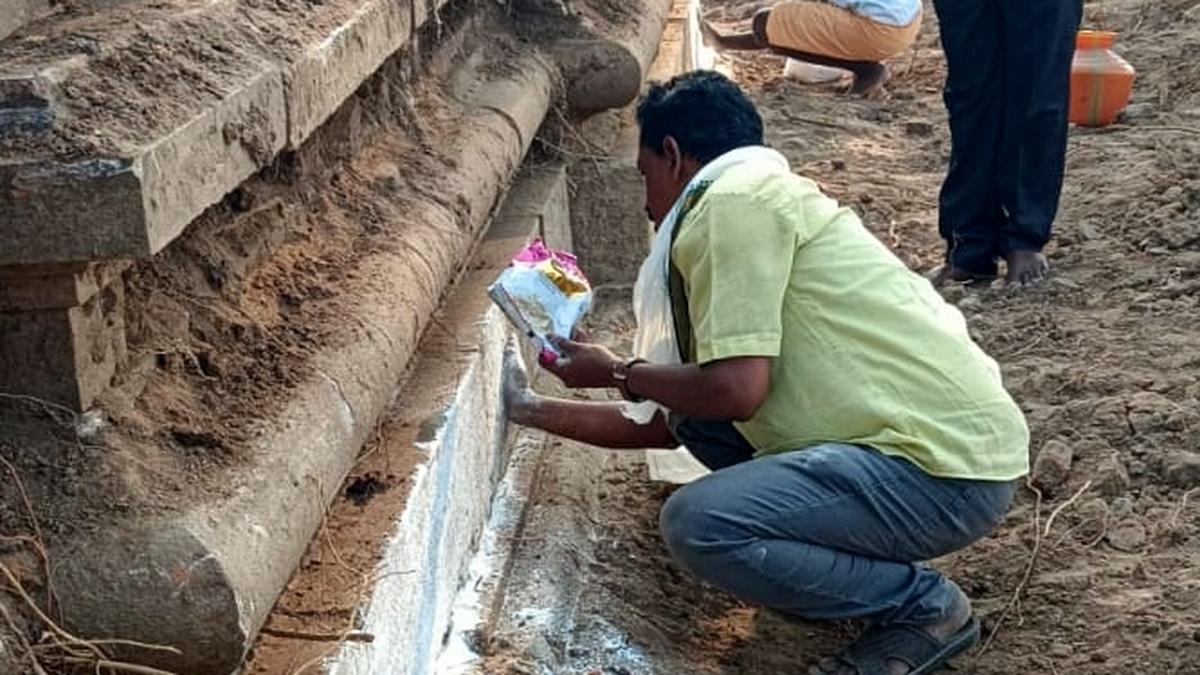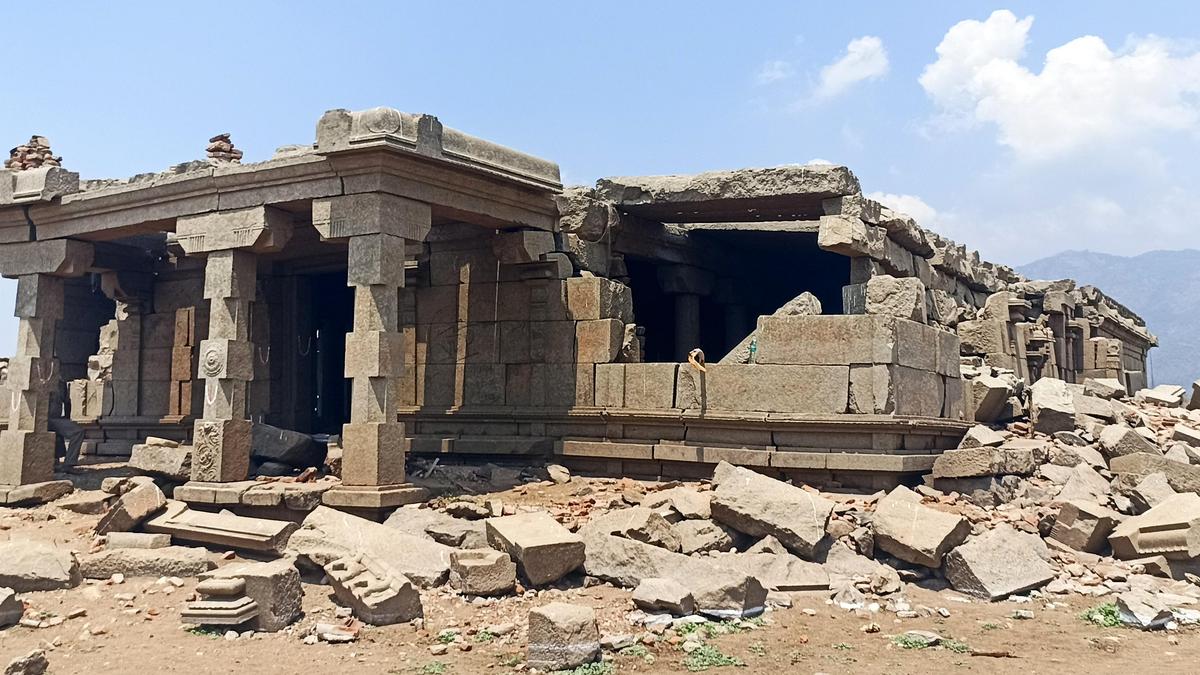
A file picture of the dilapidated Sri Madhava Perumal Temple, which has become visible as the water level in the Bhavanisagar Dam in Erode district has dropped to 59 ft.
| Photo Credit: Special Arrangement
With the water level in the Bhavanisagar Dam dropping to 59 ft., the dilapidated Sri Madhava Perumal Temple, which remains largely submerged in the reservoir area, has resurfaced.A study of 10 to 15 inscriptions found on the temple premises by the Yaakkai Heritage Trust revealed that the site is located at the confluence of the Bhavani and Moyar rivers and once housed several temples and settlements. The region also served as an important peruvali (trunk road) connecting the Kongu region with Karnataka and Kerala. One inscription indicates that a village named Thuravalur existed more than 1,000 years ago and it had a Shiva temple known as Thondreeshwaramudiayar.History of templeHistorians said the region came under the rule of the Hoysalas and that King Veera Ballala III (1292–1342) appointed his army general, Madhava Perumal Dhandanayaka, to administer the area. During this period, the Dhandanayaka Fort, later known as Danaikan Fort, was constructed. The general’s son, Veera Siddha Keththaya Dhandanayaka, subsequently built the Sri Madhava Perumal Temple within the fort.An inscription refers to the fort as ‘Nilagiri Sadaranan Kottai’, while the surrounding villages were collectively known as ‘Oduvanganadu’. Historians believe the fort was built around 682 years ago and was gradually destroyed over time. The Battle of Sathyamangalam fought during the Third Anglo-Mysore War, between the British East India Company and Tipu Sultan in 1790, was fought near the fort.Local residents and fishermen said temples dedicated to Someswarar and Veerabhadra also existed in the region. During the construction of the Bhavanisagar Dam between 1948 and 1955, 928 families from villages including Peerkadavu, Kuyyanur, Kuduvey Pudur, Vadavalli, Karapuram, Pattramangalam and Basavapuram Pudur, comprising 771 houses in the water-spread area, were relocated to new habitations in Sathyamangalam taluk in 1951.While the deities were shifted to new locations by residents, the ancient structures were submerged after the dam was built. Though the fort was completely damaged, the temple, now in a dilapidated condition, resurfaces whenever the water level drops below 60 ft.Fishermen said portions of the stone-pillared structure are now visible from the reservoir area. They added that when the water level recedes further to around 45 ft., the submerged temples and parts of the damaged fort become fully visible. “The temple was last visible in 2024 when the water level dropped,” a fisherman said.Public access to the structure has been restricted as it is located within the water-spread area of the dam. Published - May 16, 2026 03:27 pm IST