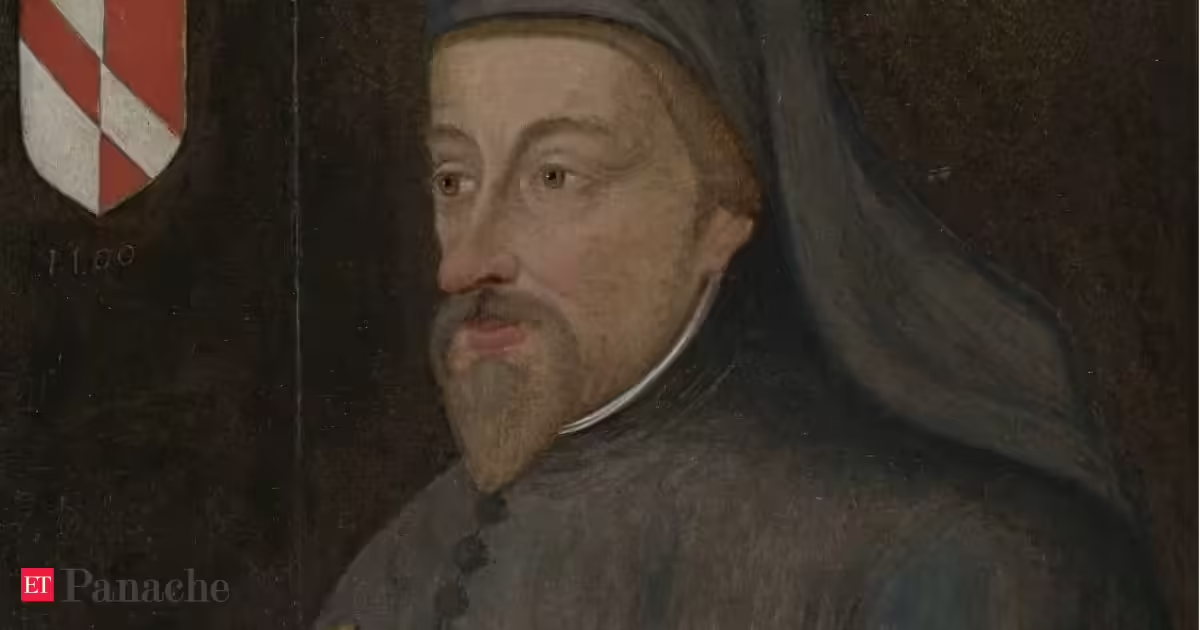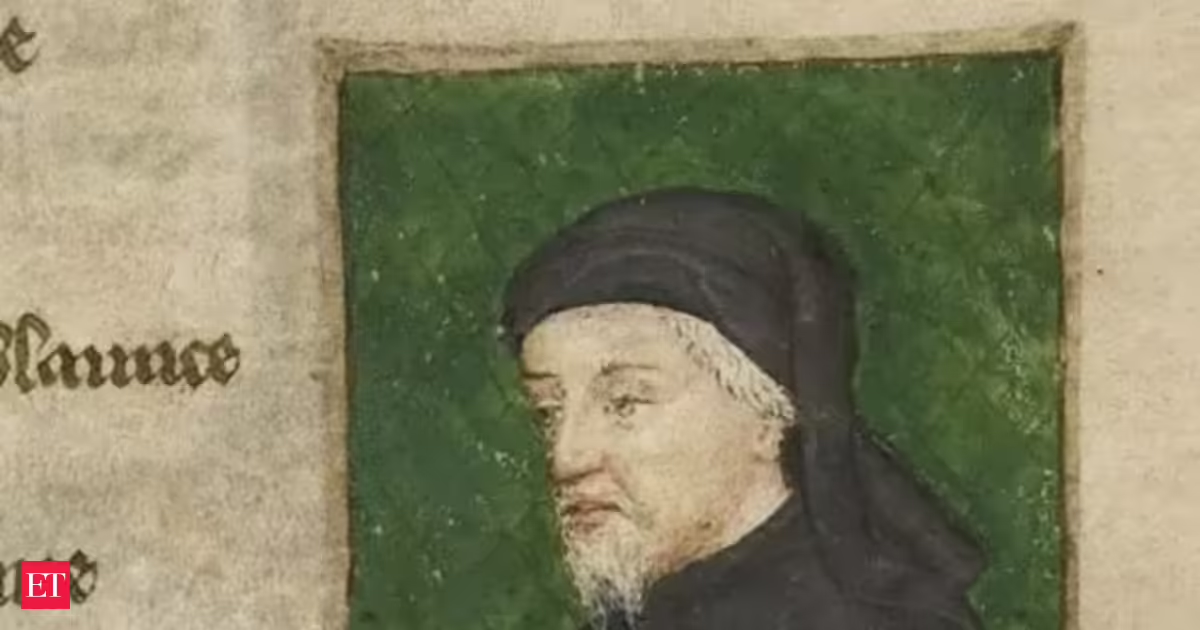
Quote of the Day by Geoffrey Chaucer: Great literary quotes often survive centuries because they speak to truths that never fully disappear. Few writers understood human weakness, ambition, morality and contradiction better than Geoffrey Chaucer, the medieval poet whose observations about society still feel strikingly modern today. His words continue to resonate because it asks a difficult question about leadership, virtue and moral decay.Chaucer’s words remain powerful because they suggest that if even the noblest among us can fall, ordinary people become even more vulnerable to weakness and decline.The Quote of the Day today by Geoffrey Chaucer is:“If gold rusts, what then can iron do?”You Might Also Like:The quote is often interpreted as a warning about the influence of powerful or respected individuals on society as a whole. Gold traditionally symbolizes purity, value and excellence, while iron represents something more ordinary and common. Chaucer’s observation suggests that if those considered noble or morally superior become corrupt, then it becomes far harder to expect integrity from everyone else.The line reflects Chaucer’s deep understanding of human nature, something that made him one of the greatest literary figures in English history. Long before the age of modern novels, Chaucer explored the flaws, humor, ambitions and contradictions of ordinary people through vivid storytelling and unforgettable characters.The Medieval Poet Who Changed English LiteratureGeoffrey Chaucer was born around 1342 or 1343 in London, England, into a middle-class family whose prosperity came largely from the wine and leather trade. His father, John Chaucer, was an important London vintner and served as deputy to the king’s butler. The family’s growing ties to the royal court helped provide young Geoffrey with opportunities that shaped his future career.You Might Also Like:His mother, Agnes Copton, came from a family connected to money and property, further strengthening the family’s social standing. Although little is known with certainty about Chaucer’s early education, scholars believe he became fluent in French and gained knowledge of Latin and Italian. His writings later revealed an extraordinary familiarity with classical literature, philosophy and European poetry.Chaucer first appeared in official records in 1357 as a member of the household of Elizabeth, Countess of Ulster. Service in noble households was often a pathway for ambitious young men seeking education, courtly refinement and political advancement. It exposed Chaucer to aristocratic culture and the workings of royal life, experiences that would later enrich his literary work, as per information sourced from Britannica.How Geoffrey Chaucer Rose From Court Service to Literary FameBefore becoming famous as a poet, Chaucer built a respected career in public service. During the Hundred Years’ War, he served in the English army in France and was captured during the siege of Reims in 1359. King Edward III contributed toward his ransom, demonstrating Chaucer’s value to the royal administration.You Might Also Like:Over the following years, Chaucer became deeply involved in diplomatic and governmental work. He traveled across Europe on royal missions to places including France, Flanders and Italy. These journeys proved enormously important because they introduced him to the works of writers such as Dante, Petrarch and Boccaccio, whose influence transformed European literature and helped shape Chaucer’s poetic voice.By the 1370s, Chaucer had become an important civil servant. He served as comptroller of customs for the Port of London and later held several royal appointments under three successive monarchs: Edward III, Richard II and Henry IV. His political and diplomatic responsibilities revealed a man trusted by the English crown during a turbulent period of medieval history.Yet despite his success in government, Chaucer’s lasting legacy came from literature rather than politics.The Literary Genius of Geoffrey ChaucerChaucer is widely regarded as the greatest English poet before William Shakespeare and is often called “the first finder of our language.” At a time when French and Latin dominated elite writing, Chaucer helped elevate Middle English into a respected literary language.His masterpiece, The Canterbury Tales, remains one of the most celebrated works in English literature. Structured around a pilgrimage to Canterbury, the work brings together people from many walks of life who entertain one another through storytelling.The brilliance of The Canterbury Tales lies not only in its narrative structure but in Chaucer’s remarkable understanding of humanity. Knights, merchants, monks, millers, clerks and wives all appear with vivid personalities, weaknesses and ambitions. Chaucer balanced humor with serious moral reflection, creating characters who still feel recognizable centuries later.His writing examined love, greed, vanity, faith, hypocrisy and power with unusual honesty. He could be sharply critical of corruption while remaining compassionate toward human imperfection. This balance of satire and sympathy became one of the defining features of his poetry.Among his other notable works are Troilus and Criseyde, The Book of the Duchess, The Parlement of Foules and Legend of Good Women. Across these works, Chaucer explored both earthly and spiritual love while raising larger philosophical questions about destiny, morality and the human condition, as per information sourced from Britannica.Meaning of the Quote of the DayThe meaning behind “If gold rusts, what then can iron do?” is rooted in Chaucer’s understanding of moral influence and societal decline.Gold symbolizes individuals or institutions expected to embody virtue, wisdom or excellence. Iron represents ordinary people who look toward those figures for guidance. Chaucer’s question is therefore deeply unsettling: if even the best among society become morally compromised, how can lesser individuals hope to remain virtuous?The quote can apply to politics, leadership, religion, education and even personal relationships. When respected figures abandon ethical principles, the damage often spreads far beyond themselves. Standards weaken, trust erodes and corruption becomes easier to justify.Centuries after Chaucer wrote the line, the quote still appears during periods of political scandal, institutional failure and public disappointment. It serves as a reminder that leadership carries responsibility, because people often imitate the behavior they see rewarded in positions of authority.At the same time, the quote also reflects Chaucer’s broader literary outlook. His works consistently examined the gap between appearance and reality. Many of his characters present themselves as honorable or pious while hiding selfish motives beneath the surface. Through humor and storytelling, Chaucer exposed how fragile human virtue can sometimes be.Personal Struggles and Later YearsDespite his literary achievements, Chaucer’s later years were not without hardship. Political instability in England affected many royal officials, including Chaucer himself. During the turbulent years surrounding the Merciless Parliament and the conflicts between King Richard II and powerful nobles, Chaucer faced uncertainty in both finances and public office.Records show periods of debt, legal disputes and professional instability. He also endured personal losses, including the probable death of his wife, Philippa, as per information sourced from Britannica.Still, Chaucer continued writing during these difficult years, producing some of his greatest literary achievements. The 1390s saw the creation of The Canterbury Tales, the crowning accomplishment of his career. Although unfinished, the work secured his place as one of the foundational figures of English literature.In 1399, after Henry IV became king, Chaucer regained royal favor and received additional financial support. Shortly afterward, he leased a residence near Westminster Abbey.Chaucer died on October 25, 1400, in London. He was buried in Westminster Abbey, an extraordinary honor for a commoner at the time. His burial place later became known as Poets’ Corner, where many of Britain’s greatest writers would eventually be commemorated.Legacy of Geoffrey ChaucerThe influence of Geoffrey Chaucer has endured for more than six centuries. His works transformed English literature by proving that Middle English could convey sophistication, humor, emotion and philosophical depth equal to Latin or French.Generations of poets and scholars admired his storytelling skill, realism and mastery of character. Writers across centuries drew inspiration from his ability to combine entertainment with moral reflection.Today, Chaucer remains central to the study of English literature, medieval culture and the evolution of narrative poetry. His observations about society, morality and human weakness continue to feel remarkably relevant in modern life.Inspiring Quotes by Geoffrey ChaucerBeyond today’s Quote of the Day, Chaucer left behind many memorable lines that continue to inspire readers:“Patience is a conquering virtue.”“What is better than wisdom? Woman. And what is better than a good woman? Nothing.”“Nothing Ventured, Nothing Gained."“The greatest scholars are not usually the wisest people."“Life is short. Art long. Opportunity is fleeting. Expierience treacherous. Judgement difficult.”“Time and Tide wait for no man."“How potent is the fancy! People are so impressionable, they can die of imagination.”More than 600 years after his death, Geoffrey Chaucer’s words continue to challenge readers to think carefully about character, responsibility and the example people set for others.You Might Also Like:
Quote of the Day by famous poet Geoffrey Chaucer: 'If gold rusts, what then can …'—Inspiring quotes by the 'father of English literature,' best known for The Canterbury Tales
Geoffrey Chaucer's timeless quote, "If gold rusts, what then can iron do?" warns of moral decay when respected figures falter. His life, marked by public service and literary genius, explored human nature's contradictions. Chaucer's enduring legacy lies in elevating Middle English and crafting relatable characters, reminding us of leadership's responsibility.
1,405 words~6 min read