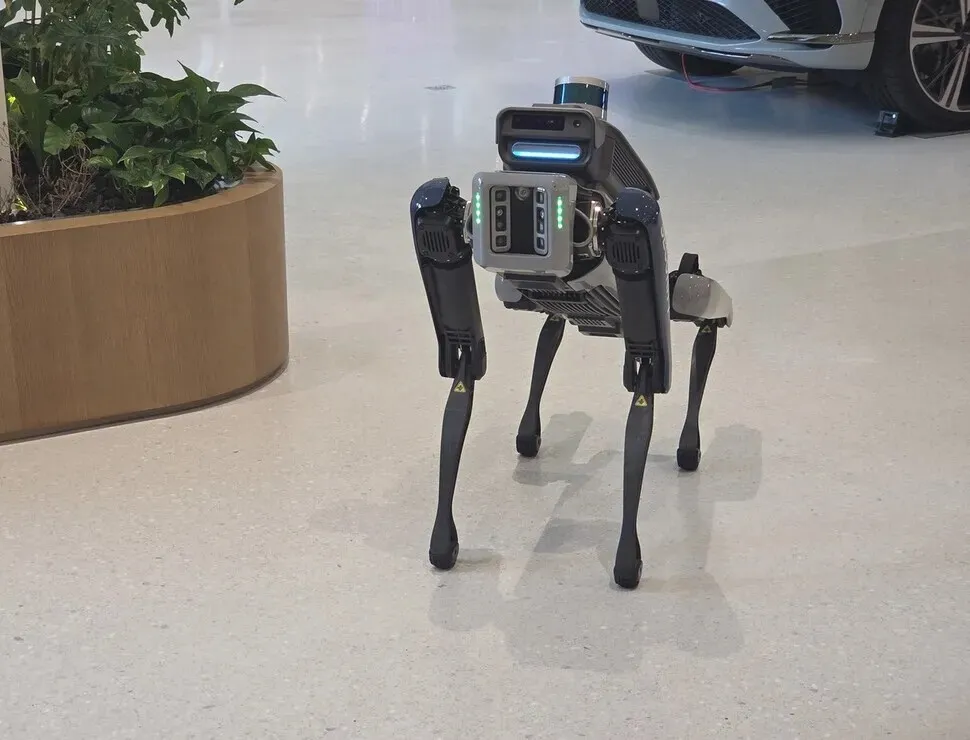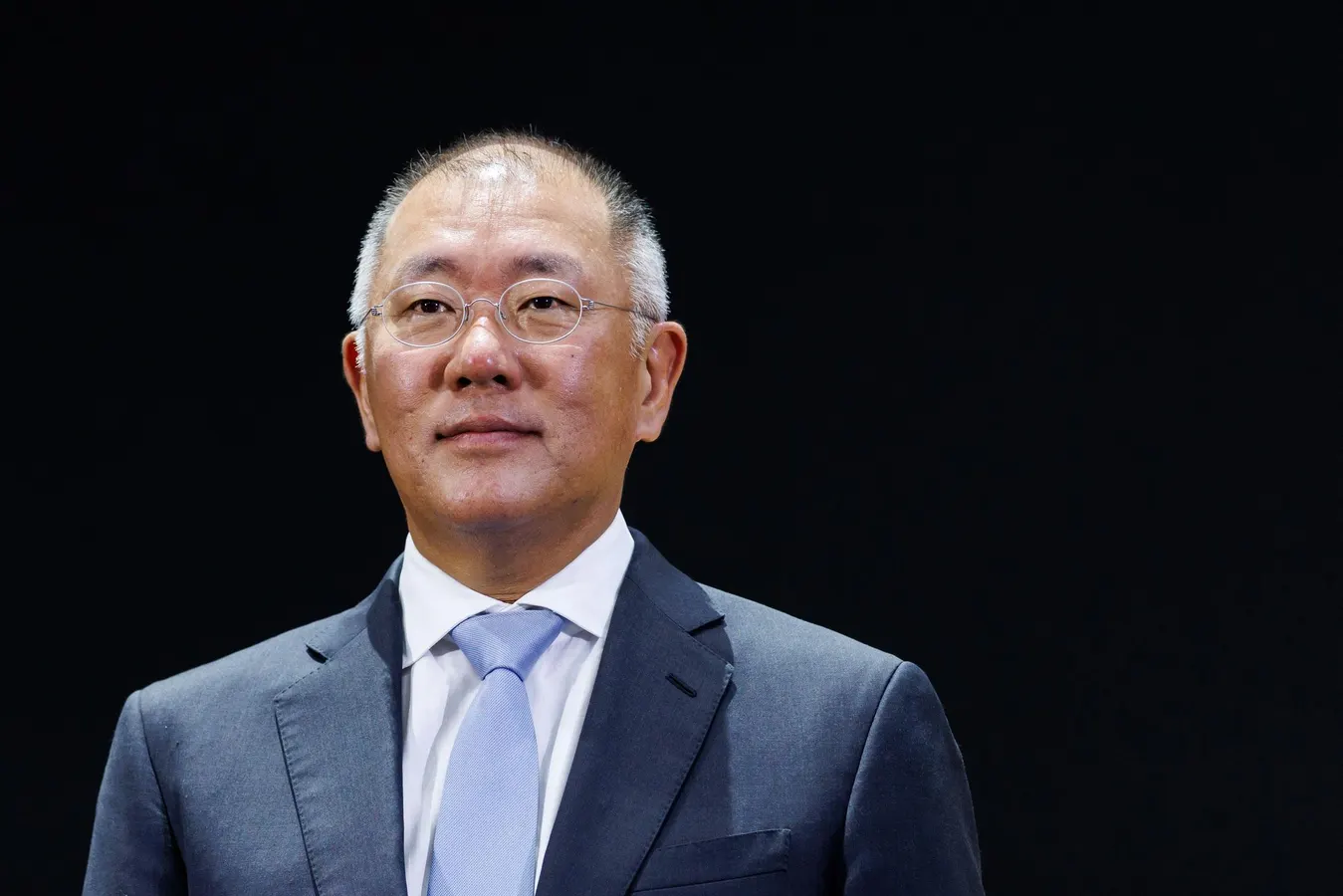
At rare town hall, Chung Euisun discusses EV rivalry, robotics and China’s accelerating innovation push Hyundai Motor Group Executive Chair Chung Euisun (left) and Alexandra Villegas Zenne, principal at Studios Architecture who was in charge of the lobby design, participate in a talk session held at the group's headquarters in southern Seoul on Thursday. (Hyundai Motor Group) Hyundai Motor Group Executive Chair Chung Euisun on Thursday highlighted communication and collaboration as key drivers of innovation, as the auto giant unveiled a major renovation of its headquarters in Yangjae, southern Seoul.Speaking at a company town hall meeting to mark the revamp, Chung described the new lobby as an open space designed to encourage interaction among employees, share ideas and foster a more agile working culture. The town hall was attended by the group's major executives and employees.Chung explained that the motivation behind the lobby’s transformation was to create an environment where “communication can happen more freely and comfortably than before.”“Just as office workers as well as engineers can work in this space, there are many different forms of collaboration,” Chung said. “The most important thing was how the company could best support that communication through (creating a) physical environment.” The atrium at the center of the lobby of Hyundai Motor Group’s Yangjae headquarters in Seoul. (Hyundai Motor Group) He added that the meetings, exchange of ideas and building mutual understanding ultimately benefit the company’s products and serve its customers."Face-to-face communication among people is extremely important," he said. “No matter how much the world advances, human interaction will not disappear. It will become even more important.”The renovated lobby reopened in March after a year and 11 months of construction, covering some 36,000 square meters — roughly five soccer fields — spanning from the basement level to the fourth floor.Its center houses a stepped lounge named Agora, inspired by the public squares of ancient Greece. The space is connected to meeting lounges, exhibition areas, cafes and gardens, intended to encourage interaction among employees.It also deployed robotics technology at the revamed headquarters, as part of the group’s push into physical AI and robotics. A fleet of service robots, including DAL-e Delivery, DAL-e Gardner and Boston Dynamics’ Spot, have been put to work handling deliveries, tending to plants and for security patrols.The renovated complex also features expanded meeting spaces, a redesigned in-house library developed in collaboration with Japan’s CCC, operator of Tsutaya Bookstore, a learning center, fitness facilities and outdoor gardens. The in-house library at Hyundai Motor Group’s Yangjae headquarters in Seoul. (Hyundai Motor Group) Ahead of the town hall, Chung met with reporters and discussed a wide range of topics from intensifying global EV competition to autonomous driving and geopolitical risks.In response to rising popularity of EV makers such as Tesla and BYD, Chung said it’s an “important opportunity” for Hyundai. “Our goal is to learn as much as possible and create products and features that customers will like even more.”“Any company in the world has something we can learn from,” he added. “We feel a lot of tension, but at the same time we also see it as a good opportunity and are even grateful for it in some ways.”Reflecting on last month’s Auto China 2026 in Beijing, Chung said he “learned a lot,” praising the speed of China’s EV ecosystem and consumers’ strong interest in technology.“Everything is moving much faster than us,” he said, citing strong government support and rapid innovation in China. “I realized again that it is important to move quickly, but also accurately.”On the group’s development of the humanoid robot Atlas by Boston Dynamics, Chung said the company is moving forward through trial and error. "It is very important to balance software and hardware, while integrating employees with different mindsets and culture." Boston Dynamics' robot Spot patrols the lobby reception area at Hyundai Motor Group’s Yangjae headquarters in Seoul. (Hyundai Motor Group) On autonomous driving, Chung made clear that Hyundai would prioritize safety over speed despite aggressive competition from China, Tesla and Waymo.“Technology gaps can eventually be narrowed, but safety is the most important thing,” Chung said. “Even if we move a little slower, we plan to focus much more on safety.”Chung also voiced concerns over escalating tensions in the Middle East, saying the conflict could delay Hyundai’s Saudi Arabian plant project slated for the fourth quarter opening.“We are building a plant in Saudi Arabia, but that could be delayed. The sales in the Middle East have also declined,” he said. “The war will eventually end, but we need to prepare well so we can sell effectively once the situation stabilizes again.”
Hyundai Motor chief stresses communication in HQ revamp
Hyundai Motor Group Executive Chair Chung Euisun on Thursday highlighted communication and collaboration as key drivers of innovation, as the auto giant unveile
764 words~3 min read