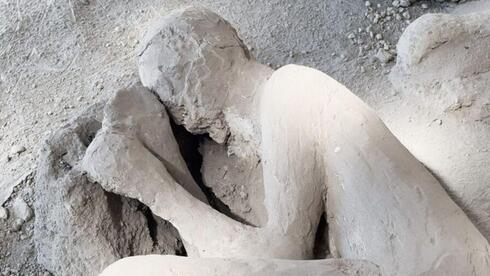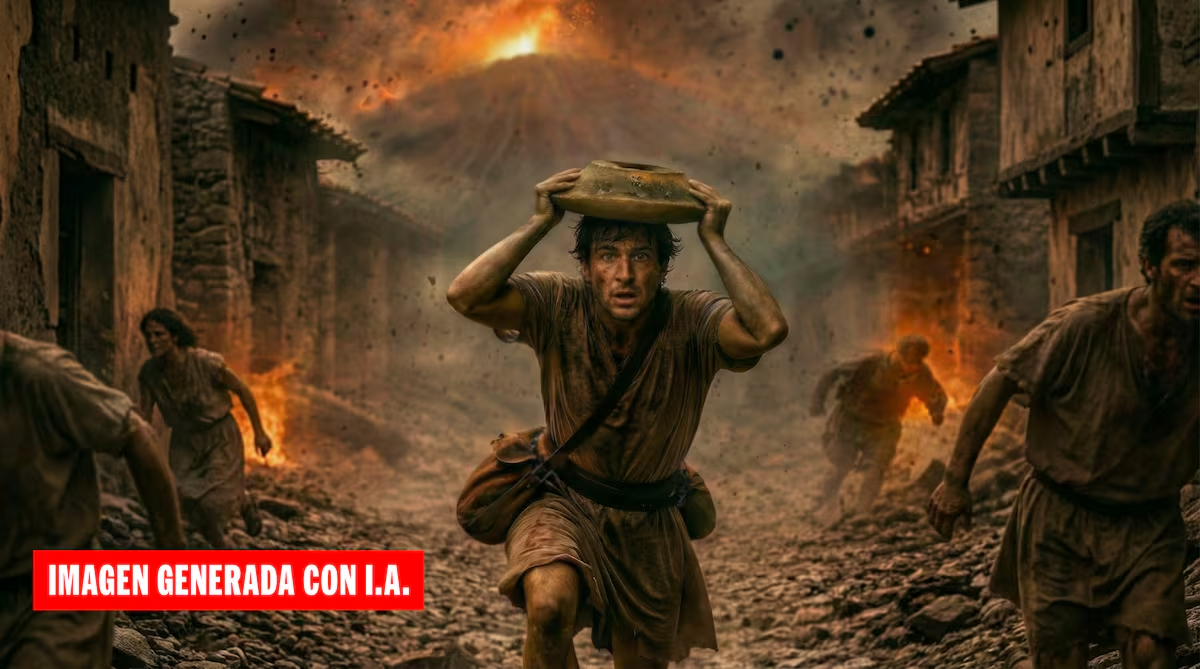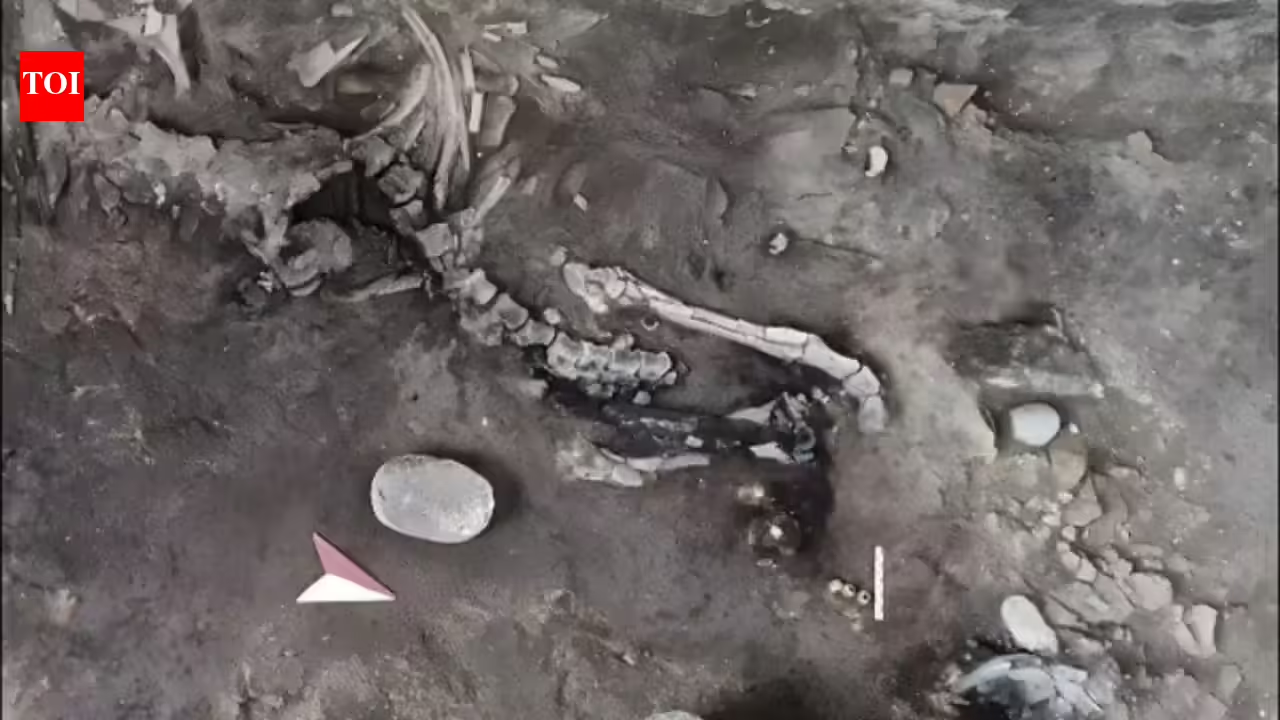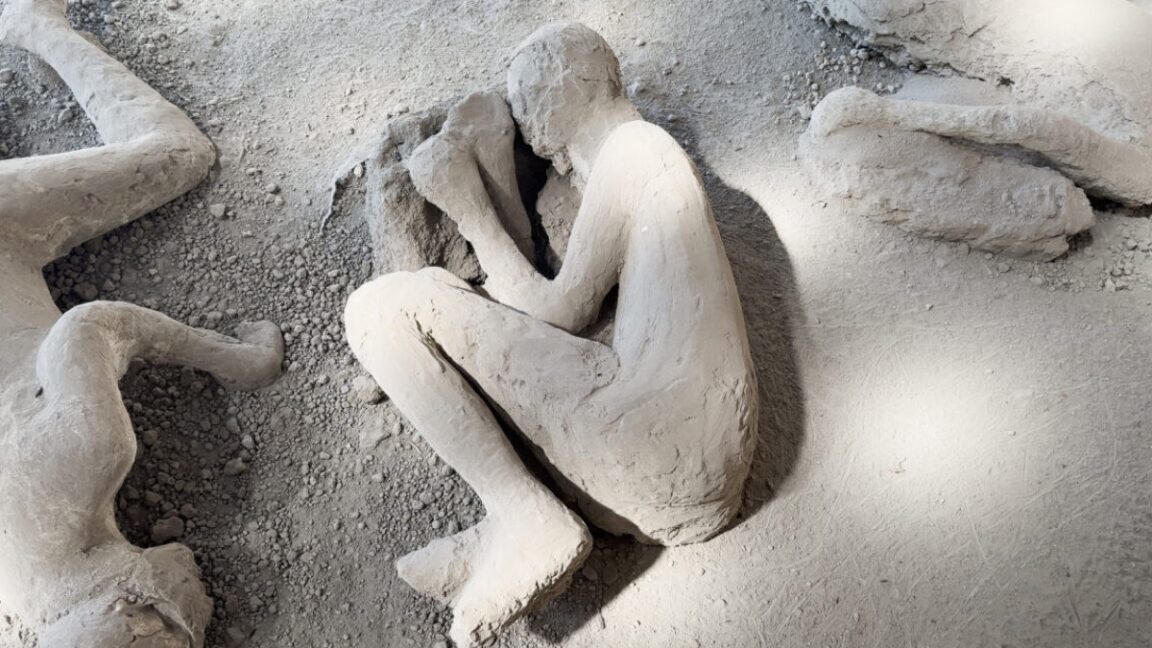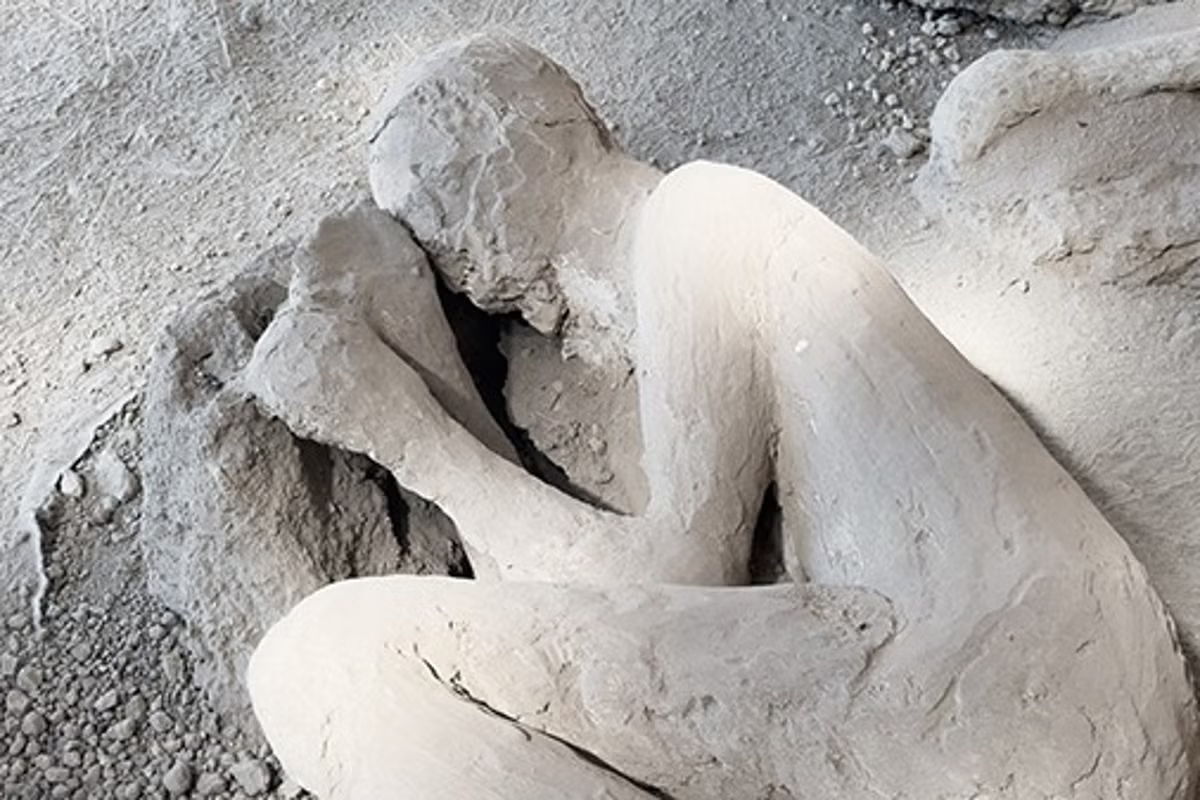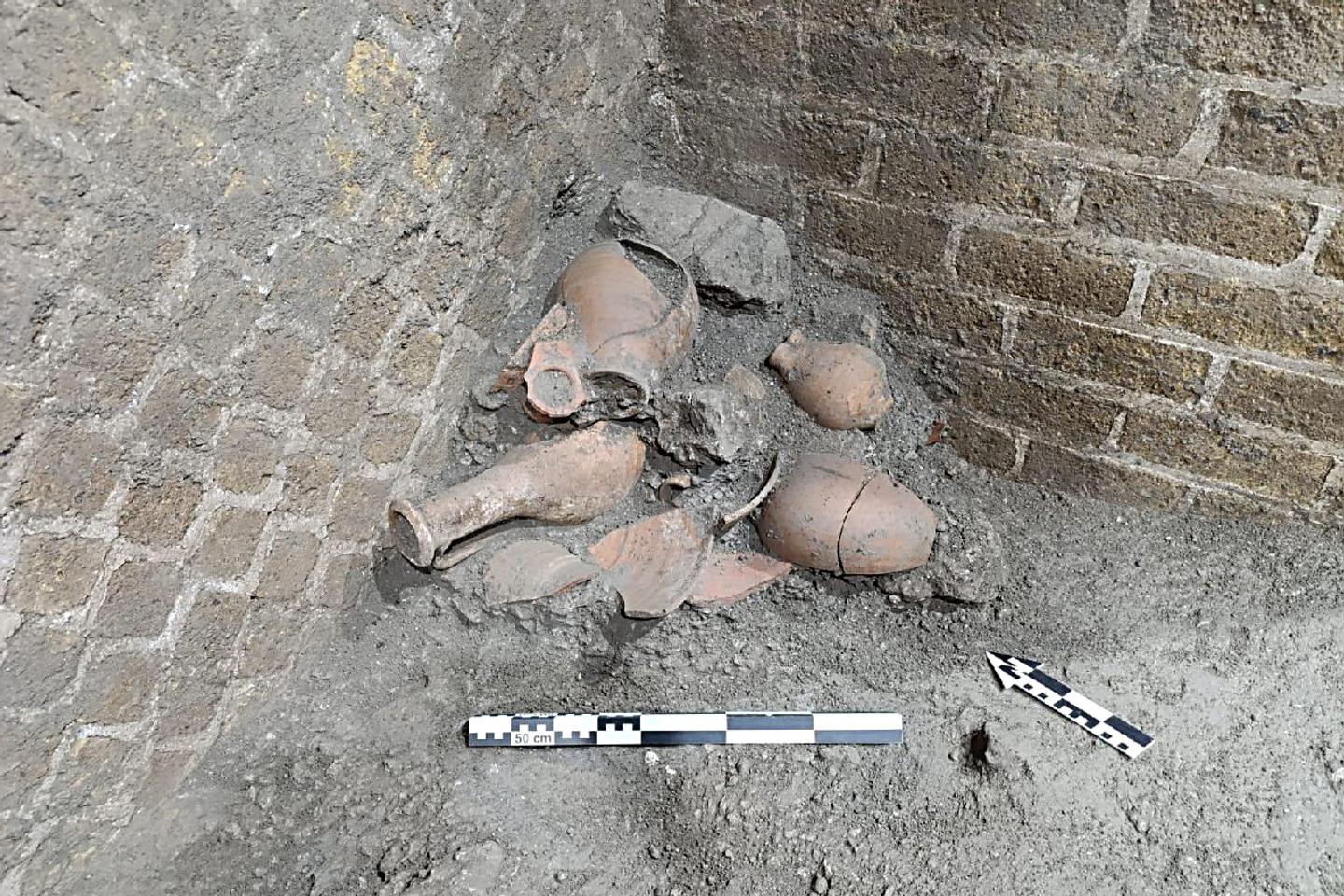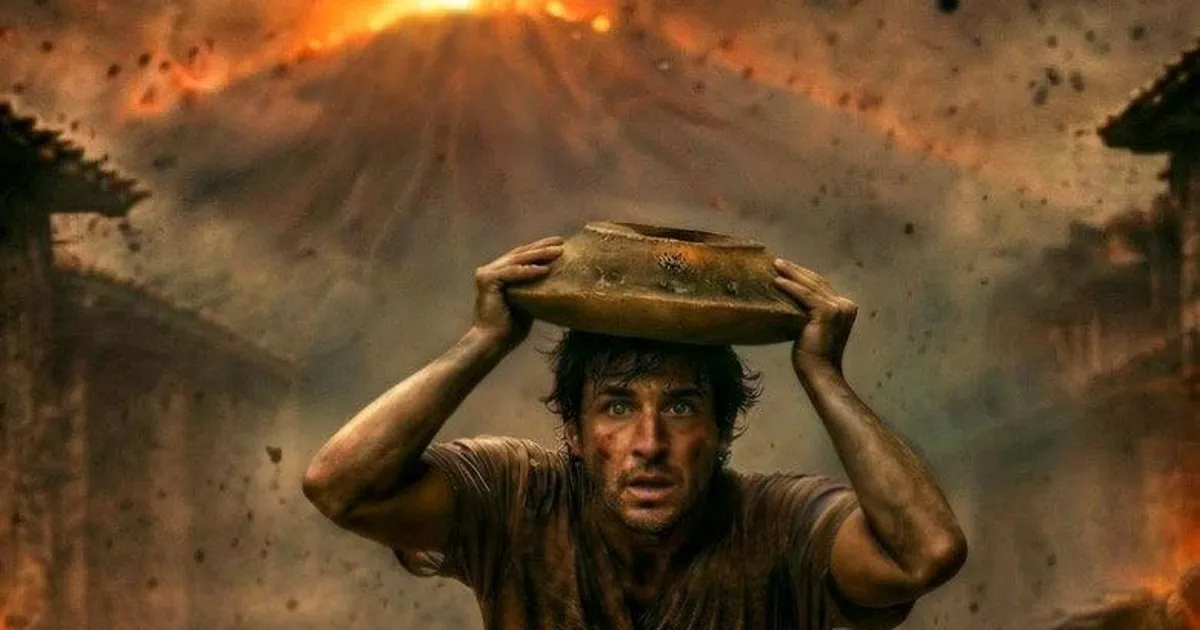
Archaeologists uncovered skeletons of two men who died at different times in the same spot, highlighting how the volcano may have killed more people than previously thought"With cloths they tied pillows atop their heads as protection against the raining rocks. Elsewhere it was already daylight, but there reigned a darkness that was darker and thicker than any night. This, they tried to dispel with torches and other lamps. They decided to go down to the shore, to see from up close if they could make their escape by sea, but it remained as rough and adverse as before."Thus the writer Pliny the Younger describes the plight of the people of Pompeii as they attempted to flee the city while protecting themselves from the falling rocks and ash spewed by Mount Vesuvius in the fateful eruption of 79 C.E.This scene, written almost 2,000 years ago, has now come vividly to life with the discovery of the remains of two victims of the eruption. One is the skeleton of a man who was trying to make his escape with just such a makeshift head covering as described by Pliny – in his case a clay mortar rather than a pillow.first skeleton found in the dig outside the Stabian Gate, probably killed by the pyroclastic flow Credit: Pompeii Archaeological Parkfirst skeleton found in the dig outside the Stabian Gate, probably killed by the pyroclastic flow Credit: Pompeii Archaeological ParkThe find is not only the latest stunning, frozen-in-time testimony from the final hours of life in the city; it also offers new insight on old questions about how many people were killed in the eruption and how they died, archaeologists and Italian authorities said as they announced the discovery on Monday.The two skeletons were found during the excavation of a tomb, built a few decades before the eruption in a necropolis on the outskirts of Pompeii. To be clear, the two were not buried. They just happened to die near the tomb after fleeing through the city's Stabian Gate, which controlled the road leading to the seaside settlement of Stabiae, which was also wiped out by Vesuvius. Their instinct was correct: not only were they running away from the volcano, likely lured into the open by a lull in the eruption, but the sea offered the best chance of escape, as amidst the unfolding disaster a rescue fleet had reached the shore under the command of Pliny the Elder, the Roman admiral and renowned polymath. Pliny was also the uncle of the younger Pliny, who witnessed the event and later wrote the account of the eruption cited above. Unfortunately, neither these two unknown victims nor the elder Pliny made it out alive.There is some controversy on the exact date of the eruption and whether it occurred in August or later in the fall of 79 C.E., but it is generally agreed that the explosive event was spread across two days. From the afternoon of the first day and all through the night, Vesuvius spewed a column of ash, smoke and lava fragments that reached a height of some 30 kilometers, and then started raining down on Pompeii and its neighboring towns. In the second phase, on the morning of the second day, the erupted column collapsed in a series of pyroclastic flows, fast-moving clouds of superheated gas and volcanic material that rolled down the sides of the mountain, instantly killing the inhabitants of Pompeii through thermal shock. This second phase is believed to have killed most of the victims of the disaster, but the new find suggests a slightly different picture, Valeria Amoretti, of the Pompeii Archaeological Park, and colleagues, report in the park's online journal. The second skeleton found in the necropolis outside Pompeii crouched under a clay mortar Credit: Pompeii Archaeological ParkThe second skeleton found in the necropolis outside Pompeii crouched under a clay mortar Credit: Pompeii Archaeological ParkAt the wrong place, at different wrong times The first victim, identified as a male aged 18-20, was found lying on his right side at a depth of more than 6 meters, just at the top of the layers of pumice stone that sealed and perfectly preserved the city for two millennia. This means that this individual was indeed killed at the end of the catastrophe by the final and deadliest pyroclastic flow on the morning of the second day – the same that is believed to have felled the rescuing admiral, Pliny the Elder.But the second skeleton from the necropolis beyond the Stabian Gate was found at a greater depth, almost one meter below the first, buried deep in hardened volcanic material. This suggests this victim died a few hours earlier, during the first or so-called "Plinian" phase of the eruption, named thusly because it was so well described by Pliny the Younger. This second victim, a male aged around 35, was carrying the aforementioned clay mortar and was found in a crouched position under the artifact, probably in a last-ditch attempt to protect himself from the ash and rocks that showered the region at this point in the eruption.The second skeleton found in the necropolis outside Pompeii crouched under a clay mortar Credit: Pompeii Archaeological ParkThe second skeleton found in the necropolis outside Pompeii crouched under a clay mortar Credit: Pompeii Archaeological ParkJust like the escapees described by Pliny, the man was also carrying a clay lamp, probably to light his way on that dawn-less morning, as well as ten bronze coins, the researchers report."The position of the body and the associated materials reconstruct with extraordinary strength the dramatic scene, evoking a desperate attempt to find cover and escape a no-longer familiar city," the Pompeii researchers write. The archaeologists also teamed up with experts from the University of Padua to create an AI-powered reconstruction of the man's final moments. The lamp found near the left arm of the second body Credit: Pompeii Archaeological ParkThe lamp found near the left arm of the second body Credit: Pompeii Archaeological ParkBeyond the dramatic effect, the discovery shows that the volcanic rocks ejected in the first phase of the eruption were large enough to be lethal and may have caused significant death in their own right, writes Pompeii Park Director Gabriele Zuchtriegel in a forward of the academic paper.The two bodies are also of note when considering the death toll of the eruption, which has never been firmly established, Zuchtriegel adds. Out of an estimated 20,000 inhabitants of Pompeii, archaeologists have only uncovered some 2,000 bodies, he notes. While it's tempting to think that many survived, Zuchtriegel concludes that it is also possible that many died in the less-explored countryside outside the built-up areas as they attempted to flee, just like these two anonymous victims who met their end among the tombs outside the walls of Pompeii.
Unusual remains found in Pompeii reopen questions about Vesuvius' eruption
Archaeologists Uncovered Skeletons of Two Men Who Died at Different Times in the Same Spot, Highlighting How the Volcano May Have Killed More People Than Previously Thought
1,131 words~5 min read