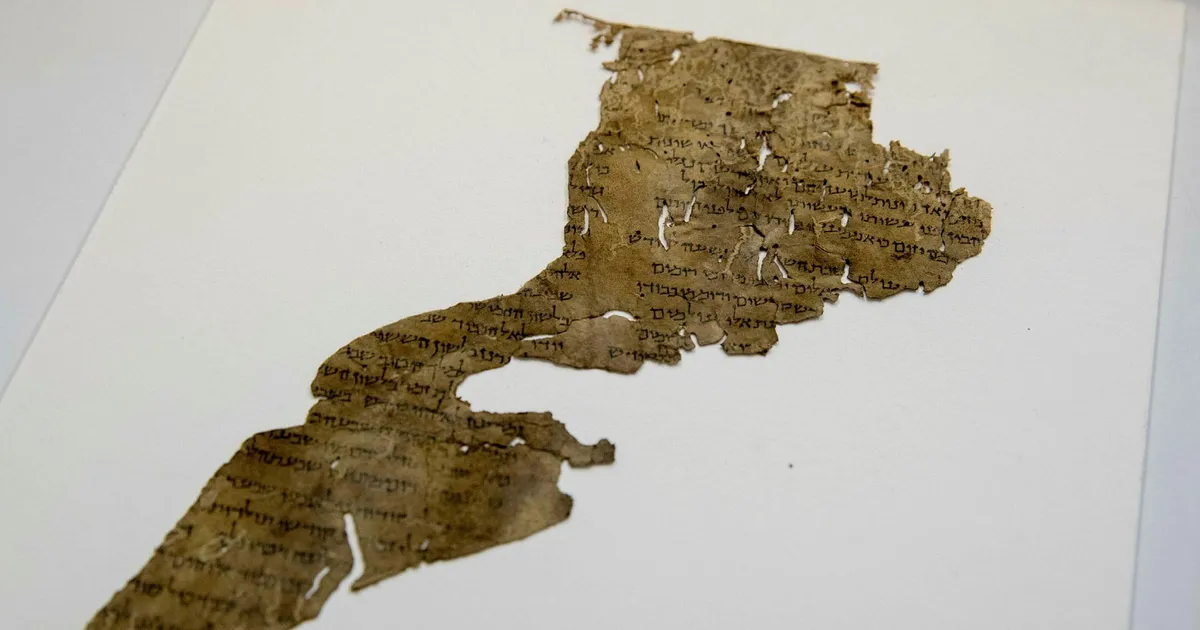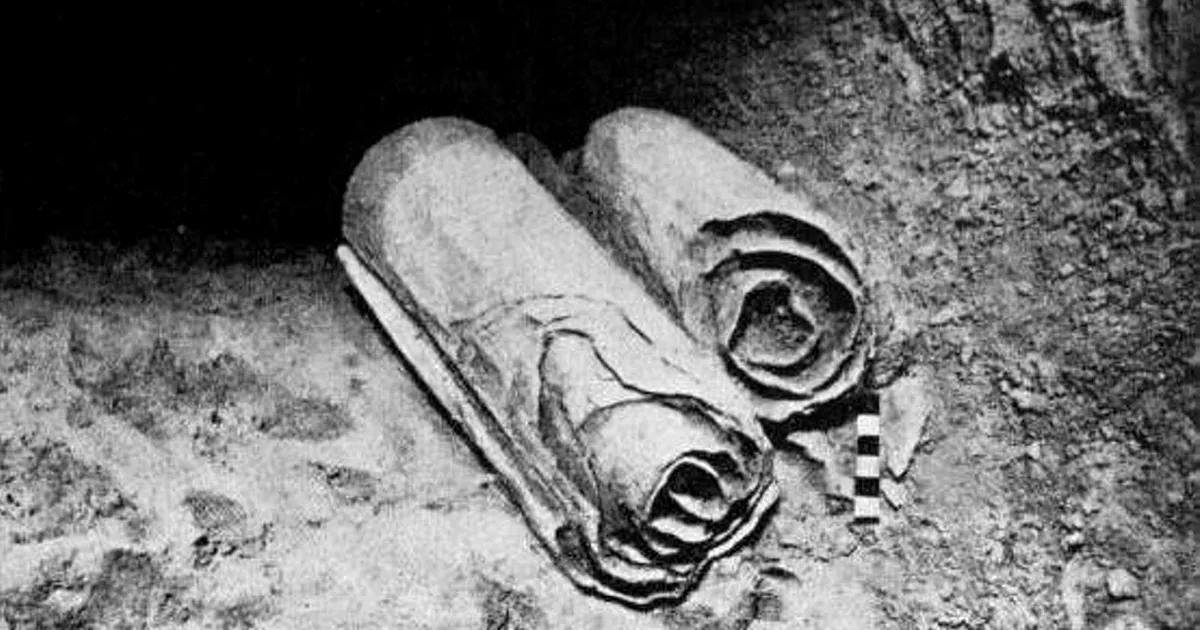
Current sectionArchaeologyOne stood among the Dead Sea Scrolls: made of metal, and seemingly never meant to be read. Who made it, when and why, and how was Bar-Kokhba involved? Shimon Gibson presents a new theoryShare to FacebookShare to XArticle printing is available to subscribers onlyPrint in a simple, ad-free formatSubscribeComments: Zen reading is available to subscribers onlyAd-free and in a comfortable reading formatSubscribeThe Copper Scroll, never read by human eyes except the people who commissioned and made it of course Credit: Abraham Meir HabermannThe Copper Scroll, never read by human eyes except the people who commissioned and made it of course Credit: Abraham Meir HabermannMay 07, 2026"At Khorrebeh, situated in the valley of Achor below the steps leading to the east, [dig] forty cubits: a coffer [full] of money, the sum of which is the weight of seventeen talents." – The proposed translation of the first lines in the Copper Scroll by Józef Tadeusz Milik (1922-2006), one of the official translators of the famous Dead Sea Scrolls, who added the words in the square brackets for the sake of clarity.That's it. Puzzling. Did the person who wrote these words deliberately aim to be obscure? The information is both detailed and vague. Presumably there were several stairways at the site of Khorrebeh, so which one do we want?The next entry reads, "In the funerary monument of Ben Rabbah, of Beit Shalisha: 100 ingots of gold." Even if one knows who Ben Rabbah was, there are probably thousands of tombs from that period and it doesn't say where this one is.These are just two out of 64 frustratingly incomplete entries which have stumped scholars since the scroll was unearthed. There has never ever been consensus as to what the Copper Scroll is all about: who created it, when and why. But now, biblical scholar and archaeologist Shimon Gibson from the history department at the University of North Carolina at Charlotte, proposed a bold new thesis for its story in an article in Volume 36 of Eretz-Israel: Archaeological, Historical and Geographical Studies published in March by the Israel Exploration Society.This is in addition to shedding light on exactly where it was found within that Dead Sea cave (3Q) – apparently even that has been controversial, with many scholars getting it wrong, he says."A couple of years ago, I went to the cave with Joan Taylor of King's College London," he says. Based on re-examination of archival materials from the 1952 dig and their exploration, they managed to pinpoint the precise location where the scroll was found, and prepare a new map of the cave.But mainly, Gibson now raises a unique proposal as to why this seemingly impenetrable and "useless" artifact was created in the first place.Shimon Gibson indicating the spot in Cave 3Q where the Copper Scroll had been found. Credit: Simon Gibson Shimon Gibson indicating the spot in Cave 3Q where the Copper Scroll had been found. Credit: Simon Gibson Can't touch itDiscovered by an American French team in 1952 in a cave called 3Q about 1.8 kilometers north of Qumran in the cliffs overlooking the Dead Sea, the Copper Scroll has mystified scholars ever since. It was so unlike the other 900 or so Dead Sea scrolls discovered by Bedouin or archaeologists in the other caves, complete or in fragments, which were written on parchment or papyrus. For one thing it was made of metal. For another, the other scrolls' contents, whether in Hebrew or Aramaic or even (rarely) Greek, are not a mystery; they are biblical texts, sectarian writings, and commentaries, which have enlightened research into the religious ideas of Second Temple-period Judaism since their discovery.The Copper Scroll is different. Although the words are clear, the message itself is enigmatic. It is a list of items of monetary value, without any narrative or introduction. Since it was engraved on almost pure copper, requiring a degree of investment and time, the content was clearly very important to somebody.But being made of metal, the scroll could not be regularly unrolled, read, and rolled up again. The metal would have succumbed to metal fatigue, probably at the first such treatment, and broken into pieces. "This was a record that was intentionally engraved some 2,000 years ago and then kept firmly shut," Gibson sums up.So, what have we so far? The scroll contains an inconsistently-styled listing of some 64 treasures, some mentioning an amount, some not, and often maddeningly vague – the ninth entry for instance reads merely "In the cistern in front of the Eastern Gate, at a distance of fifteen cubits [=7.5 meters], there are vases."Why were these specific "vases" valuable, and where was this "cistern?" There are literally thousands upon thousands of ancient subterranean water cisterns scattered around in Judea alone, and which "eastern" gate? It makes for frustrating reading, Gibson points out in conversation with Haaretz.In the 1960s, one scholar, John Allegro, from the University of Manchester, embarked on a quest to find these treasures, and though he had all sorts of adventures and wrote a book about his hunt, he was unable to turn up even one of the treasures because the data in the scroll he found was too inexact. Since then - none have ever been found.While the Copper Scroll is undoubtedly a list of treasures, not always specified with clarity, with vague directions as to where they were to be stashed – the concept behind it remained a mystery. Scholars suggested some ideas: it was a fantasy list or a wish-list of treasures for a new temple (with locations?); or perhaps it reflected the wealth of the ascetic religious sect living at Qumran.To some scholars, the items that the writer of the Scroll did cite, notwithstanding the general air of mystique, confirmed that the Copper Scroll must contain nothing less than a list of the Temple treasures secreted just before or even after Jerusalem's destruction in 70 C.E."What actually happened to the Temple treasures after the building was despoiled and burnt by the Romans, is of course something we would all like to know," Gibson adds.We do have some idea. Far from denying that they looted the richly adorned Temple, stealing its treasures and the great menorah and silver trumpets, the Romans commemorated the feat in the famous Arch of Titus in the forum in Rome, and in a second even bigger arch discovered in 2017 at the Circus Maximus. But we don't know that they got it all.The cave of the Copper Scroll, aka 3Q, about 1.8 km north of Qumran. Credit: Simon Gibson The cave of the Copper Scroll, aka 3Q, about 1.8 km north of Qumran. Credit: Simon Gibson Bar Kochba's spreadsheetFirst things first. What actually was found in 1952? Two rolls made of copper originally made as a single rolled-up scroll 2.3 meters (7.5 feet) in length. It was created out of three separate copper plates riveted together; over the centuries the rivets at one seam corroded and the scroll broke apart into two rolls. It is this pair we refer to as the Copper Scroll. Gibson believes that indeed, it never was habitually unrolled and read because, corrosion aside, there are no signs of wear and tear on its surface.The Copper Scroll had been deliberately buried in a cave hiding other scrolls from the previous rebellion, Gibson suggests Credit: Simon Gibson The Copper Scroll had been deliberately buried in a cave hiding other scrolls from the previous rebellion, Gibson suggests Credit: Simon Gibson Even if this metal scroll does contain a list of Temple treasures, as some would believe, what good would it have served? The main snag is that nobody in antiquity could read it. Theoretically one writes a scroll in order for it to enlighten others but even just one reading could ruin it forever more. Also, it was hidden away in a cave, and could not easily be retrieved.Gibson believes the answer lies with the self-proclaimed "nasi" (president) of the provisional Jewish state Shimon Bar Kosiba, the man better known as Bar Kochba.It was he who led the Second Jewish Revolt against the Romans, starting in 132 C.E. and ending in 136 C.E. During the war, the lionized Jewish general and his followers used the Judean Desert and the region around the Dead Sea for hideouts for his soldiers and as refuge for fellow dissidents. Numerous finds dating from this period have been found in caves near the Dead Sea, including in caves containing earlier deposits of scrolls from the first century. Taylor has documented many of these later finds, as well as at the Qumran site itself.Like any major military enterprise, Bar Kochba's rebellion needed funding and that meant obtaining monies and pledges from supporters. These financial donations had to be recorded.This is what Gibson thinks was the primary function of the Copper Scroll – it was a kind of 2,000-year old Excel sheet.He also has an idea about the missing information. "Any accountant worth their salt will tell you that incomplete data is poor book keeping," he remarks. "But right in the Copper Scroll itself, at its very end, there is mention of yet another scroll hidden at a place called Kohlit (which has yet to be found), and it likely contained the rest of the corroborating data that would have satisfied any accountant." Names, for instance.The broken copper scroll in the Jordan Museum in Amman. Credit: Simon Gibson The broken copper scroll in the Jordan Museum in Amman. Credit: Simon Gibson The devil you knowWhy would a cryptic record of generosity be engraved on metal and then hidden away? Gibson believes that was because the donations would have been given to Bar Kochba in the early years of the rebellion. Around about 133 or 134 C.E., after the Roman general Sextus Julius Severus was sent to the region to stamp out the rebellion, a great fear arose. Nobody would want the sensitive documentation containing the personal details of Bar Kochba's supporters to fall into the hands of the Romans, who would then exact retribution.The scrolls – the Copper one and the one it mentions, still undiscovered, at Kohlit – were likely commissioned by Bar Kochba himself, plausibly with a promise that they would be exhibited at some future date once the rebellion was successful and the country had been rid of its Roman occupiers, Gibson proposes.He also points out that if it was a list of Temple valuables removed and secreted by Jews ahead of a howling Roman advance, surely they would have taken the menorah too; yet we see the Romans took that. "Some of the looted funds were even used to help build the landmark Colosseum in that same city which is admired by tourists to this very day," Gibson adds.Of course it is always possible that the Romans did find any secreted Temple treasures – we certainly haven't. They may not have had the scroll but they had Jews to torture. But that's pure speculation.Archeologist Joan Taylor in the cave of the Copper Scrolls. Credit: Simon Gibson Archeologist Joan Taylor in the cave of the Copper Scrolls. Credit: Simon Gibson Taylor, in a recent study, concurs with Gibson on the Bar Kochba dating for the Copper Scroll, based on analysis of the "distinctive" writing style and the language, which is typical of early Mishnaic Hebrew, i.e., the mid-to-late second century.But she suggests a different purpose, not a roster of philanthropic supporters of Bar-Kokhba, but a list of tithes to the Temple cult, which persisted even after the Romans tore down the house of worship in Jerusalem in 70 C.E. The list is rife with cultic references, such as priestly vestments, she explains. Also, crucially, being manufactured of insanely expensive copper, which is a more durable material than parchment or papyrus, the Copper Scroll was designed to hold up over the ages, unlike organic material. It "is like a time capsule, made for the future," she suggested, made and hidden by people who "had a fairly dismal view of their own survival."Gibson believes that this future event was one where the formal recognition of contributions made by the donor Judean families would be announced, their names would be read out, they would be thanked – for eternity. The Copper Scroll was created in a time of extremist messianic ideas and ideology, with other manuscripts among the Dead Sea Scrolls warning of a final reckoning to take place at the End of Days (aharit hayamim).Jewish messianism in the Roman era was less about Satan and a Savior and more about kicking the Romans out of Judea, it has been observed; therein lay salvation. In any case, for that evil day, one must have a firm record of one's financial assistance to the rebellion against those terrible Romans; and especially if one believed that that the Bar Kochba rebellion was geared toward the ultimate eschatological goal, of the End of Days.Taylor agrees that this list of treasures isn't rescued valuables from the Second Temple, but rather than it citing donations to the war, she thinks it involves tithing to the surviving priests for the sake of the future. The Jews would have paid tax to the Romans and tithed to God. They seem to have been quite confident that the Temple would be restored once the Romans were gone; and it isn't as though the destruction of their synagogue would have led them to say, oh well that's the end of that, we're not doing anything like that again, Taylor points out. No, they'd have planned to build another, which is what Bar-Kochba wanted to do; and they were preparing for that.So both Gibson and Taylor see te Copper Scroll as embodying collection of value, the question is for what purpose: war or to rebuild the temple."The Copper Scroll has always been an enigma, already from when it was first discovered and published. None of the explanations that have been proposed until now have been especially convincing," commented ancient Judaism expert Yonatan Adler of Ariel University. "Enigmatic finds of this kind absolutely invite thinking outside of the box, and I congratulate Prof. Gibson for his intriguing hypothesis. Even if we still lack a 'smoking gun,' novel and well-argued hypotheses of this kind are what move the inquiry forward."Bar Kochba himself was killed in the year 135 C.E. in Betar, a fortified town southwest of Jerusalem and the last stronghold of the revolt. Fighting would continue into 136 C.E. Is Gibson right that this was his spreadsheet? Finding Kohlit and the hypothetical second scroll would be a good omen.In the NewsThe Mysterious Copper Scroll and the End of DaysThe Ghosting Protocols: Cancel Culture in Ancient Egypt and RomeIron Masses Found on Israeli Seabed Change Understanding of Early MetalworkingUnusual Remains Found in Pompeii Reopen Questions About Vesuvius' EruptionWhen Israel and Aram Went to War, How Did the Biblical Shepherds Feel About It?Remembering and rebuilding two years laterICYMIWhatsApp Co-founder Donates Record-breaking $200 Million to Jerusalem HospitalLeaked Video of Arab Lawyer's Violent Arrest Contradicts Israel Police Account'A Slave Economy': Inside Israel's ultra-Orthodox Parallel StateConstruction Begins on Bypass Road to Bring 'One Million' Israelis to West BankZionism Didn't Go Wrong, It Was Always Built This WayIsraeli Artists Slam Venice Biennale Participation: 'Again, Israel as a Victim'
The mysterious Copper Scroll and the End of Days
One Stood Among the Dead Sea Scrolls: Made of Metal, and Seemingly Never Meant to Be Read. Who Made It, When and Why, and How Was Bar-Kokhba Involved? Shimon Gibson Presents a New Theory
2,536 words~12 min read