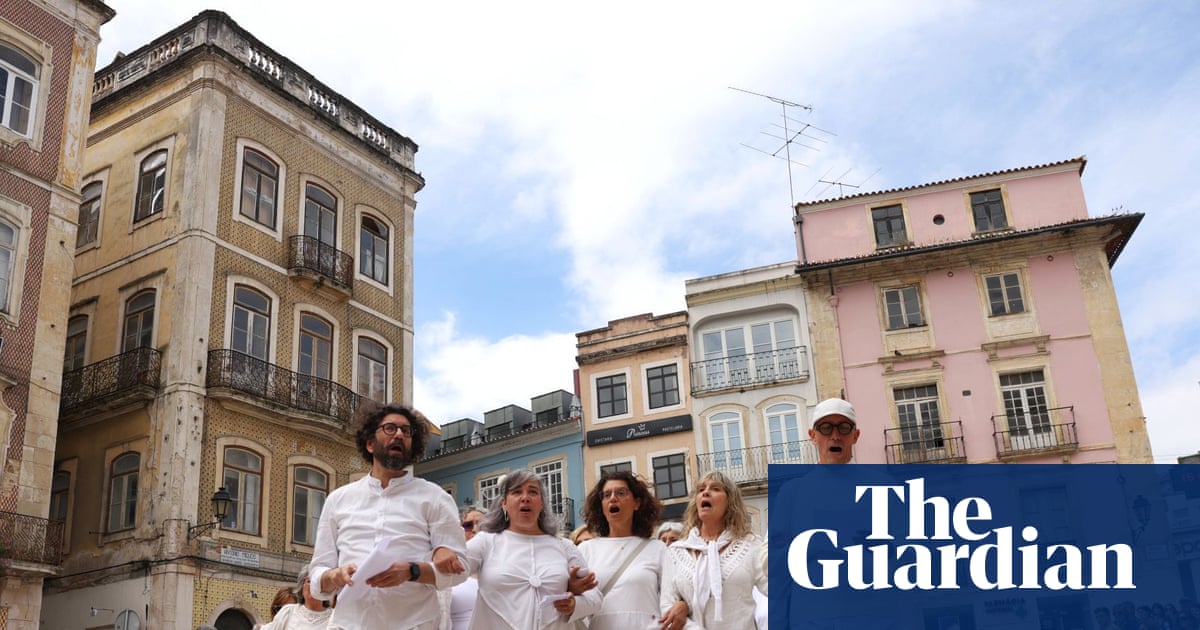
Art festivals can fill abandoned buildings with new life – or clear a path for property developers. Coimbra’s Anozero is trying out a more confrontational approach
I
f you decide to spend a night at Coimbra’s Monastery of Santa Clara-a-Nova in the near future, do bear in mind that the place is almost certainly haunted. Disembodied children’s voices echo around the first floor of the 17th century convent perched atop a hill in the Portuguese university city, overlooking the medieval centre from across the Mondego river.
In the garages, dry foliage has been arranged in geometric shapes, as if in preparation for a wicca ritual. You need the nerves of a ghost-hunter to walk through the pitch-black ground-floor corridor of the dormitory wing, lit only by a neon strip at either end, where tortured wails ambush you from the monkish cells. Sung in Albanian, Chinese, Kurdish, Kyrgyz and Turkish, these laments are part of an installation by US artist Taryn Simon, but they feel like spectral reminders of the nuns who lived in these quarters for two centuries.
After the last nun died in 1891, Santa Clara-a-Nova served for almost a century as a barracks for the Portuguese army, and since 2015 the nunnery has been the central hub of Anozero, a biennial art festival that sees its 9,650 sq metres filled for three months with works by creatives from around the world. But as the government has recently granted a private company the right to develop the semi-derelict building into a hotel, that arrangement could soon come to an end.