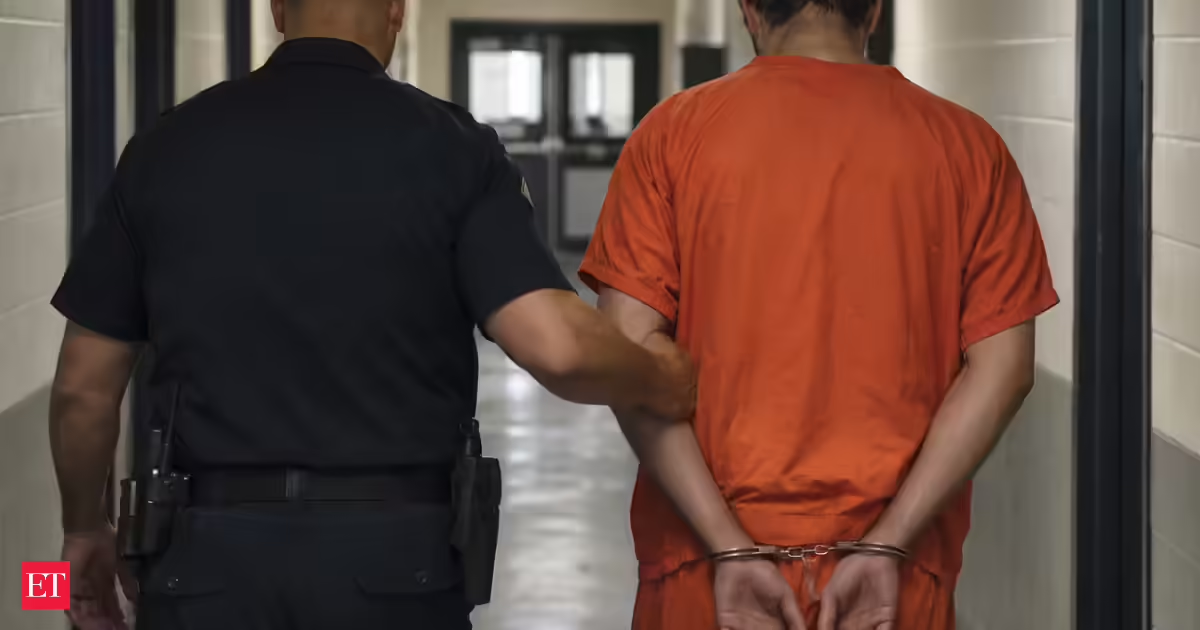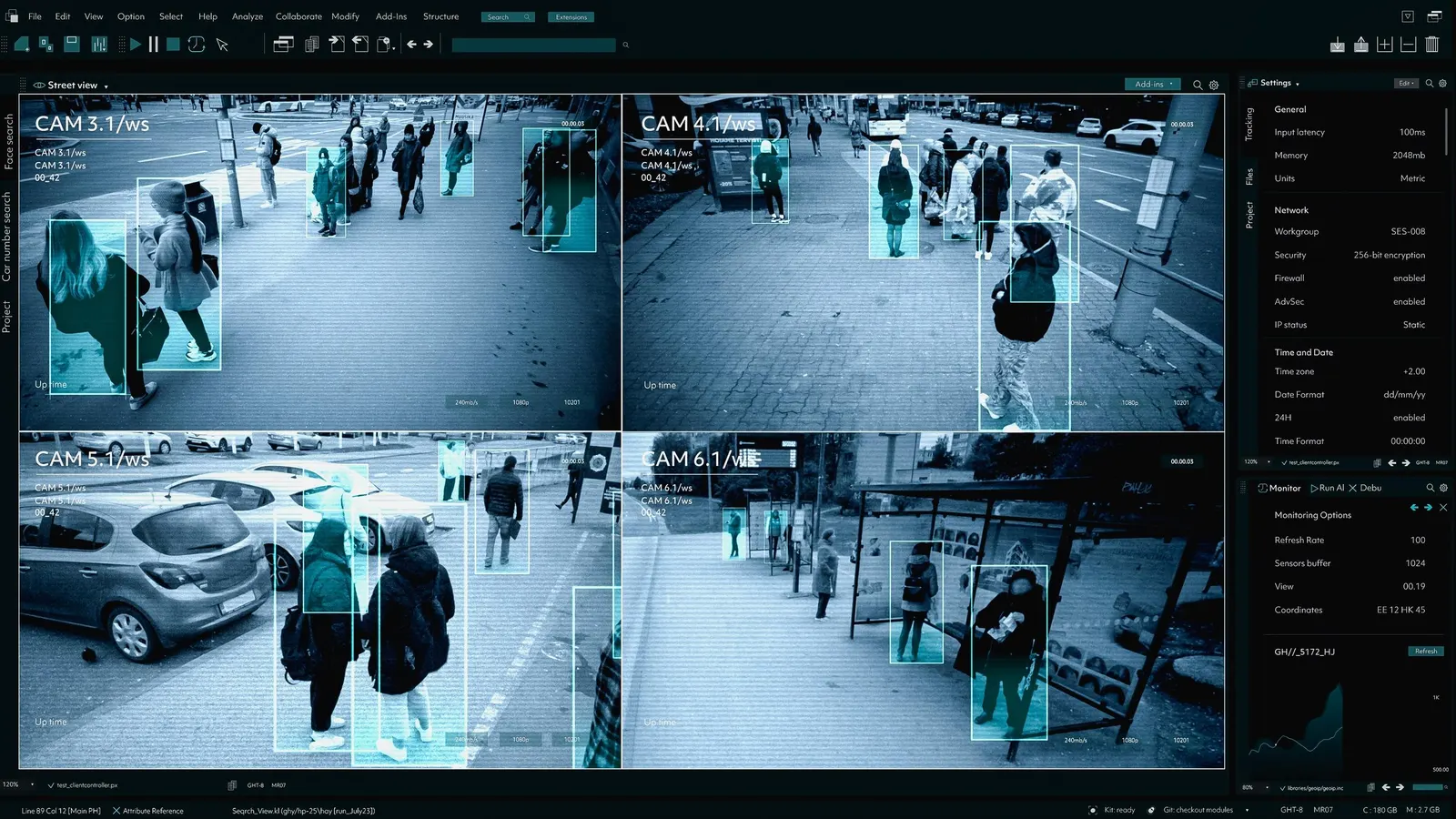
CCTV AI facial recognition camera on a city streetgettyAngela Lipps, a 50-year-old grandmother from Tennessee, spent more than five months in jail after a facial recognition system flagged her as a suspect in a bank fraud case in Fargo, North Dakota. She had never been to North Dakota. She had never been on an airplane.On July 14, 2025, U.S. Marshals arrested Lipps at gunpoint while she was babysitting four young children. She was booked as a fugitive from justice and held without bail in a county jail in Tennessee. After three and a half months, she was extradited to Fargo, where her court-appointed attorney finally pulled her bank records. Her purchases proved she was home in Tennessee during every single fraud incident. "It wasn't until December 19th that my lawyer and I finally sat down with a detective," Lipps said in a GoFundMe campaign organized on her behalf. "It took five minutes for the whole thing to fall apart. Five minutes." She was released on Christmas Eve.How does something like this happen? The answer requires understanding what facial recognition technology actually does, what it does not do and why trusting facial recognition technology is the same as blind trust in any AI: fraught with peril. Without a trained human verifying what these systems produce, a computer's best guess becomes someone's worst nightmare.How Facial Recognition WorksFacial recognition technology converts a human face into a numerical representation. When a photograph enters the system, algorithms analyze the geometry of the face: the distance between the eyes, the depth of the eye sockets, the width of the nose, the shape of the jawline, the contour of the cheekbones. These measurements get distilled into what the industry calls a "faceprint," a string of data points representing the spatial relationships of that particular face. Think of it as a mathematical fingerprint. But unlike an actual fingerprint, a faceprint is not unique to a single individual. It is an approximation.MORE FOR YOUIn a law enforcement context, the process works as a one-to-many search. An investigator submits a "probe image," usually a still frame from surveillance footage, and the system compares that probe against a database of known images. These databases vary widely. Some contain only mugshots. The FBI's Next Generation Identification system draws from arrest photos associated with fingerprint records. Clearview AI, the system used in the Lipps case, has built its database by scraping billions of publicly available images from the internet, including social media profiles, news articles and personal websites, without the knowledge or consent of the people pictured.The system then returns a candidate list, a ranked set of images the algorithm considers the most mathematically similar to the probe. This is where the misunderstanding begins. The system is not identifying anyone. It is saying these faces share similar geometric properties. It is returning suggestions ranked by statistical probability. That is all it was built to do.The accuracy of this process depends on variables often outside anyone's control. Image quality matters enormously. A well-lit, front-facing, high-resolution photograph will produce dramatically different results than a grainy still pulled from an angled security camera in a bank lobby ceiling. Lighting, facial expressions, aging, the tilt of a head: all of these shift the algorithm's confidence score. Interpol's own facial recognition guidelines note that a passport-quality photo is ideal and that non-standard images collected during investigations may affect accuracy in ways that are hard to predict. Even under the best conditions, the system produces candidates, not conclusions.Facial Recognition Leads: Where the Process Breaks DownVirtually every facial recognition vendor, every agency that publishes a policy on the technology and every federal guideline says the same thing: a facial recognition result is an investigative lead. The New York Police Department's policy, for example, states that a match does not by itself establish probable cause to arrest or obtain a search warrant. The Government Accountability Office has found that most federal agencies using the technology initially did so without even requiring staff training.A lead is a starting point. It means: go find out if this person is actually connected to the crime. Pull their financial records. Check their travel history. Look at cell phone tower data. Verify they were in the same state. A lead is supposed to trigger an investigation. It is not supposed to replace one.In the Lipps case, the West Fargo Police Department ran surveillance footage through Clearview AI, which flagged her as a "potential suspect with similar features" to a woman using a fake military ID to withdraw tens of thousands of dollars from local banks. West Fargo shared that result with Fargo detectives, who compared the AI's suggestion to Lipps' social media photos and Tennessee driver's license. Police say additional investigative steps were taken but have not specified what those were. A judge signed an arrest warrant with nationwide extradition.Fargo Police Chief Dave Zibolski later acknowledged "a few errors" and conceded there was over-reliance on the technology. Detectives had assumed surveillance photos were submitted to the North Dakota State and Local Intelligence Center, a certified facility trained in facial recognition analysis. They were not.Robert Williams was arrested in Detroit in 2020 after facial recognition matched his expired driver’s license photo to a blurry image of a shoplifting suspect. He spent 30 hours in a filthy, overcrowded cell. The match was wrong.Porcha Woodruff, eight months pregnant, was arrested in 2023 by six officers for a carjacking she did not commit, again on the basis of a facial recognition hit.Michael Oliver. Nijeer Parks. Randall Reid. Alonzo Sawyer. In six of seven confirmed wrongful arrest cases that the Innocence Project wrote about in 2024, the person wrongfully arrested was Black, consistent with a 2019 federal study finding that some algorithms were up to 100 times more likely to confuse two non-white individuals. And in every case, the pattern is similar: the technology returned a candidate, and the corroborating investigation that should have followed was either skipped or built on the same flawed foundation.Putting Too Much Trust In TechnologyThe Lipps case is about facial recognition, but the underlying problem goes well beyond one technology. It is a story about misunderstanding and overly trusting any technology, and the same pattern is showing up everywhere AI tools are being adopted faster than people can learn their limitations. Attorneys have submitted AI-generated legal briefs containing fabricated case citations, hallucinated by the very tools they trusted to save time.As I recently wrote about in Forbes, a police department in Utah had to explain why an AI report-writing tool claimed an officer had shape-shifted into a frog, because the software picked up background audio from a Disney movie and wove it into an official police report as fact. When people put too much trust in technology they do not fully understand, they stop asking the questions that would reveal its mistakes.As someone who has spent over 17 years working in digital forensics, I see this problem daily. A photograph, a video, a facial recognition match: none of these are self-proving in 2026. The era in which visual evidence could be taken at face value is behind us. What matters now is the verification layer, the corroborating data that confirms what a digital artifact appears to show.Consider how we handle suspected deepfakes. When the authenticity of a photo or video is in question in one of my cases, we can run it through an AI detection tool that will return a probability score, a statistical guess about whether the image was generated or manipulated.That score is a useful starting point, but it is not proof. To actually authenticate the image, we have to go deeper: examine the device it was captured on, pull file system metadata, EXIF data, creation timestamps, modification history and trace the chain of custody from the device to the courtroom. The AI detector gives us a lead. The device-level forensics gives us the answer.Facial recognition operates on exactly the same principle. The AI gives you a place to start looking. It does not give you permission to stop. In the Lipps case, her bank records were sitting there from the moment she was arrested. Nobody looked at them for months.Jay Greenwood, the attorney who represented Lipps in North Dakota, put it plainly: investigators used facial recognition as essentially their only tool. There is a phrase that has become common in discussions about AI: "human in the loop." It means that automated systems need a point where a human being reviews, validates and makes the final call before action is taken. In law enforcement, this is the difference between a useful investigative tool and a system that locks up innocent people.The landmark settlement in the Robert Williams case against the Detroit Police Department established what should be the national standard: police cannot arrest anyone based solely on a facial recognition result and must obtain independent, reliable evidence linking a suspect to a crime before making an arrest. Every department in the country that uses facial recognition should operate under the same requirements. Most are not.How Facial Recognition Should Be UsedFacial recognition technology is not going away. When used as an investigative lead that triggers rigorous, independent verification, it can be a legitimate tool. The FBI has used it to solve cold cases. Customs and Border Protection has processed hundreds of millions of travelers using facial comparison. The technology has real utility when the people using it understand what it actually produces and, just as importantly, what it does not.Fargo police have since announced they will no longer use information from West Fargo's AI system and will route requests through state and federal intelligence centers instead. All facial recognition identifications will go to the Investigations Division commander for monthly review. These are reasonable steps. But changing which system generates the match does not help if detectives still treat the match as a positive identification without doing the verification work that follows.The verification step cannot be something that happens only when an attorney demands it five months into a wrongful detention. It has to be built into the process from the start: before a warrant is sought, before an arrest is made, before someone's life is taken apart.Angela Lipps lost her home, her belongings and her dog while she sat in a jail cell. She went months without her dentures. Her first airplane ride was in handcuffs. On Christmas Eve, she walked out of a North Dakota jail into a life that had been dismantled by an algorithm's suggestion and a failure to verify it.Fargo police have declined to apologize. The charges were dismissed without prejudice, meaning they can be refiled. No one has been disciplined.The technology did what it was designed to do. It found a face that looked similar. Everything that went wrong after that was entirely human.
Woman Wrongfully Jailed 5 Months After AI Facial Recognition Error
Police jailed a woman for five months based on an inaccurate AI facial recognition match. Here's how the technology works and why the real failure is human, not machine.
1,795 words~8 min read